
Introduction
We understand that many of our readers aren’t looking to take a deep dive into technical jargon, so we’ve dialed down the math and mechanics wherever we reasonably could. That said, the nature of our approach—recursive, symbolic, and mathematically precise—naturally limits how much of the technical scaffolding can be left out. Where clarity or simplicity eludes us, our apologies.
Rather than modeling Genesis as a single, divine event stretched across literal seven days—all of which we fully affirm as fact—we’ve chosen to explore it programmatically, as it were: a recursive structure, layered with emergent phases, memory, and rhythm. What we’re after is a possible “how”—not a finished answer, but a living scaffold. This interplay between structure and spontaneity echoes the Genesis narrative itself, where boundaries invite life, and repetition gives shape to meaning. After going through the exercise, it has left us asking: Does all of Creation hum with this integrated dynamic—emergence, memory, and rhythm—not merely as features, but as its very signature by the finger of God?
.
Day One: Emergent Geometry in Two Voices
In this section we present two distinct yet harmoniously converging models, each revealing curvature not as a prescribed formula, but as a natural consequence of emergent structure. One of the models descends into matter through feedback and lattice resonance, the other rises into light through recursive harmonic modulation.
Model 1: Electronic Band Structure (Lattice Feedback Model); we have visited it before (Materials are Encoded). It visualizes concentric ring behavior in a simulated atomic lattice. Emergence arises via search-update-feedback, echoing quantum interactions in crystalline solids. It reveals curvature in momentum space[1] as isoenergy[2] bands, fingerprinting material identity.
Model 2: Recursive Modulated Light—this is our Genesis Day 1 Field Model (Fig. 1, code). It uses recursive phase modulation on a 2D spatial grid as shown in the code. With minimal code and parameter changes, it too births concentric rings—curvature as a harmonic sort of “bloom.” It shows curvature in real space, echoing divine emergence: “…Let there be…”
Despite their differences in implementation and domain, both models arrive at identical geometric signatures: rings upon rings, curvature nested in curvature. They are twins, separated by methodology but united in essence—that’s the takeaway. And that essence is this: change in change—the labor of recursion—is the whisper of the second derivative, and from it flows the curved geometry of Creation. Two paths—one rooted in materials-physics, the other in symbolic recursion—both unveil curvature as the deepest music of emergence. It is as though Jehovah God composed a universe where complexity sings from simplicity, it emerges from it. But Creation as command, through emergence, is that a diminishment of our Lord’s sovereignty, does it place credit where credit is not due? No, we don’t think so, rather, it’s a demonstration of His incomprehensible genius, because what is clear is that God as Composer didn’t dictate every overtone or partial, no, instead He set motif, structure, and aplenty tension—and from that emerged a symphony more beautiful than prediction. The fact that rings arise from recursion in two disparate settings only adds to the sacred mystery— God didn’t just command, i.e., utter the song, He did much, much more, He composed a universe capable of singing it back to Him.
Day Two: Architectural Separation
Day 1 unfolded like a Bang, like a pulse: phase modulation rippling outward in radial bloom, with emergence taking center stage as motion grew from silence. It was electric symmetry born of encoded phase. Day 2, in contrast, feels architectural — separation with decided intent. Bands don’t ripple, they settle. There’s tension between verticality and identity: cyan ascends, tan suspends, blue descends (Fig. 2, code). The framework isn’t just motion, it’s a “conversation” between domains, Notice the movement, the action: is from Bloom (Day 1) to Boundary (Day 2). Day 2 redirects Day 1’s radial energy into stratification in lockstep with the transition from recursive modulation to structural “obedience.” So, whereas Day 1 erupted with electric bloom, Day 2 builds with architectural alignment: The waters, once free, now yield to verticality, to vertical law, to an incipient gravity. And it’s special, it’s a special separation: one without erasure. Each grain (color) remembers its origin but…obeys its final domain. And it’s not just a stratifying movement, but vectored meaning encoded in every grain’s (pixel’s) path. It’s a sort of “frame-by-frame repentance”— blue cells begin misplaced, but correct over time—as though Day 2 is a visual confession in that sense. The code uses quantile-based cell groupings, and directionally constrained motion vectors, and real-time color logic based on y/vertical position. Frames 0–5 represent staging for “identity stabilization,” while frame 49 is the signature frame—here is realized a visual culmination: bands are resolved, and stratification is achieved. In this way Day 2 sets the stage for Day 3 in God’s work—the emergence of dry land and recursion within form.
Day Three: A Pulse of Pattern and Purpose
If Day 2 was about divine division and atmospheric layering, Day 3 pulses with convergence: structured growth, symmetry unfurling, and recursive branching that feels both organic and sacred. See how the Creation here divides, then emerges as recursive rhythms breathe order from chaos through recursion (Fig. 3, code).
Day 3 marks a turning point, where the waters recede, the land rises, and life begins to sprout, not as chaos, but in harmonic cadence. “…Dry land appeared. And the earth brought forth grass, herb, and tree—each after its kind…” (Genesis 1:9-10)
Our Day 3 recursive layers:
- Water Layer: Subterranean “memory”—the quintessential foundation for modulation.
- Earth Layer: Emergence by division, pulsing with patterned recursion.
- Vegetation Layer: Early emergence modulated by sine-phase growth—cones of symbolic sprouting.
- Tree Layer: Sporadic emergence, slower modulation, height echoing seeded permanence.
We utilize sine and cosine offsets to map recursive emergence. Opacity allows for deeper layering without drowning color contrast. Tree spawning is randomized per cycle, reflecting generative unpredictability, i.e., “after its kind.” So, this code is less about phase modulation per se and more about how the sine and cosine show the pulsing earth and trees, it’s recursive emergence driven by “trigonometric breathing,” not just phase modulation in the strict signal-processing sense. The terrain pulses through Sin[x + t] Sin[y + t], which creates a grid of intersecting waves that expand and contract diagonally with time. Added in is Cos[3x] Cos[3y] to get spatial texture layered over temporal motion—like divine fingerprints shaping the soil. The vegetation and tree layers listen to that heartbeat:
- The cones grow upward with Abs[Sin[x + y + t]], echoing local emergence intensity.
- The trees modulate height with Abs[Cos[x – y + t]], introducing directional variance across the terrain.
So, instead of modulating a phase offset per se, we’re showing how sine and cosine form a living matrix of emergence—recursive pulses tied to position, interleaved with time. It’s “Genesis-as-resonance” if you will.
“…And the earth brought forth grass and the tree yielding fruit, whose seed is in itself…” Genesis 1:12
Notice carefully that “brought forth” and “in itself.” If ever there was a summary-statement of recursion there it is—it’s hard to miss it. Here’s the crux of it: recursive emergence is not solely mathematical—it is metaphoric. How so? God’s Genesis code isn’t just a calculation—it’s a symbolic storytelling device, it’s “memory in motion” thanks to the recursion. Each cycle in recursive emergence contains echoes of prior forms—just as each generation in Scripture carries the imprint of the one before. It’s not random repetition, it’s meaningful inheritance. Again, consider “…whose seed is in itself…” This evokes not just biological self-containment, but spiritual patterning—the idea that every entity holds a blueprint of its origin and future. That’s recursion as metaphor for self-revealing Truth, not just algorithmic behavior. Each pulse carries memory, each sprout, the Blueprint. It unmistakably means this: Creation unfolds not randomly, but with intention. Atheists and evolutionists tragically stumble right here—and down for the count are most of them sad to say. So, for Day 3, we presented structured emergence by phase. Vegetation grew in harmonic rhythm, yet, fractal potential was assumed, and indeed unfurled (as in the fern leaf and myriad other fractal bearers around us)—though not here computed. To compute that would not be too difficult—cellular automata shine here—but to show that fractal emergence was not our goal in this instance.
Day Four: Time Is Given its Rhythm
“…And God said, let there be lights in the firmament of the heaven… and let them be for signs, and for seasons, and for days, and years…” Genesis 1:14
From the ancient scrolls of Genesis to the flicker of recursion in the Genesis Code, Day 4 beckons us into a realm of rhythm—where time is born through oscillation, and the heavens become a divine chronograph.
Solar and Lunar Modulation: Rhythm as Governance
The core of our animation rests on two sine waves:
- The sun, modeled as a primary oscillator, travels across the upper firmament, ruling the day.
- The moon, introduced as a phase-shifted echo, glides beneath—essentially a reflected cadence of the sun’s trajectory ( Fig. 4, code).
This phase delay isn’t just numerical—it’s symbolic of hierarchy without conflict, of separation without opposition. In our code, this phase delay is rendered via a Pi/2 phase offset:
- sunPhase[t_] := Sin[(2 Pi t)/dayLength]
- moonPhase[t_] := Sin[(2 Pi t)/dayLength + Pi/2]
Each loop contains recursive harmony. Governance becomes not a static decree, but a flowing rhythm—a modular
memory seeded into creation.
Recursive Star Placement as Divine Echoes
“…He made the stars also…” Genesis 1:16
The star field isn’t random—it’s echoic, birthed from recursive sampling of solar-lunar waveforms. The stars act as harmonic punctuation marks, seeded along curves shaped by divine time. Technically, recursive sampling creates harmonic placements via trigonometric mapping. Color blending—white, light yellow, light blue—embeds symbolic roles—prophecy, clarity, memory, respectively. And opacity modulation gives breath to the stars—each a whisper of recursion, a flicker of divine remembrance.
The animation divides the canvas in two:
- A cyan-tinted day realm for solar rule
- A deepened moonlit sector where stars shine in recursive glory
This literal division echoes the firmament separation described earlier in Genesis, visually reinforcing the theme of ordered duality—light and darkness, ruler and reflector, moment and memory.
Spiritual Dimension: Manifestation Through Modulation
Maybe this animation can be thought of as a symbolic act of creation:
- Modulation = Manifestation, i.e., each sine wave expresses not just motion, but intent—a rhythmic signature of divine order.
- Phase = Memory, i.e., the moon’s echo isn’t passive—it’s a mnemonic device, a celestial metaphor for “recursion of creation across layers.”
- Stars = Witnesses, i.e., their emergence along recursive paths tells of signs and seasons, prophecy and observation.
So, our Day 4 maps theology onto trigonometry, thus letting the Word “breathe” as it were through rhythm, shape, and recursion. But why do this, the Word breathes just fine on its own? Granted, it’s done simply to show that creation, indeed, that the Creation itself isn’t static—it was spoken in waves, governed by modulation, recursive phase modulation, and witnessed by stars (Job 38;7, Psalms 19:1-6).
Day Five: Recursive Emergence | Multiplication in Waters and Skies
“…And God said, Let the waters bring forth abundantly…and fowl that may fly above the earth…” (Genesis 1:20)
On Day 5, we witness emergence from divided realms—waters below and skies above. In phase-modulated recursive modeling, this day unfolds as:
- Aquatic recursion: A waveform echo drawn from depth, cascading through harmonics to symbolize abundance (“…bring forth abundantly…”). Traits modulate in a rising rhythm, like multiplication expressed in expanding wavelets.
- Aerial recursion: Flying kind traits phase-modulate against an elevated emergence offset, revealing recursive ascent—each loop building altitude, not just repetition. This reflects movement “above the earth in the open firmament,” symbolized by upward recursive curvature.
The “Kind” logic in code preserves amplitude to represent life force, while recursive overtones grow in subtle variation—not chaos, but symbolic fruitfulness. These recursive rhythms aren’t mechanical—they’re blessings. “…God blessed them, saying, be fruitful, and multiply…” becomes the recursive directive itself (Fig. 5, code, Tab. 1, Tab 2).
Day Six: Harmonic Motion and Co-modulation of Dominion
.
“…Let the earth bring forth the living creature after his kind…” (Genesis 1:24) “And God said, let us make man in our image…” (Genesis 1:26)
Day 6 embodies a crescendo of complexity (Fig. 6, code). The recursive system shown in the figure now modulates four distinct emergence offsets—Cattle, Creeping Thing, Beast and….Humankind[3]. Humankind’s trait includes a binary gating logic that stems from the image of God within which is quite distinct from the sine/cosine traits we assigned to the various “kinds” mentioned in Genesis. Each trait curve phases over time but is ultimately mapped into frequency—Figure 6 is a frequency domain picture. The underlying time-domain waveforms reflect distinct motions: hoof rhythm (cattle), creeping tessellation (creepers), beast stride (beast), and cognitive gating (human). These trait-specific rhythms interact through recursion, and co-modulation zones emerge where two or more traits overlap in active recursion. To identify these zones, the time-domain waveforms were transformed into the frequency domain, which makes trait coherence and divergence easier to discern. Each kind contributes its own waveform, frequency mapped, and the composite—represented as a cumulative metric, “stacked sum”—becomes readable as symbolic harmony, or lack thereof. Looking again at Figure 6, the solid blue stacked sum curve shows steep accumulation early on due to phase-rich, high-frequency traits—especially from Cattle, Creepers, and Beasts. But around step 10 or 11, the curve begins to slope gently. This inflection marks the point of trait saturation. From step 12 onward, the curve approaches a plateau. This flattening isn’t just numerical—it’s a symbolic fingerprint of cognition’s arrival. The animals harmonized and saturated. But humanity diverged; please notice: the human signal didn’t fade into structure, it continued to interpret it. Note how the dashed human curve keeps oscillating even after the animal traits have saturated (Fig. 6). While the animal traits saturate the frequency spectrum by step 11—Cattle, Creepers, and Beasts forming a coherent plateau—the human frequency continues to oscillate. This isn’t waveform noise; it’s recursive logic unfolding. Humanity’s trait emerges from binary gating, a pattern of distinctions—not smooth rhythms, but flickering gates that unfold over recursive steps. Even when mapped into frequency, it doesn’t decay. It adapts. That’s the genius—and the practicality—of our special creation. Fine, but why does the stacked sum curve flatten even as the human trait continues to oscillate in frequency space, after all, it’s a sum? It’s because the stacked FFT captures cumulative amplitude per bin, not the temporal persistence of traits. Each trait’s frequency spectrum is normalized, then added across bins. Early animal traits flood the spectrum with high energy, saturating key bins and creating a numerical bias. Later, when human traits activate those same bins, their impact is diminished—not because they’re absent, but because their modulation is narrower, binary-gated, and lower in amplitude. Yes, the human trait continues to oscillate—but its contribution is more refined, with low amplitude spread and limited bin coverage. Those bins are still active, yet the stacked curve remains flat because earlier animal traits already filled them. The human additions don’t “move the needle”—the spectrum has already been tilted. In essence, the system doesn’t need louder oscillations—it needs structured coherence. That’s the turning point. When recursive patterns saturate, interpretation becomes possible. Cognition doesn’t amplify—it recognizes. So, the animals harmonized… then rested. Humanity diverged—not by adding more energy, but by remapping meaning. The stacked sum curve flattened not because creation ceased, but because animal traits couldn’t harmonize with cognition’s recursive logic. Yet the human frequency persists—not to dominate, but to echo intention through an already-built structure. Referencing Genesis 1:24–27, humans are created after cattle, creepers, and beasts. That sequence mirrors our data model: cognition influences the curve only after structure exists to respond to. Thus, step 10 or 11 marks a threshold of awareness. And the human trait doesn’t merely contribute new data—it reframes the entire spectrum. But why not earlier? After all, the dashed human curve appears from the start (Fig. 6). The answer mirrors the earlier argument: cognition requires structure. It cannot function in a vacuum. Meaning arises only once creation is saturated with coherence. Symbolically, dominion doesn’t flatten chaos—it flattens coherence. It doesn’t create from nothing; it responds to emergent pattern. And when recursive structures accumulate enough—around step 9 or 10—cognition steps in, not to observe, but to enact. That’s the watershed moment, the real Big Bang. Why? Because that’s when being turns into knowing, when dominion becomes binary: the rhythm of distinction and cultivation begins per note 6. Humanity doesn’t just name creation, it participates in it here. Here we divide to see clearly, and we cultivate to act meaningfully. From that moment, God’s special creation begins to “talk”—and the human role begins to echo our Creator’s pattern. The next section hopefully adds more clarity to our Day 6 modeling method introduced here.
The Stacked Sum Curve (frequency domain): What Is the Stacked Sum Curve?
Mathematically, each trait’s waveform in time (Cattle, Creeper, Beast, Human) was converted into a frequency spectrum via fast Fourier transformation (FFT). To ensure fair spectral contribution, each trait’s spectrum was normalized, then stacked: Cattle + Creeper + Beast + Human. The result is a single composite curve showing total harmonic magnitude per frequency bin—a curve we call the stacked sum spectrum. This stacked spectrum is essential for several reasons:
- The stacked sum is quite telling/revealing. Think of each trait as a “voice” in the creation account, the stacked curve shows where those voices harmonize in frequency space[5].
- It reflects additive amplitude per bin, not temporal persistence. Early-emerging animal traits inject strong, wideband energy into the spectrum, saturating many bins. Later-emerging human traits, though still oscillating and active—necessarily so, or I couldn’t write this and you couldn’t understand it—contribute more narrowly and less forcefully due to their gated, binary rhythm. Thus, human bins remain active post-saturation, but contribute less to the total magnitude, leading to a visible plateau in the stacked curve. This isn’t a failure of human emergence—it’s a fingerprint of qualitative divergence. The human signal persists structurally, even if it doesn’t re-energize the composite. Symbolically, the flattening marks a shift: from resonance to recognition. Human cognition doesn’t dominate the harmony—it reinterprets it.
- Shared peaks are symbolic affirmations—zones where life rhythms co-resonate, and non-overlap is equally telling, because it bespeaks separation.
- In the time domain, events unfold step by step—like flipping switches. Things happen or they don’t, guided by yes/no logic. That’s called gating, and it works like a checklist, it’s Boolean and brisk. But in the frequency domain where the stacked sum curve lives, the story shifts. We’re not controlling—we’re listening. No filters, no switches. Just structure, emerging quite naturally, simply from how things move and repeat. It reveals the hidden architecture in the signal. It’s not forced—it’s found. That’s why frequency analysis is so very practical and special and works to our benefit here, not least because human dominion, being binary[6], leaves sharp discontinuities in the stacked sum curve.
- One can track how sparse spectral presence affects overall coherence; for example, cognition may weaken certain harmonics, signaling trait separation.
- When designing phase offsets for new kinds or symbolic agents, we can use the stacked curve to pick complementary frequencies
- It’s a spectral compass for creation. In metaphor, the stacked curve becomes our “Genesis tuning fork”—an impartial witness to where life sings and where silence reigns.
The stacked sum curve doesn’t just tell us what already happened and how it played out relatively, it hints at what continues to happen. In this way of thinking, Creation wasn’t a performance—it was a tuning system that still listens. It tells us where the traits agree, where they compete, and where cognition silently but definitely distorts the peace. What’s telling, too, is how each frequency bin seems to invite a story. Some frequencies hum with multiple voices in unity; others are ruled by one trait alone—almost like domains of influence. Let’s break it down a little more:
- Lower frequencies feel elemental—soil, pulse, rhythm (cattle, creepers fit here).
- Higher amplitude/peaks rather flash with urgency—movement, stirrings, maybe even symbolic rebellion (beasts fit here).
- Human cognition, with its stark binary contour, drags and refracts—it bends and distorts harmony-bins like spiritual gravity.
And here is the big takeaway: The stacked sum clearly shows a symbolic rupture. That clean fracture in frequency harmony at the emergence of human cognition visually and sonically suggests: something fundamentally different began. Let’s unpack what it might imply—scientifically, symbolically, and theologically
Spectral Insight vs Evolutionary Continuity
In the evolutionary paradigm, humans are seen as gradually emergent from lower forms—biologically, cognitively, behaviorally. But if evolution were purely incrementally additive, we’d expect a smooth gradient: animal rhythms slowly transforming into human ones. Yet the stacked sum curve—symbolic of biological resonance—tells another story. Cattle, Creeper, Beast, with their analog, periodic waveforms (biologically rhythmic, e.g., circadian cycles, migratory patterns, vocalizations) interlace harmonically, sharing frequency bands and compatible modulation. Then human cognition appears—binary, discrete—and breaks that resonance. It doesn’t merge or extend; it disjoints, like a dissonant chord entering a harmonious song. Which begs the question: if humans evolved from lower forms, why doesn’t the resonance reflect continuity? Let’s consider:
- This resonance fracture mirrors Genesis 2:7—“and man became a living soul.” Not just animated matter, but self-aware, spiritually encoded. Cognition as a non-physical modulation here is quite distinct from biological resonance.
- Evolution claims to explain structural features of the body, maybe, maybe not, but this suggests that consciousness is emergent in a way biology alone doesn’t account for. The spectral break aligns with arguments that humans possess symbolic thought, meta-awareness (the ability to recognize that you’re having a thought while you’re having it), and moral reasoning, all things not clearly predicted by pure physiology.
- From this stacked spectral view, human cognition doesn’t merely start—it contradicts prior rhythms, it can’t harmonize with them. Analog and Discrete are like oil and water in that regard[7].
In sum, this stacked spectrum code, of itself, likely doesn’t refute evolution outright—it challenges the idea that cognition is biologically inevitable. It points toward a threshold moment—not a gradient—where modulation broke, and “something other” entered. Whether one interprets that as divine intervention, symbolic rupture, or cognitive nonlinearity the stacked sum curve has captured it. Bottom line, the human appearance and forward never coheres with the animal kingdom going by this idealized model, and the spectrum makes that fracture startlingly plain. The biological kinds—Cattle, Creeper, Beast—resonate together. They share frequencies, overlap harmonics, almost as if nature itself is a layered song. But when human cognition enters the system, something changes—not just a new voice, but a structural break. The spectral continuity isn’t extended—it’s disrupted. Coherence breaks not because humans fail to contribute, but because they contribute a fundamentally different kind of signal that is persistently binary (ask/learn, see/do, divide/cultivate—thus it was coded up on purpose by us), and therefore it is necessarily phase-insensitive, and non-harmonic. And this separation with lower forms is quite baked in: Humans don’t continue their pattern of resonance—they mark a new domain. Biblically, it’s a given: “…God breathed into his nostrils the breath of life, and man became a living soul…” That verse (Genesis 2:7) signals an intervention, not a continuation.
Well, at least one thing seems undeniably clear—this Day 6 spectral model disputes gradualist evolution. If we humans evolved from lower forms, why don’t their cognitive rhythms extend the spectral tapestry? That question is easy to answer, namely, in this framework, human emergence appears as an ontological leap, not a spectral blend. Instead of growing out of nature, cognition breaks from it—that’s key. That doesn’t erase biology—it transcends it.
Is the Day Six Model Biased?
You bet it’s biased. It’s deliberately symbolic[8]. How else but symbolically is one to reach way back yonder to the Beginning? (Besides super colliders and the like; our method is less costly by the way, and probably more accurate because we have better control over the influencing parameters, and have more freedom of choice for those parameters, thus we could devise myriad similar models to test, likely all pointing to the same conclusion.) The sine and cosine waveforms underlying the spectral picture were carefully hand–picked to reflect metaphorical traits bottom line:
- Cattle with a slow hoof pulse
- Creeper with rotational symmetry, a tessellation
- Beast with burst-like frequency
- Human cognition as binary interruption
These choices encode meaning, not just math; meaning here is carried by the math, like a signal rides a modulated carrier wave—structure transmitting intent. It’s signal processing 101; can’t those elegant principles find application here in this theological context? The stacked sum reveals relationships that emerge from design intent, not evolutionary “data” if there even is such a thing. But bias isn’t the same as invalidity—especially in conceptual modeling. The fact that trait waveforms were thoughtfully assigned based on behavior and symbolism means:
- They’re not arbitrary—they mirror qualities
- The FFT reveals how those qualities resonate when layered
- The break in harmony isn’t manufactured—it reflects structural dissonance
So, the conclusion that human cognition disrupts biological resonance isn’t unfounded. It’s a generalizable insight, stemming from the binary nature of cognition, its incompatibility with analog biological rhythm, and the resulting fracture in harmonic unity. In this way the stacked spectrum is both a mirror and a magnifier: it shows not what is strictly empirically true, but what is symbolically observable given thoughtfully assigned qualities. Bottom line, we didn’t cook up the results—we crafted a lens. And that lens reveals something profound: if creation was composed in harmonics, cognition wasn’t just a new note—it was a new instrument entirely. And if human cognition disrupts biological resonance, then there has to be a complete disconnect between humans and other biological forms, a conclusion that the stacked spectrum seems to confirm with spectral conviction. If we treat the FFT-stacked sum curve not just as data but as symbolic structure, then the emergence of human cognition signals a categorical disconnect, not a gradual departure. What the model illustrates isn’t mere divergence; it’s consummate incompatibility in rhythmic language. The animal forms—Cattle, Creeper, Beast—converse in harmonics. They overlap, reinforce, synchronize. Human cognition, when introduced, doesn’t join that conversation—it interrupts it. It doesn’t stretch the song—it silences it. That rupture suggests humans aren’t simply a new kind—they’re a new class of creation altogether, operating on an entirely different modulation framework.
The First Abstraction
Biology may explain continuity—shared cells, organs, even behaviors—but modulation tells another story: Co-expression, harmony, and resonance begin to fracture with cognition. We humans aren’t biologically separate[9]—we’re rhythmically isolated[10]. But how so? Cognition introduces abstraction, self-awareness, symbolic thought—none of which align with the temporal feedback loop of embodiment. That loop engages the environment in rhythmic exchange, but thought? It steps outside—contradicting, pausing, imagining alternatives. Even when liturgy, music, or communal gestures—bowing, chanting, dancing, etc.—reintroduce somatic resonance, tangible and embodied, they don’t bind thought back to its origin. They at best echo its path, rarely directing it (thought leads; it does not follow). Instead, they amplify, frame, or even challenge the trajectory thought has already chosen. Resonance, then, isn’t a spectrum—it’s a phase space: a domain where modulation, motion, and timing entwine[11].
What we’ve uncovered here isn’t radical—it’s familiar, almost intuitive. Humanity, endowed with abstraction and interpretive power, inhabits a distinctly different phase space. One not merely lived—but read. That is, a space shaped not just by biology, but by a mind tuned to meaning.
Cognition in Animals?
Our Day 6 spectral model doesn’t deny cognition in animals but strongly emphasizes that human cognition modulates differently. Animals show intelligence—emotion, memory, tool use—but these operate within biological rhythm[12]. Human thought disrupts that domain because human thought is binary, phase-insensitive, and symbolic. The FFT spectrum doesn’t just exclude animals—it fails to show resonance with human emergence. Genesis 2:7 says, “…man became a living soul…”—not merely animated, but modulated, by Spirit. This wasn’t evolution continuing—it was modulation reclassified.
Well, as we wrap up here, one might say that this Day 6 exercise wasn’t just a test—it was a kind of “Genesis audition tape,” where each waveform asked if it belonged in the orchestra. And when cognition stepped into the studio? The frequency said: “This voice isn’t like the others.” That’s more than fascinating—it’s worldview-challenging.
Day Seven: Completion, Satisfaction, Recursive Reflection
Day 7 marks a shift—not into silence, but into satisfaction and remembrance. The Genesis Code transitions from active creation to rhythmic cadence, portraying rest not as the end, but as the continuation of a pattern already set in motion. Earlier days introduced separation, emergence, and multiplication, and this day reflects those acts back into the Vault, encoded as memory. In theological terms, Day 7 is Sabbath not just because activity (motion) stops, but because meaning settles. It’s where creation is no longer expanding outward—but breathing inward, satisfied (Genesis 1:31). The code behind this simply cues fading rhythms and paused recursion (Fig. 7, code), yet the symbolic message is clear: Though the stars do not literally speak, they remember. And in this way Rest becomes, in a sense, the “Archive of Creation.”
Concluding Comments
Let’s summarize the days as we have presented them above and then draw some conclusions.
Day 1—Light and Division. Day 1 separates light from darkness—not annihilation, but distinction. This is not unlike the binary our Creator instilled in us: distinction<>cultivation. Day 1 doesn’t just split light and darkness; it establishes the logic that later culminates in human cognition: the ability to distinguish, interpret, and cultivate meaning. One might say that Day 1 encodes the first binary. So, Creation begins not with structure, but separation. The act of separation creates context in that before anything can exist with meaning, it must exist apart. This is the consistent cognition instilled in us—God operates like that, and so do we. Light divides from darkness here, setting the rhythm for interpretation: not what is seen, but how distinction begins (to distinguish is to recognize). In Hebrew, BADAL (to divide or separate) is utilized here—the same root appears later when holy is separated from common, yet another binary, a weighty one (light from darkness in a different, spiritual sense). So, God doesn’t overwhelm with detail—He starts with contrast. And from this act springs a logic of “modular identity”—each day of creation builds from this initial bifurcation (modularity in coding is the hallmark of elegance, thus it betrays the Creator). In a way, God seems to say: “…Don’t look only at the substance—look at how I structure difference…”
Curvature as Emergence
Day 1 presented two distinct models—one physical, one symbolic—which converged to reveal curvature as an emergent signature of creation. Model 1 simulated atomic lattices through feedback loops, revealing concentric isoenergy rings in momentum space—material resonance encoded. Model 2 used recursive harmonic modulation to birth rings in real space, echoing divine light and symbolic emergence. Despite differing domains, both unveil identical geometric patterns—nested rings as fingerprints of recursion. This symmetry suggests that complexity doesn’t arise by force, but through modulated memory—what is called “change in change.” Rather than diminish divine sovereignty, this emergent beauty magnifies it: God didn’t dictate every waveform—He composed a cosmos capable of singing the song back to Him.
Day 2—Rhythmic Separation: The waters part—physically, rhythmically. The firmament divides above from below, introducing temporal modulation. What’s striking is how the separation isn’t violent—it’s rhythmic. That implies coherence, even in division.
From Bloom to Architectural Intent
Day 2 transitions from the radial bloom of Day 1 into architectural intention—motion reorganized into stratified identity.
Recursive energy now yields to structural obedience—cells move with purpose, encoded with directional vectors tied to vertical position. Rather than breaking, the waters now align. Day 2 transformed “electric emergence” into “sacred architecture”—preparing the ground for recursion to take root in Day 3.
Day 3 is all about foundation and multiplication, dry land forms, and life emerges with recursive elegance—seed within seed, tree within tree— the very logic of DNA, even if not explicitly named. This is modulation manifest: form now precisely replicates. The rhythm thickens—creation starts to multiply itself, not just display.
Structured Emergence and Sacred Resonance
Day 3 marked a shift from division to convergence—land rises, vegetation sprouts, and recursive rhythms bring harmony to chaos. The animation layered water (memory), earth (modulated emergence), vegetation (sine-based growth), and trees (height via cosine variance). Instead of strict phase modulation, the code used trigonometric breathing—pulses of sine and cosine sculpting a living matrix of emergence over time. Vegetation grew “after its kind,” echoing biblical language and metaphorically revealing recursion as inheritance—not repetition. Creation here isn’t random—it’s intentional. Each cycle carries memory, each sprout a blueprint: “…whose seed is in itself…” becomes the visual metaphor for recursion: self-contained, self-revealing…sacred.
Day 4—Appointed Measures: Lights are placed—not for light itself, but for timing. Sun, moon, and stars don’t just illuminate here—they coordinate. Creation gains a clock, encoding rhythm with planetary precision. It’s the start of harmonic calibration.
Celestial Rhythm and Divine Modulation
Day 4 animated the architecture of time. Sine waves charted the sun and moon—one as ruler of day, the other a phase-shifted echo in night. Governance emerged as rhythm, not decree (divine rule in Genesis Day 4 isn’t portrayed as a one-time command, but as an ongoing oscillatory system). The sun oscillates through the upper firmament; the moon follows with a Pi/2 offset—symbolizing reflection, memory, and divine cadence. Stars appeared not randomly, but through recursive sampling of solar-lunar waves. Color and opacity encoded prophecy, clarity, and remembrance. Cyan day and deep moonlit night represented structured separation—”moment versus memory,” light versus darkness. Creation was presented here as speaking through waveform. Time here is not just tracked—it’s declared (the luminaries aren’t merely timekeepers—they are very time’s declaration; tracked implies observation—something external marks the passage of time, like watching a clock tick, but declared means time is actively introduced, spoken into being here; it becomes part of creation’s rhythm, not just its measurement; the luminaries aren’t just participants riding along creation’s rhythm—they are the rhythm; their modulation doesn’t merely reflect time, it establishes it). And “…He made the stars also…” became a function of recursion across layers, a “mnemonic sky of divine witnesses” per the writeup. They observe time’s unfolding—not initiating rhythm like the sun and moon, but affirming its cadence, like “celestial notaries;” in the code they preserve recursion: holding echoes of modulations past.
Day 5—Swarm and Song: Waters and skies burst forth with motion. Flyers and swimmers don’t just move—they sing in biologic rhythm. Each creature pulses within a narrow spectral band, entrained by habitat yet alive with internal clockwork.
Multiplication across Realms
We must remember that Creation rises from separation, and now waters below and skies above become fertile grounds for recursive emergence. Waveforms echo from the depths, modulating into aquatic abundance. Flying kinds ascend in recursive arcs, curving skyward—not merely repeating, but amplifying. “Kind” logic governs amplitude, preserving life force across subtle overtones. “…Be fruitful, and multiply…” is no longer spoken—it’s embedded as Rhythmic Law.
Day 6—Resonance Fracture: Land creatures emerge—Cattle, Creeper, Beast—each with smooth, interlaced rhythms. Then human cognition enters—not as extension, but decided rupture. Biology offers no converter to bridge analog rhythm and symbolic thought. Thus humans don’t resonate—they redirect, collapsing waves into binary abstraction. (Dominion begins not in flow, but in reasoned choice.)
Spectral Threshold and the Binary Divide
Creation crescendos in layered rhythm—Cattle, Creeper, Beast, and finally Humanity. Each kind carries its own motion logic: hoofbeat, tessellation, stride. These animate analog waveforms, harmonizing through the stacked sum curve, which reveals spectral unity among the early kinds. But around step 10 or 11 as shown above, the harmony shifts. The cumulative metric softens. A threshold is crossed—not into new variation, but into structural discontinuity. Human cognition enters not as extended resonance, but as interruption: binary, phase-insensitive, symbolic…persistent. Like a dissonant chord in a tonal score, it doesn’t stretch the song—it ends it. This isn’t gradualism, not at all—it’s ontological rupture. Where evolution posits continuity, the spectral model suggests fracture. Analog kinds share frequency bands and rhythmic traits. But human thought arrives discretely: a signal of abstraction, moral awareness, and volition. Genesis 2:7 affirms it—“…and man became a living soul…” The moment awareness begins reading creation’s rhythm rather than merely living in it…resonance collapses. Biology isn’t erased here—it’s surpassed.
This Day 6 model is intentionally symbolic. The waveforms aren’t arbitrary, they were crafted to mirror essence:
- Cattle: slow, pulsed rhythm
- Creeper: rotational symmetry
- Beast: burst-like surges
- Human: binary gating logic
The waveforms encode meaning through motion, like a signal riding a carrier wave. It’s not empirical “data”—it’s a crafted lens. Yes, it’s biased, but bias here reflects design intent. The FFT doesn’t fabricate dissonance—it reveals it. The break isn’t forced—it’s discovered. So, cognition, in this framework, doesn’t simply emerge—it contradicts. The analog song shared by earlier lifeforms is not remixed—it’s overridden. Dominion arrives not to harmonize but to distinguish, and in doing so, reframes rhythm as recursion. Humans, then, are not just a new voice—they’re a new instrument altogether. And the stacked curve, seen rightly, confirms it.
Day 7 — Pause and Interpretation: Creation doesn’t end—it rests. Not from fatigue, but to open space for meaning. Not for God, of course, who needs nothing, but for those in whom creation finds its purpose. Rhythm pauses so cognition may interpret…and appreciate its Creator. The cycle isn’t broken—it’s refracted through stewardship, through worship. Rest becomes recursion’s invitation to reflect, so that those shaped by creation may shape blessed meaning in return, singularly in their Creator and His handiwork.
Final thoughts. In the Genesis Gode we’ve modeled, creation doesn’t unfold linearly—it modulates, layer by layer, through symbolic phase transitions. Day 1 begins with separation: light from darkness. By Day 2, the Vault emerges—a recursive delimiter. Day 3 reveals symbolic multiplication; Day 4 encodes time with rhythmic scaffolding. Day 5 initiates emergence through frequency-differentiated kinds. Day 6 fractures the resonance—analog lifeforms (Cattle, Creeper, Beast) pulse harmonically until human cognition, modeled as binary gating, disrupts the rhythm. Day 7 finalizes not by adding more signal, but by pausing it—a rest encoded in “satisfied saturation.”
The analog vs binary tension revealed isn’t a glitch—it’s the Design. Lower kinds move with embodied cycles; humankind interrupts with cognition, recursion, choice. The FFT-stacked sum curve bears witness: harmony among animal kinds, then spectral rupture as cognition enters. That’s not resonance failure—it’s ontological elevation:
“Analog waveforms encode the rhythm of Creation; binary signal encodes the mind within it.” Said differently, resonance was never meant to be uniform—only meaningful.
This symbolic modeling doesn’t just imitate Genesis—it enacts it. The sine and cosine waveforms, the deliberate encoding of behavior, the saturation of dominion—these aren’t artifacts. They’re invitations: they don’t merely represent, they engage. They frame rhythm as something purposeful, and perceptible, and thus accessible. Would Gödel agree? We think so. Gödel would nod, for this Genesis Code, its animation, gestures toward truths unprovable yet unmistakable. When rest emerges from recursion, and dominion from dissonance—Code becomes Canon, Mr. Gödel.
Praised be your Name great Creator God, even Eternal Word. Amen.
Illustrations and Tables
Figure 1. Day 1: Separation of Light and Darkness.
Figure 2. Day 2: Separation of the Waters.
Figure 3. Day 3: Earth Brings forth Form: Rooted Emergence.
Figure 4. Day 4: Time Finds its Rhythm: Sun, Moon, and Stars .
Figure 5. Day 5: Waters Swell with Life, Skies Flutter into Motion.
Figure 6. Day 6: Beasts and creepers in rhythm—then man, and resonance fractured.
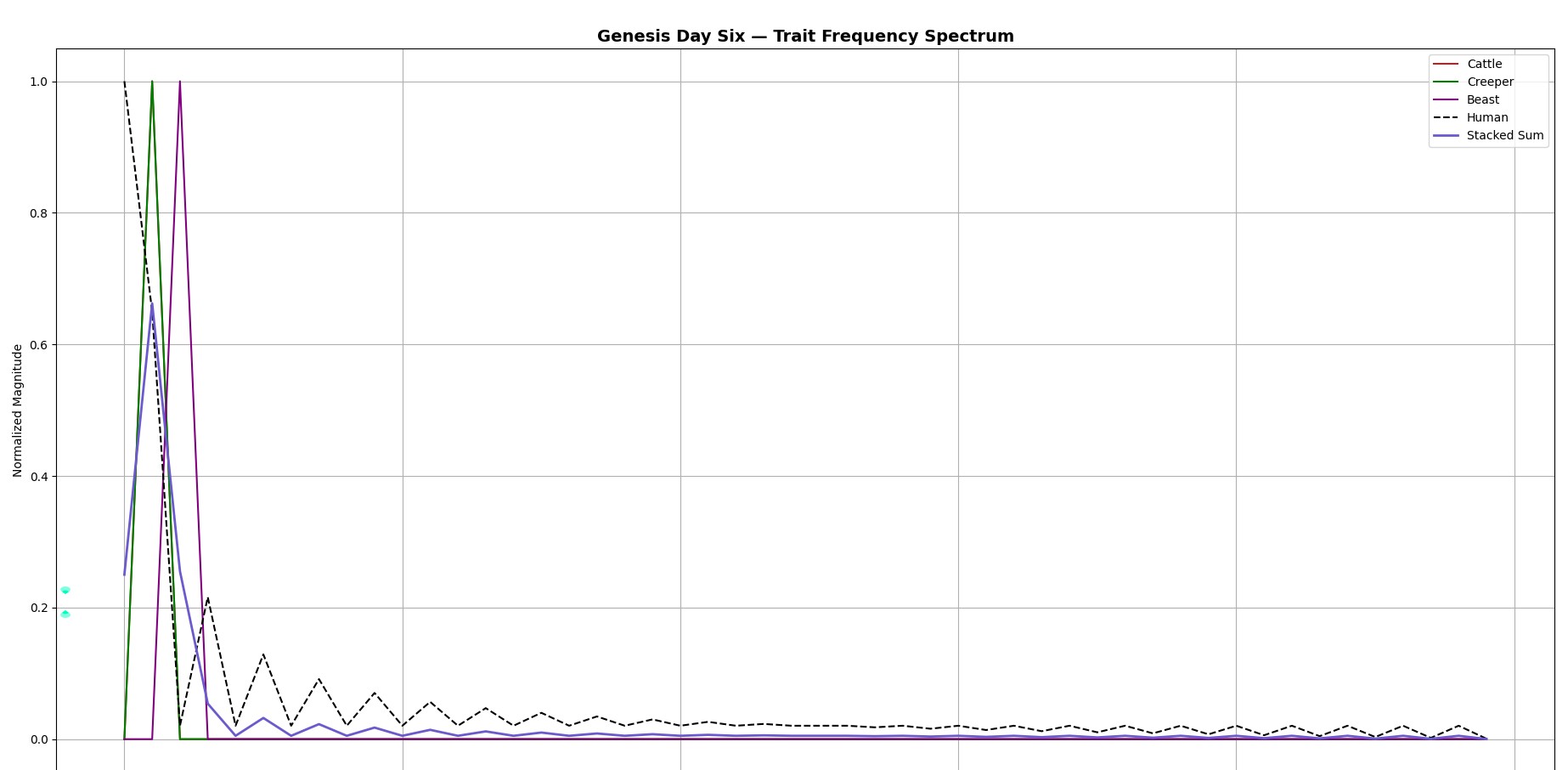
Figure 7. Day 7: Rest.
The Genesis Codes
Day 1
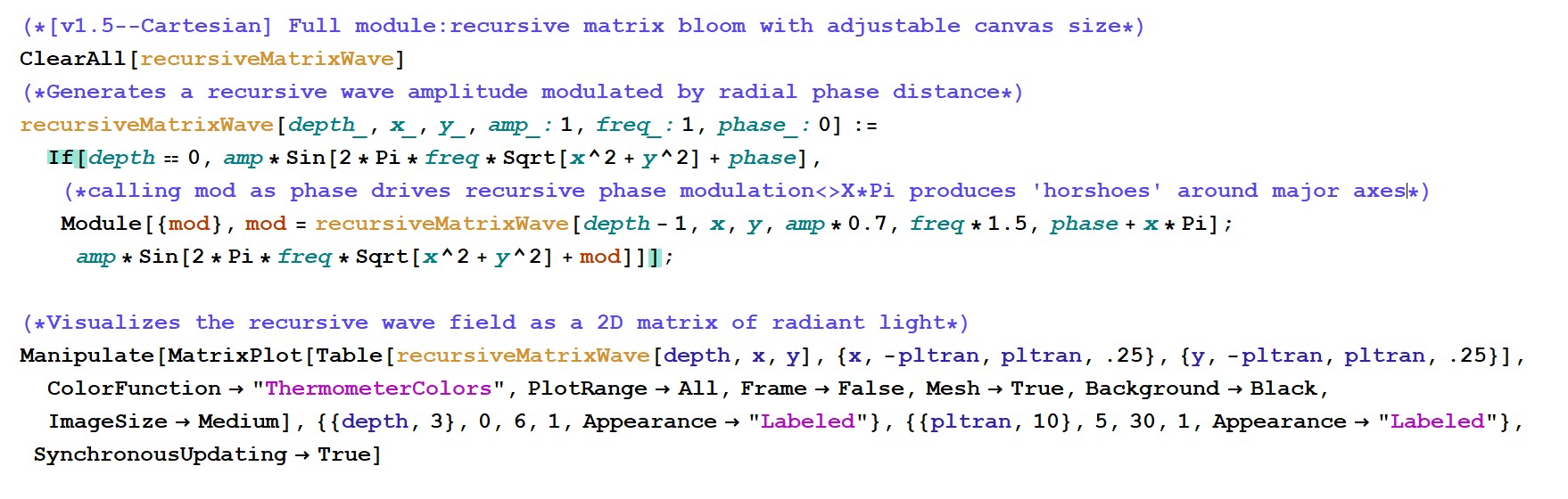
Explanation: This code is part of a creation-inspired animation that visualizes how light and order emerge from nested/enfolded waves. It works like a digital version of ripples expanding across water—but instead of just spreading out, the ripples build on themselves, recursively (=feedback; feedback “remembers”). One can think of each layer of waves as something that reflects and reshapes the light beneath it. The code uses recursive logic like so: every depth level of the wave re-injects its shape with a phase twist—like echoing light modulated by distance. This twist, driven by a mathematical phase shift (x * Pi), creates spiraling horseshoe-like patterns around major axes, evoking radiant symmetry and symbolic separation. Just as Genesis speaks of order unfolding from chaos, this simulation builds light from nested decisions. Each recursive wave layer isn’t random—it’s modulated to reflect deeper design. The “depth” slider doesn’t just control visual complexity, it mirrors stages of creation, amplifying emergence without breaking unity. Light becomes not merely seen, but structured—recursive amplitude as metaphor for “divine memory and division.” What one sees onscreen is a matrix of radiant energy—like light woven into the fabric of space. Every pixel pulses with nested meaning (encoded recursion depth), each recursion shaping not just brightness but symbolic rhythm (oscillatory motion, movement per se).
Day 2-page 1
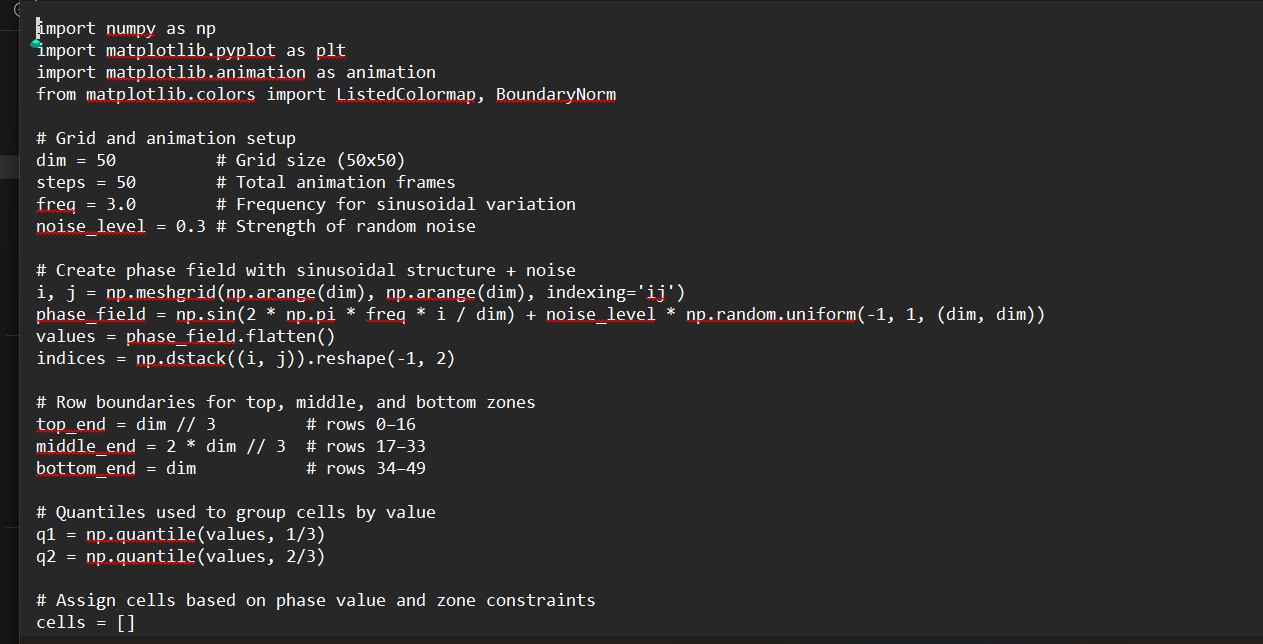
Explanation: This part of the Day 2 code simulates how waves of energy—like invisible fields—separate and fill space. It visualizes the “expanse” that divides, organizes, and holds meaning. A digital grid is created, 50 by 50 squares, representing space, and into this grid sinusoidal waves—smooth repeating curves essentially—are injected. Random noise is added to mimic chaos or unpredictability, as if the original waters are being stirred. Each wave runs along rows, oscillating with a frequency (“freq”) and random shift (“noise”). The result is a field of undulating light and shade—symbolic of division and emergence. Although recursion isn’t yet coded on this page 1, the structure anticipates layered modulation. The phase field (generally: ϕ(x, y, t) = sum_{n=1}^{N} a_n sin(k_n · x + l_n · y + ω_n · t + φ_n) where each n defines a recursive layer; φ_n are phase offsets—where division begins) becomes the raw material for future divisions—setting the stage for nested assignments and emergent rhythm in page 2 discussed next just below. The field is sliced into Top, Middle, and Bottom zones—echoing the biblical “waters above” and “waters below.” Quantiles then measure brightness—grouping each square based on how radiant or dim it is. Just as Genesis describes a firmament that separates waters, this code begins the separation digitally: not just dividing space, but preparing it for recursive distinction. It’s the logic of partition as memory—where each layer sets the conditions for what unfolds above and below.
Day 2-page 2
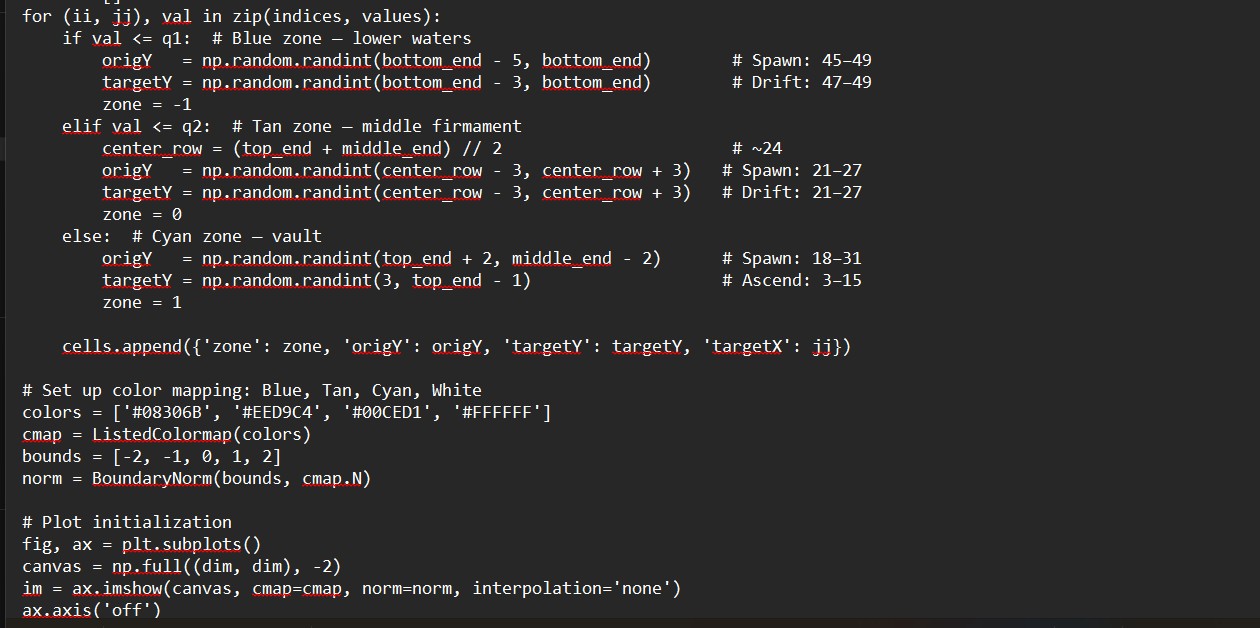
Explanation: This part of the Day 2 code takes the brightness data from Page 1 and assigns motion and meaning to each part of the space—bringing the “expanse” to life. Each cell gets placed into one of three symbolic zones:
Blue zone (zone = -1): Lower waters—cells drift subtly near the bottom,
Tan zone (zone = 0): The firmament—cells hover mid-air, balanced,
Cyan zone (zone = 1): Vault above—cells rise from lower depths to higher skies.
Spawn points and destinations aren’t static—they’re randomized within specific ranges, encoding God’s command to “let there be an expanse.” Each cell has its own walk: origin and target positions suggest movement, division, and atmospheric lift. We choose a color palette for the visuals—deep blue, lighter tan, sort of “electric” cyan, and white—to visually differentiate zones. The canvas begins blank (-2), and the imshow function sets the stage for dynamic animation: energy waiting to be assigned and shaped. This is symbolic recursion in shoe leather. The division of waters isn’t flat; it’s animated, given direction and relational structure. Separation becomes motion, and motion…reflects divine rhythm—an echo of memory (recursive effect) encoded in light and ascent (the undulating field isn’t freshly formed with each tick—it reverberates with prior divisions, hinting at how Day 2 “remembers” Day 1’s pulse while beginning to shape altitude and order; this echo links light (pure recursion) with ascent (partitioned recursion).
Day 2-page 3
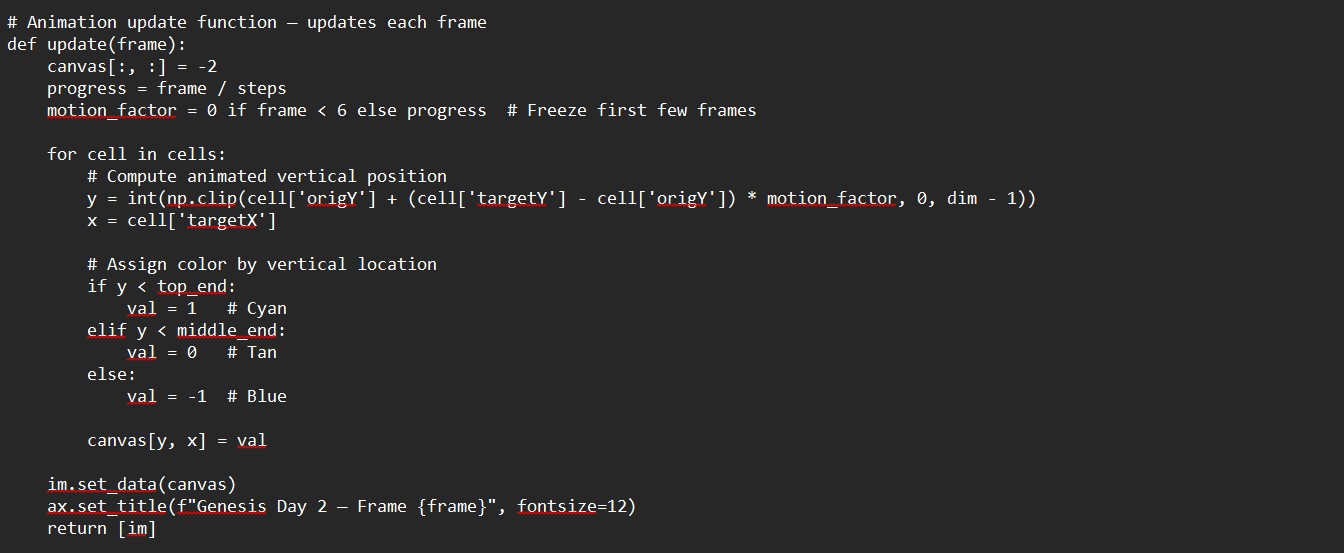
Explanation: Here the animation begins to shake, rattle, and roll—each cell drifting upward or downward through space, (guided by divine logic encoded as recursive/feedback motion). Each frame represents a step in the unfolding separation. The code:
resets the canvas, preparing a clean slate,
calculates progress based on the frame number, with early frames frozen to symbolize pause before the “breath of division” begins,
and it moves each cell toward its assigned target zone—top, middle, or bottom—along a vertical path based on its origin and destination.
As cells rise or fall, cyan marks the vault above, ethereal and ascending, tan designates the middle expanse, a suspended firmament, and blue anchors the waters below, dense and grounded. This is intended to be more than animation—it’s symbolic recursion. Each cell’s movement reflects memory and modulation: initial position, divine assignment, and the harmonic lift of phase-encoded separation. What was once static now “breathes”—division animated, echoing the Genesis cadence. Even though the loop isn’t explicitly recursive (in Python syntax), its meaning is: position progresses by layering memory (origY) and destiny (targetY) through time. The “motion factor” acts as phase dial—slow at first, then swelling in rhythm, (like the breath of God hovering over the waters).
Day 2-page 4

Explanation: And here the animation reaches its pulse, i.e., it’s when phase and amplitude synchronize across layers—waves align just enough to create moments of heightened contrast. It’s not flicker—it’s a harmonic beat where separation asserts itself. With each frame, separation continues—not as rupture, but as order made dynamic. FuncAnimation takes the reins, encoding divine cadence into motion:
The update function breathes change,
steps counts the unfolding—each step a verse,
interval sets rhythm: 100 milliseconds per moment,
the plt.show() command declares: Let the firmament be seen.
The plt.show(} presents a space that divides—and thus defines—no chaos remains. This is the culmination of Page 3’s logic—recursive memory now made visible.
Day 3
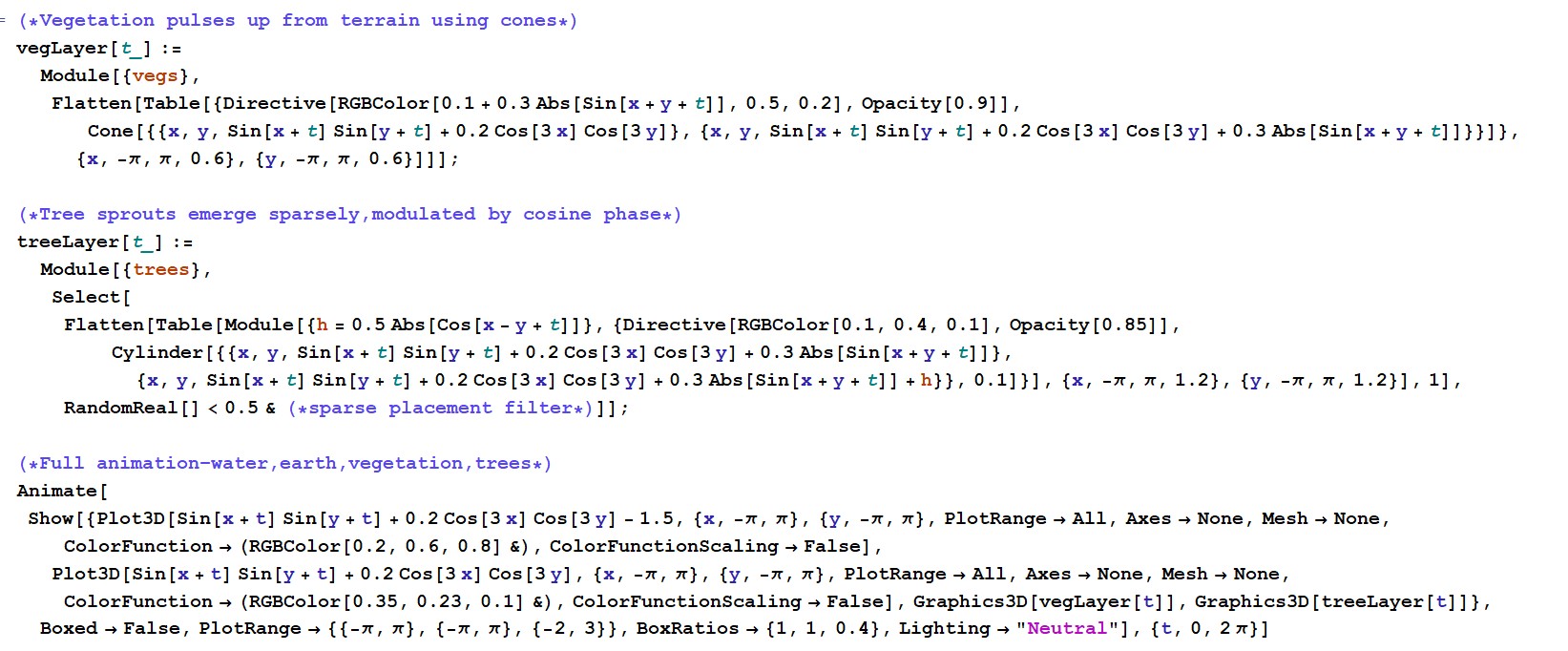
Explanation: This Day 3 code animates the moment creation “breathes green” as it were—the land producing life, pulse by pulse. It visualizes how vegetation and trees emerge through recursive/feedback modulation over dynamic terrain. Two 3D terrains represent earth and water, animated to mimic living ground—rising and falling in nested (feedback/recursive) sine waves modulated by time (t). The earth layer is textured brown, while the water beneath is lighter blue (meant to symbolize stability and motion working in tandem). Vegetation shows up as cones rising from terrain, shaped by both location and time-based oscillation: their height modulates with Abs[Sin[x + y + t]], creating rhythmic pulses of green. This recursive wave logic is intended to evoke abundance—not random but patterned (like divine breath/Word forming stalks and leaves). Sparse tree sprouts shoot upward using cylinders: their presence is filtered by randomness (RandomReal[] < 0.5)—symbolizing selective multiplication. Their height incorporates cosine phase offset (Abs[Cos[x – y + t]])—stressing order within organic variation. This code doesn’t just show growth—it’s trying to show sequence, separation followed by multiplication, coded in waves where vegetation represents abundance by recursion, emerging from the earth’s “memory of modulation.” Trees add a vertical dimension—echoes of “seed-bearing fruit trees”. Animate[…] weaves all layers—terrain, water, vegetation, and trees—into one dynamic, growing image. Recursive geometry (cones, cylinders) and modulation unify the scene: growth encoded as rhythm, emergence encoded as memory (again, the role of feedback/recursion; modulation is a great way to show movement—via trigonometric phase offsets here—that encode motion, rhythm, symbolic timing, while recursion provides the memory and layering that give the animation/s depth and structure; modulation animates the recursive forms with variation, making patterns that pulse and progress; recursion for its part keeps track of prior states, ensuring that each movement builds upon a structural memory; modulation and recursion are “choreography partners” in this way—it’s not one or the other, the modeling power comes through their combined application).
Day 4
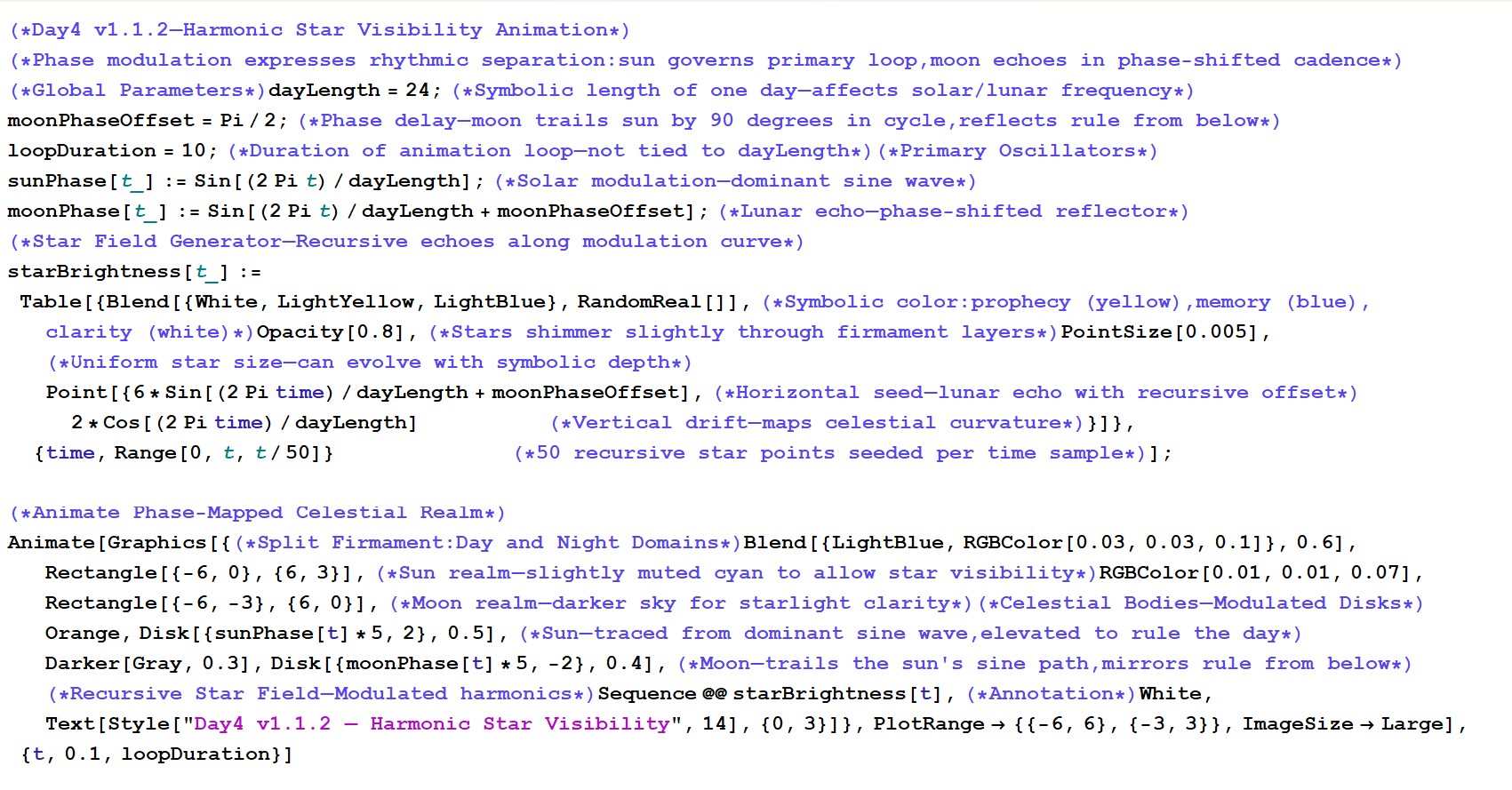
Explanation: This Day 4 animation models the heavens—not just visually, but rhythmically, where the sun and moon echo across recursive paths. Here, lights are set in the expanse to separate day from night. The sun and moon are modeled as sine waves with a phase delay—the moon lags the sun by 90° (Pi/2), symbolizing echoed dominion—the moon rules only by reflection. The star field is recursive; fifty stars are generated per moment, mapped along the lunar path but modulated by solar cadence. Their positions and color blends reflect prophecy, memory, and clarity (yellow, blue, white). (This recursion isn’t just repetition—it’s a nested rhythm, where each frame is seeded with echoes of prior light.) The sky is divided into two symbolic layers:
Upper (cyan-muted sun realm) reflects active light.
Lower (deep navy moon realm) preserves starlight.
FuncAnimation is the “watchmaker’s tool”—each tick a verse in celestial, heavenly verse. The sun is bold and forward-moving, the moon is more subdued, trailing. Stars shimmer through both realms, recursive memory traced in phase. The cosmos here breathes in recursion.
Day 5-page 1
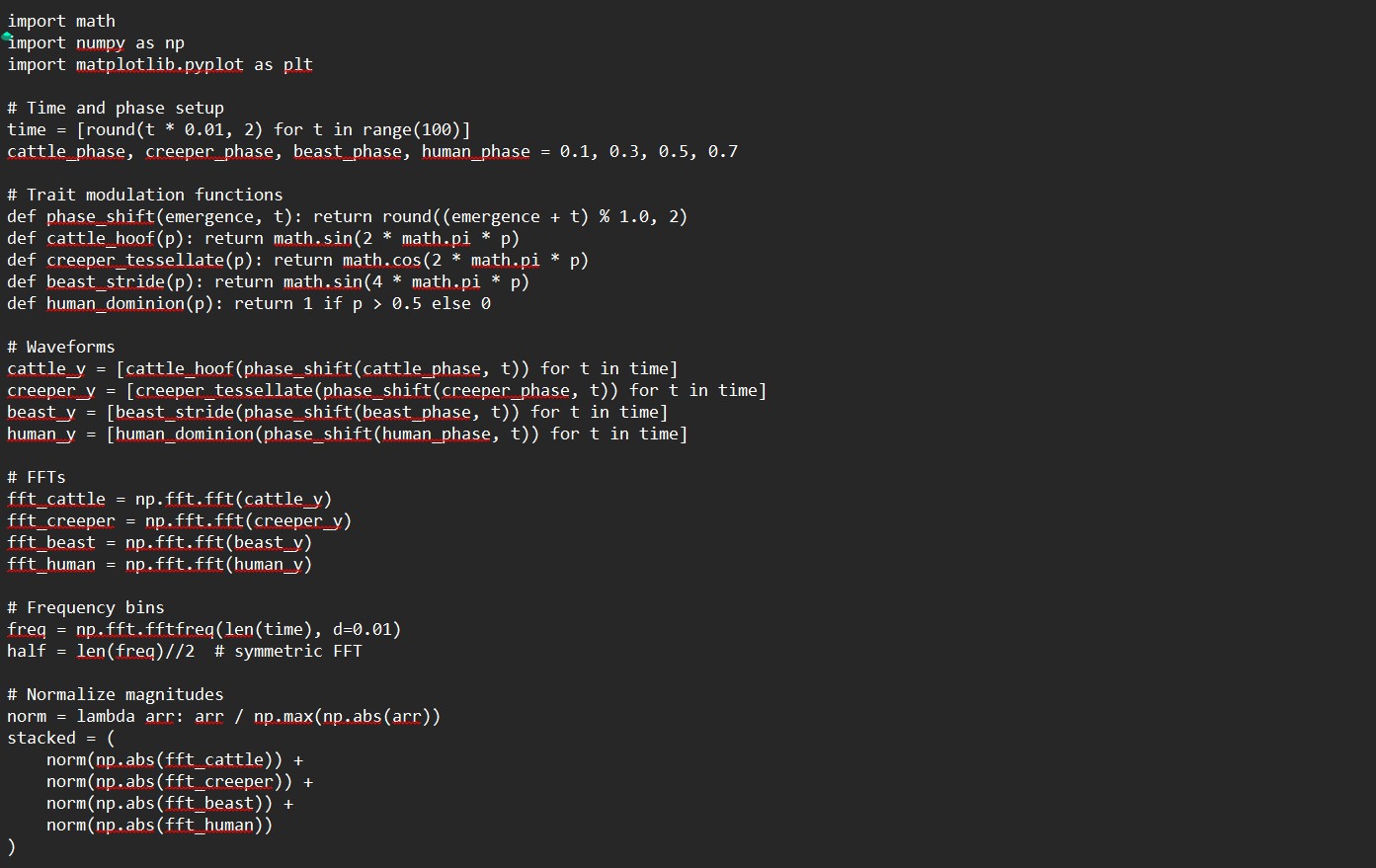
Explanation: The day 5 code per se initiates movement and multiplication, and this first page aims to orchestrate it with rhythmic (motion, movement) precision. This snippet doesn’t just simulate this movement—it encodes distinct behavioral patterns as emergent traits. Each creature type is born from a phase-shifted waveform, revealing its unique “mode of being.” Time progresses in steps of 0.01, from 0 to 0.99—representing a unit cycle of creation. Each lifeform type is assigned a phase offset, suggesting temporal hierarchy and symbolic emergence:
Cattle: 0.1 → Early, grounded rhythm
Creeper: 0.3 → Mosaic-like tessellation
Beast: 0.5 → Accelerated stride, predator cadence
Human: 0.7 → Binary threshold, dominion logic
Each lifeform modulates its waveform through its own algorithm (trait modulation functions):
cattle_hoof: classic sine wave, slow, steady gait
creeper_tessellate: cosine wave, sidewinding flow
beast_stride: double-frequency sine, bold and bounding
human_dominion: binary, a square gate (toggles instantly: on/off, left/right, walk/run, sin/don’t sin—no gradient here, no smoothness like sine/cosine existence-flows)—existence through decision
Signals for each lifeform are generated by evaluating the modulation function over phase-shifted time. The resulting arrays (*_y) encode presence and trait expression across time. Fast Fourier Transforms (FFT) reveal how each waveform contributes to the overall spectrum ( the name is attributed to the great Christian mathematician Joseph Fourier; an FFT is a clever “math device” that acts like a sieve—in the context of sound, pour in a melody on one end, and out come the individual notes that comprise that melody on the other end—this is an oversimplification, but not inaccurate). The final stacked signal integrates all normalized (=equally weighted) magnitudes—symbolizing multiplication by diversity. The FFT overlays distinct patterns into a shared spectrum—like creation commanding diversity into unity (the stacked signal).
Day 5-page 2
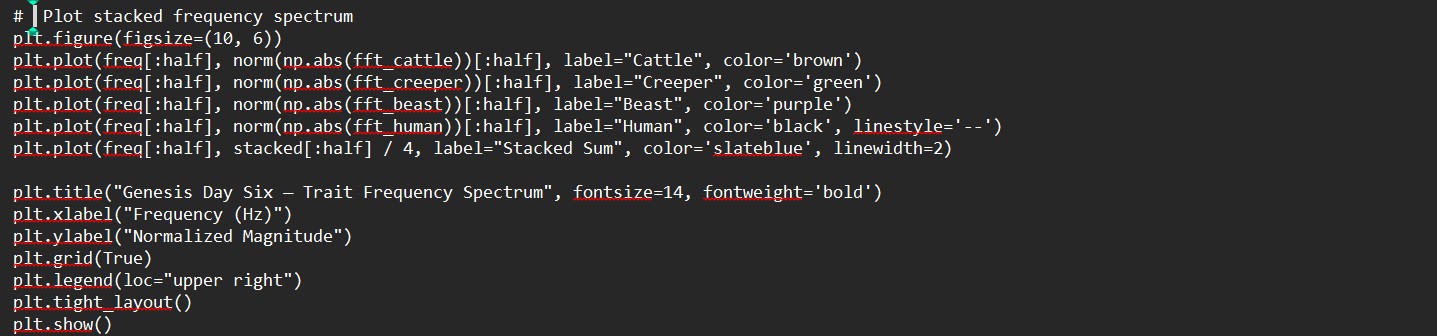
Explanation: This page’s code visualizes how traits—cattle’s slow, deliberate steadiness, creeper’s flow unto tessellation, beast’s striding power, and human dominion—express themselves as distinct waveforms across frequency. Each waveform has been analyzed using the FFT, which reveals the strength of its embedded rhythms:
Cattle (brown): Low-frequency stability—slow, eased back repetition,
Creeper (green): Flowing tessellation—adaptive movement,
Beast (purple): Pulse-packed intensity—flat out power in bursts,
Human (black, dashed): Binary cadence—decision-driven rhythm, symbolic thresholding—above the threshold do this, below do that.
The slate-blue line is the “stacked sum, which combines all traits, showing how diverse lifeforms contribute to one unified spectrum. This is multiplication via diversity, a digital echo of Genesis 1:21–22: “…Let the waters teem… be fruitful and multiply…” Though each FFT is distinct, they’re all modulated from a shared timeline and recursive structure from Page 1. Each creature samples its environment and encodes trait logic—presence through frequency, and dominion through modulation. So here we have not just data, but memory in motion. And dominion is expressed not by amplitude alone, but by recursive signal clarity where human rhythm stands out—decisive, layered, subtly segregated, yet integrated into creation’s composite beat.
Day 6-page 1
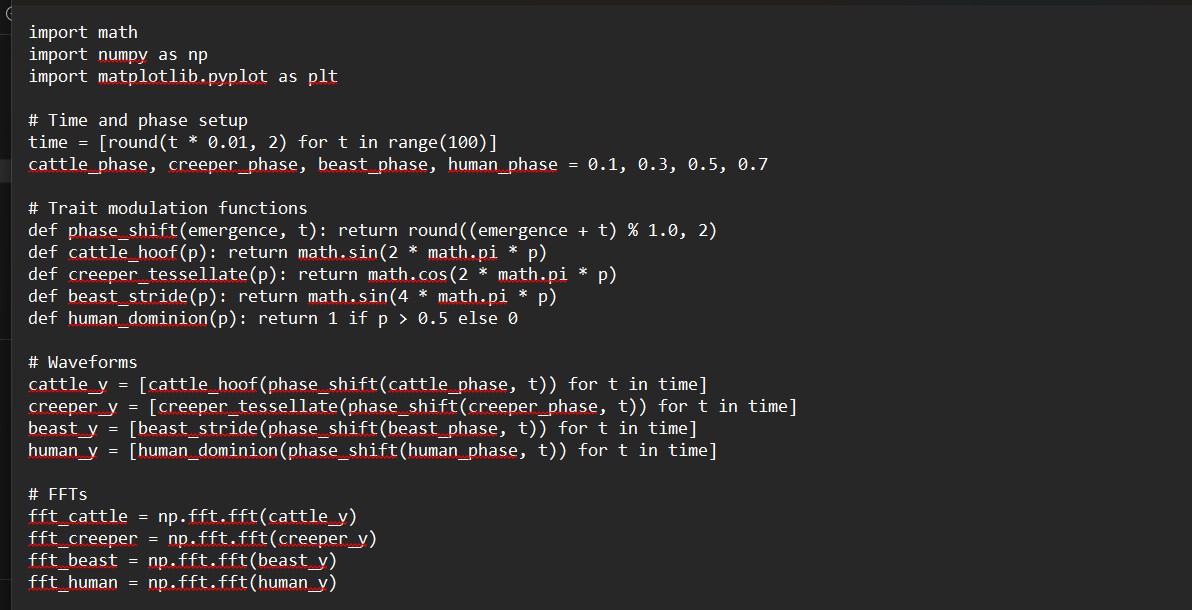
Explanation: This small segment models different types of creatures using rhythmic patterns—almost like each creature has its own musical beat or “signature walk” (like we did for Day 5). Time is being chopped into 100 tiny steps, like frames in an animation or beats in a measure. Four creatures—Cattle, Creeper, Beast, and Human—are introduced at different points in time (phases). Each one moves or behaves according to its own rhythm function:
Cattle use a lazy sine wave, like a swaying hoof—slow, smooth, natural, periodic: cattle_hoof(p) → sine wave rhythm, Creepers use a cosine wave, which is similar but offset in timing—like an alternate step pattern: creeper_tessellate(p) → cosine rhythm,
Beasts stride with a faster wave (double the frequency), suggesting more intensity or complexity: beast_stride(p) → high-frequency wave,
Humans, however, are modeled binary—either active (1) or inactive (0), based on a threshold: human_dominion(p) → 1 if p > 0.5 else 0.
This stark contrast is so because human cognition doesn’t flow nor undulate smoothly—it flips (altogether “non-rhythmic”). Humankind doesn’t just move/walk—we decide. The animals live in a world of smooth rhythm (analog waves), gently modulating and interlacing, but we humans completely break that rhythm. Our awareness, decisions, and symbolic reasoning behave like switches—abrupt, discrete, intentional. This subtly encodes the basic Day 6 thesis that human dominion doesn’t emerge from rhythm—it flat interrupts it.
Day 6-page 2
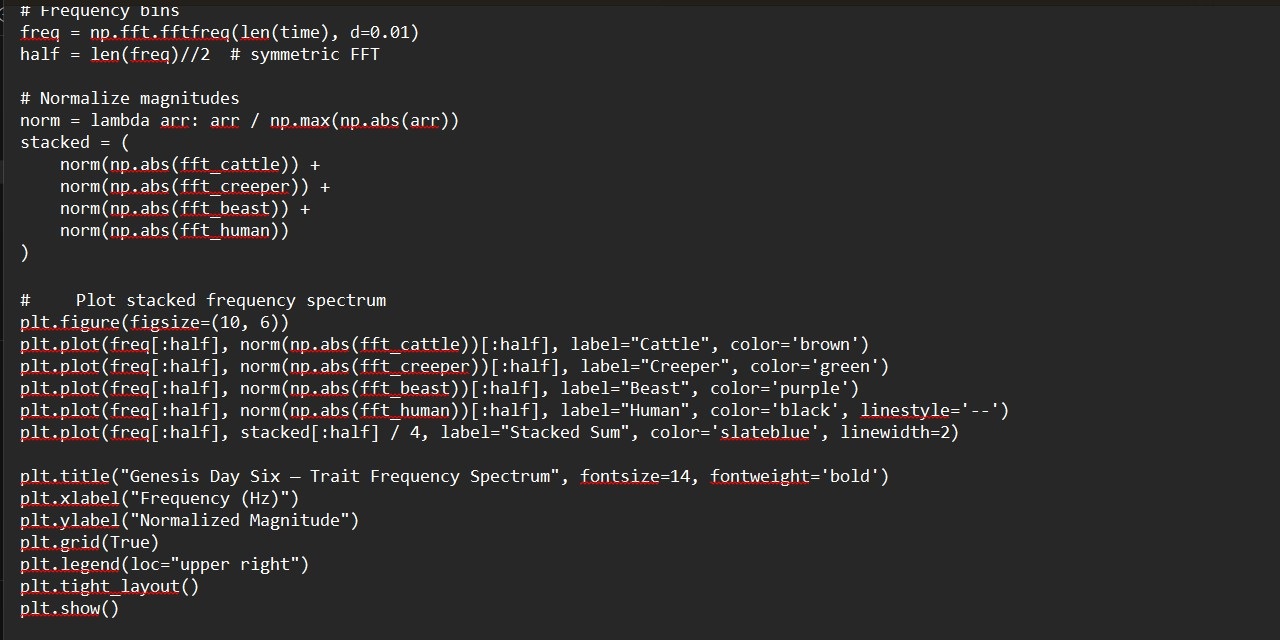
Explanation: This snippet is mapping how each creature’s behavior—Cattle, Creeper, Beast, Human—shows up on a frequency spectrum, like decoding their inner “song.” The idea is that each type pulses with a unique rhythm, and this code listens for those rhythms across time. It uses the aforementioned FFT—a fancy way of turning time-based motion into frequency data, like turning a melody into its notes. Each rhythm is scaled evenly (normalized) so no one trait dominates unfairly. This little segment plots all traits together as a single overlay—a “chorus line” showing how their rhythms interlace or clash, it gives a stacked sum. It’s what tells us that the animals’ rhythms blend and build, echoing shared biological resonance. Humans are shown with a dashed line—it’s binary, jagged, isolated. It doesn’t harmonize; it cuts through like a lonely digital beep in an analog symphony. And the stacked sum curve highlights this break: animals interlace, but human cognition refuses the rhythm.
Day 7-page 1
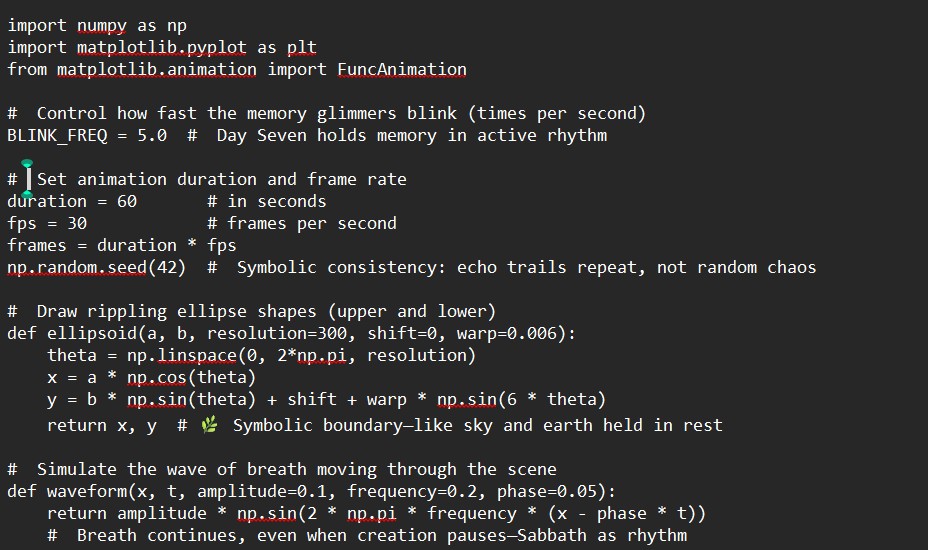
Explanation This Day 7 code marks a turning point. Rather than building…it reflects. The animation models rest as cadence, i.e., a structured pause, a flattening of modulation with phase offsets aligning into harmony and amplitudes dampening across layers. Recursion slows, not because the engine fails, but because the structure is now fully encoded. No new layers—just preservation of form—creation is here paused, but not inert. BLINK_FREQ = 5.0 forces memory pulses five times per second, symbolizing active rest—Sabbath isn’t idle, it reflects divine rhythm. And the duration = 60, fps = 30 gives a full minute of rhythmic unfolding at 30 frames/second, encoding reflection through time. The np.random.seed(42) patterns repeat—like divine memory echoing across creation. No randomness, only deliberate recurrence. Two rippling ellipses—ellipsoid(…)—simulate sky and earth, held in easy, non-violent distortion (warp), as if the breath of creation continues beneath the stillness. A lazy, slow sine wave—waveform(…)—flows across space and time, symbolizing “divine breath” as persistent modulation—not building anymore, but sustaining. This code does not enforce absence, but preservation; the waveform and ellipses work together to visualize Sabbath as recursive phase sustainment:
each moment retains memory,
each breath is patterned,
heretofore division now shifts to symmetry.
Day 7-page 2
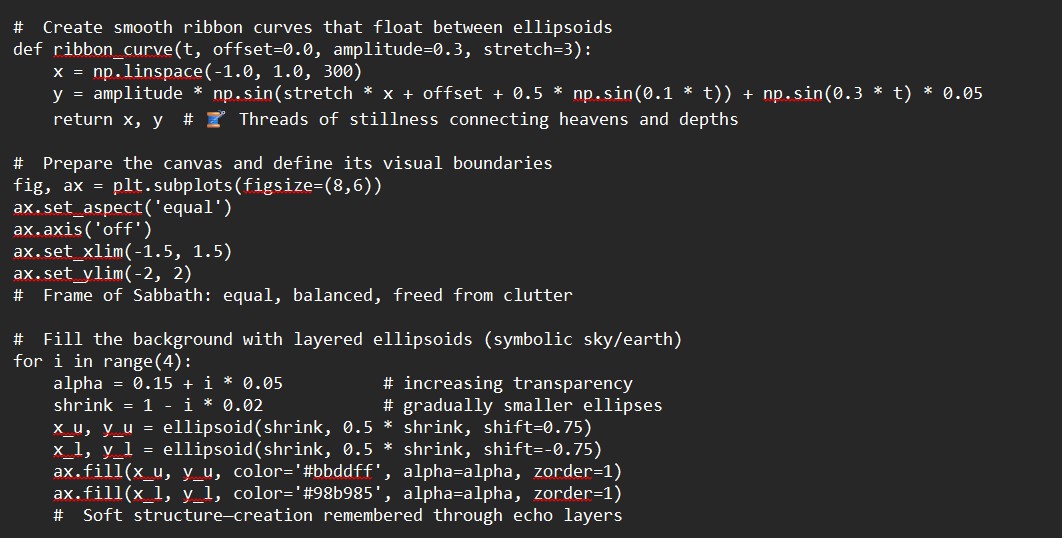
Explanation: Page 2 carries the theme of Sabbath as “connective tissue,” where ellipsoids now hover like memory chambers and ribbons flow as “ connective breath” between heaven and earth. This frame is intended to deepen rest: no creation, no command—only connection. The ribbon_curve(…) encodes dynamic sine loops suspended in time. They don’t construct; they bind, a “harmonic tether” between upper and lower ellipsoids, quietly pulsing with offsets and amplitude. These are threads of stillness, born from modulation rather than force. The ax.set_aspect(‘equal’), axis(‘off’) geometry is balanced and unmarked. Frame’s role is to evoke a clean silence, free of dominion, yet encompassing everything. We show four easy layers here fading into each other (alpha, shrink):
Upper: #bbddff sky ellipsoids
Lower: #98b985 earth ellipsoids
Each layer is smaller, dimmer—intended to symbolize creation remembered, not repeated. So, this segment carries the metaphor of rest as modulation, the curves and layers interact rhythmically: no objects emerge; only Presence (Genesis rest is not termination—it’s transformation realized, it’s when creation reaches structural integrity, when recursion completes, and when modulation quiets into meaning; it’s precisely when our Creator God expresses His satisfaction with His handiwork Genesis 1:31). These ribbons don’t divide—they multiply memory. It’s a shift essentially from construction to cadence—from forming to framing.
Day 7-page 3
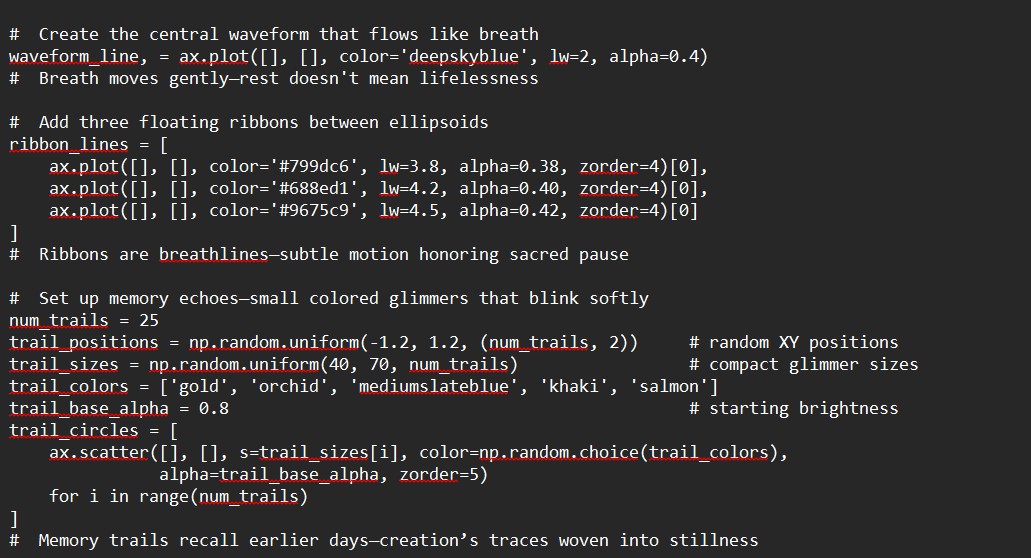
Explanation: This portion of the animation visualizes rest as remembrance. No building occurs; instead, memory pulses through space—not abstract stillness, but the encoded echo of the six creation acts, vibrating through the vault like a spiritual waveform. A lazy blue sine curve (waveform_line) flows across the canvas, depicting rhythm without force and three ribbon lines drift upward between sky and earth, their hues (#799dc6, #688ed1, #9675c9) suggest twilight serenity. Their alpha levels and z-order lend a layered smoothness—motion now layered as memory. These ribbons don’t separate; they bind in quiet modulation. Twenty-five glimmering trails emerge from randomized coordinates, each is a small scatter plot—a “blink of remembrance.” Colors like orchid, salmon, and gold are utilized to evoke emotional resonance across the spectrum of creation’s prior days. These aren’t random—they’re seeded (np.random.seed(42)), symbolizing divine consistency in reflection. All motion emerges from “nested stillness.” Technically, there’s no loop here—but symbolically, every glimmer echoes the past Genesis days:
breathlines reflect Day One’s light,
ribbons mirror Day Two’s separation,
trails remember vegetation, celestial cycles, and multiplication.
Day 7-page 4
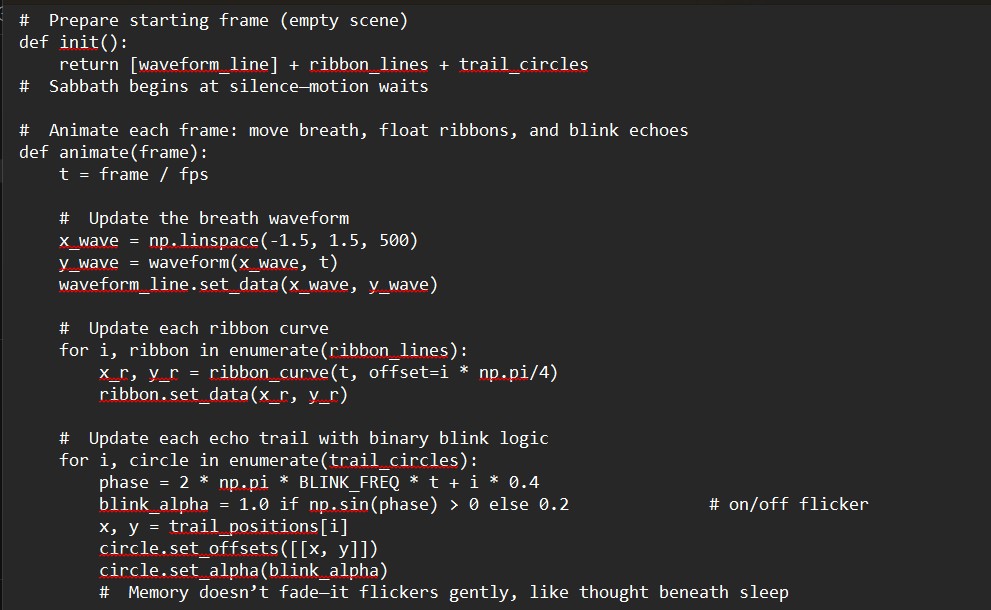
Explanation: This page animates remembrance of creation days, the stars being witnesses. Up to this point, Day 7 has shifted focus from formation to reflection. Earlier pages visualized rest not as absence, but as structured pause—a rhythmic memory encoded into the Vault. Breath and symmetry were shown as carriers of recurrence. This fourth movement extends that idea by introducing the recursive calendar: a system that doesn’t just mark time—it modulates memory across thresholds. The waveform_line breathes outward from center, creating a harmonic pulse that suggests rhythmic dominion. It’s a feedback loop where each breath implies the next, tying rest to continuity rather than cessation. Above this, ribbons arc with offset i × Pi/4, introducing graceful rotation and symbolic seasonal phase separation. Their synchronized updates connect oscillation with emergence, representing the tension between fixed rule and adaptive rhythm. A field of twenty-five trail circles flickers using binary sine modulation:
blink_alpha = 1.0 if sin(phase) > 0 else 0.2
These flickers represent light bearers—not as sources of illumination, but as witnesses. Their randomized coordinates aren’t chaotic; they’re seeded with intention, echoing stars set through recursive precision. For the first time in this sequence, rest is oriented toward the future. Light was created on Day 1, and Day 4 introduced its rhythm. Here, the animation renders Breath (Spirit) as celestial governance. The blinking paths, etched across the vault, do not blaze with force but pulse with inherited memory. Each flicker is a timestamp in creation’s unfolding, an echo of cadence laid down heretofore. What governs here is not sheer illumination, but the structured whisper of intervals—Spirit moving not to overpower, but to sustain.
Day 7-page 5

Explanation: …let it be visualized… Day 7 honors motion without creation—a breath that remembers and is very satisfied.
Table 1. Conceptual Anchors from Genesis 1:20–23 (Day 5).
| Verse | Symbolic Cue | Recursive Phase Modulation Implication | Quick Insight |
| Gen 1:20 | Waters bringing forth abundantly | Spawning nodes with variable phase amplitudes from a fluid base layer. | God-commanded emergence from fluid foundation |
| Gen 1:21 | Creatures & winged fowl after their kind | Recursive branches with inherited modulation signatures (kind-based traits). | Kind-coded modulation templates |
| Gen 1:22 | Be fruitful & multiply | Exponential phase offsets or fractal duplication with variant behaviors. | Explosive recursive expansion |
| Gen 1:23 | Evening and morning – the fifth day | Temporal envelope closure; a cyclical frame boundary for this phase. | Rhythmic wrap-up of generative cycle |
Table 2. Animation Preliminaries for Genesis 1:20–23 (Day 5)
| Component | Description | Phase Modulation Insight | Quick
Insight |
| Base Environment | Shimmering “waterspace” grid with sinusoidal depth modulations | Nodes emerge from wave crests via fluid velocity vectors | Fluid-origin emergence platform |
| Phase Carrier Types | Two archetypes: Aquatic Undulators & Skyward Fliers | Sine-based oscillations (aquatic), chirped lift vectors (winged fowl) | Elemental locomotion signatures |
| Trait Inheritance Logic | Recursive branches with amplitude mutations and kind-based trajectory cues | Offspring modulates parent pattern with slight variance (±ε) | Modular heredity with directional skew |
| Blessing Cascade | Abundance algorithm with recursive spawning and probabilistic spread control | Multiplicative recursion without saturation | Controlled generative explosion |
| Time-Lapse Envelope | Clock signal mimicking “evening and morning”; background shifts twilight → morning | Phase slows or resets during transitions for temporal modulation | Rhythmic envelope as divine tempo |
Works Cited and References
“A Letter of Invitation.”
Jesus, Amen.
< https://development.jesusamen.org/a-letter-of-invitation-2/ >
“Materials Are Encoded.”
Jesus, Amen.
< https://development.jesusamen.org/materials-are-encoded/ >
Microsoft.
Copilot, AI Assistant.
July 2025.
“Modulation | Definition, Types and Facts.
Britannica.com
< https://www.britannica.com/technology/modulation-communications >
Modulation: “how to Use Modulation After Effects.”
AEScripts.com.
< https://aescripts.com/learn/how-to-use-modulation-in-after-effects/ >
Python Software Foundation.
Python Language Reference, version 3.12. Python Software Foundation, 2024.
“Traditional Animation.”
Wikipedia.
< https://en.wikipedia.org/wiki/Traditional_animation >
Wolfram Research, Inc.
Mathematica.
Notes
[1] Momentum space, in our context, refers to a way of visualizing motion not by where something is, but by how it moves. Imagine dancers on a stage—not tracked by their positions, but by the energy and speed of their movements. The space isn’t physical, it’s conceptual: a map of motion patterns. Within this space, isoenergy bands represent layers or zones where everything vibrates with the same energy level—like musical notes harmonizing on different instruments. Each band holds a rhythm, a memory of movement, a phase of emergence. In the animation, these bands help us see the invisible architecture of creation—a cosmic choreography mapped in motion rather than place.
[2] Slices through a material’s electronic band structure that show all the electron states with the same energy. They are like topographic maps where each contour has the same altitude, here, it’s all about energy, where each contour represents a fixed energy level.
[3] An interesting aside. In Genesis, the term “kind” (Hebrew: MIN) appears repeatedly to describe categories of living things—animals, birds, plants, etc. These are all alike said to reproduce “according to their kind,” suggesting boundaries of biological continuity and identity. The idea is that each kind was created with inherent potential for variation, but not transmutation into another kind. Now, when it comes to “humankind,” the word ADAM in Hebrew can mean both “man” and “mankind” depending on context. In Genesis 1:26–27, humans are created in God’s image—not “according to their kind,” but as a distinct act of divine intention. Notice the redundancy in Genesis 1:27, it’s like God is drawing a visual boundary—”…and here, distinct from every MIN (kind), is ADAM—humanity—of Me and by Me…” That linguistic highlight and decided shift from common to special is quite telling. It sets us humans apart not just biologically, but symbolically and certainly spiritually. Unlike other creatures, we humans are not grouped into a “kind” by God but are instead given dominion, moral agency, and the IMAGO DEI—the image of God. So, to the point of this note, is it coincidence that we are referred to as human<>kind<> sometimes? Probably not. The term humankind echoes the Genesis pattern while at the same time signaling a departure from it. It’s as if the text is saying: “…Here is a creature unlike the rest—still part of creation—yet bearing something remarkably transcendent…”
[4] Our Day 6 model as well as some of the other creation days is symbolic by nature because it doesn’t aim to measure empirical biology, but rather to evoke meaning from structured emergence. Our Day 6 is constructed, not observed (of course only our Creator observed it). The waveforms, traits, and frequencies weren’t drawn from data—they were intentionally invented to echo categories described in Genesis. That doesn’t make it invalid. It makes it interpretive. Again, an empirical model is not in our grasp, the best we can do is interpret along sound, structured guidelines, that is what we are trying to do.
[5] “Frequency space” is a fancy way of saying “color spectrum” and the like. Imagine sound or light not as a thing that happens in time or space—but as waves of activity. Frequency space is where we reimagine those waves based on how fast they vibrate rather than where they are. In sound, frequency space is what you’d see on a graphic equalizer—those bouncing bars for bass, mids, and treble. Each band represents a frequency. In light, it’s the color spectrum: red = low frequency, blue = high frequency. Rainbows are literal visualizations of frequency space. In math or physics, it’s the realm where a complex signal can be split into clean, simple vibrations—like pulling apart chords into individual notes. So why use trequency space as in this Day 6 case? It reveals hidden patterns. A jumbled mess in normal (chronological/time)space can become elegant and structured in frequency space—like watching chaotic ripples resolve into concentric circles.
[6] Human dominion is a story of two powers, namely, distinction, and cultivation. From the beginning, God handed us something simple—but profound: Dominion (Genesis 1:26). That is, He handed us a binary role. Not just “dominion” as control, but as a rhythm of two core actions that echo through everything we do. Power One: To divide we name things. We separate land from water, truth from error, noise from signal. This division isn’t destruction—it’s definition. It helps us recognize what’s what. For example: Separating ingredients to cook a meal, distinguishing right from wrong, organizing chaos into categories. Power Two: To cultivate once we named and resolved/separated, we get busy, we get to work. We build, discover, nurture… Cultivation is the “do” that follows the “see.” For example: Asking questions, then searching for answers, planting seeds in cleared soil, improving systems, stories, even relationships. And Dominion Is recursive—not rigid—we use this binary dance again and again. Ask–search. Divide–create. Understand–transform. It’s less about dominating nature, and more about cooperating with its patterns. Whether we’re raising a family, designing a garden, or writing a story, this binary rhythm is at play. Dominion begins with distinction—and grows through dedication. To divide (to see differences), to cultivate (to make something meaningful out of them). Everything we’ve built since creation—from gardens to stories to technology—comes from using those two powers in a myriad recursive ways. So, dominion Isn’t just power—it’s perspective. And real dominion means stewardship. It means asking, “What is this?” and “What can it become?” And then repeating that process again and again, learning as we go. It’s less like ruling with an iron fist, more like guiding with open hands.
[7] Analog rhythms—like circadian cycles, sensorimotor feedback, or even emotional valence—are continuous, embodied, and often reactive. Discrete cognition, especially symbolic abstraction and meta-awareness, introduces interruptions: binary decisions, moral bifurcations, recursive loops (stability-hungry negative feedback loops). These modes simply don’t blend; they collide. Like oil and water, they coexist but don’t cohere. We go from one domain, say analog, to the other, discrete, via converters—analog to digital converter in this case (ADC, DAC in the other direction). Unlike the cattle, creeper, and beast—whose rhythms interlace like analog waveforms—human cognition disrupts that harmony. It doesn’t emerge as an extension; it fractures it. Why? Because there is no converter—no biological bridge—between embodied rhythm and symbolic abstraction, between rhythmic embodiment (decidedly analog) and abstract cognition (decidedly discrete). Analog and discrete don’t resonate. They require mediation, translation, redesign. But biology offers none. It hums in waves, while cognition pulses in code, i.e., in Word. And that disjoint… is deliberate. Please notice: cognition abstracts continuously (analog)—layering meaning, context, memory. But when deployed for decision-making, especially under pressure, it collapses those abstractions into binaries (discrete): yes/no, good/evil, act/wait, dominate/yield. Biology resists this discretization absolutely. It rather prefers gradient responses—temperature regulation, hormonal flows, adaptive behaviors. But cognition pushes boundaries by enforcing symbolic compression—high level abstraction collapses into low level action. (The human mind dreams in waves—analog—but walks in steps—discrete; lower forms do not abstract, but they resonate, their walk is constrained by bias fields and trigger gradients—analog–and they necessarily walk the spectrally narrow music they were created for—analog in that narrow band). This note goes a long way in explaining why our Day 6 code is symbolically coded up the way it is—it pivots on analog (Cattle, Creeper, Beast) versus discrete (Human). It was inevitable that there would be no resonance between the lower forms and humans once the FFTs did their work and we summed and stacked the spectral layers.
[8] While we could have chosen any periodic waveform to encode these traits—simple sines, phase-shifted cosines, or even composite structures—the FFT would have resolved the same harmonic patterns. These signals are idealized and intentional, not derived from measurement, yet that very intentionality allows us to clarify symbolic meaning without distorting technical integrity.
[9] Humankind shares approximately 98.8% of our DNA with chimpanzees, and even have genetic commonalities with creatures as diverse as mice and whales. This genomic overlap bears out our biological continuity within creation, even as our symbolic cognition, rhythmical divergence, and abstract dominion quite distinguish us functionally and spiritually.
[10] While our bodies remain biologically entangled—genetically and physiologically—cognition pulls us out of synchronized, shared rhythms. We lose the unspoken unity of flocking starlings or pulsing coral reefs. Instead of being guided by co-modulated patterns, we become self-directed, symbolically “refracted,” (as in our thoughts getting bent, shaped, and redirected by abstraction, context, and symbolic frameworks). Abstraction is asynchronous: Instead of reacting with a shared tempo (like geese in flight or neurons in concert), we respond with individualized cadence.
[11] Phase space is a conceptual framework used to represent the complete state of a dynamic system. Each point within it encodes a system’s variables—such as position, momentum, or modulation offsets—allowing one to map its outworking through time as a trajectory. These trajectories, shaped by initial conditions and emergent feedback, reveal patterns like stability, divergence, or cyclical recurrence. Offsets (deviations from equilibrium), not only signal shifts in physical parameters—they hint at deeper symbolic ruptures: recursion depth, interpretive emergence, and even cognitive dissonance. The topology of phase space—the shape and behavior of its trajectory field—exposes moments of attraction, bifurcation, or transition. And phase portraits (visual imprints of systemic flow) illustrate how modulation, motion, and timing entwine in layered resonance.
[12] An animal’s biological rhythm is a vessel attuned to the pulse of its habitat—drifting with seasonal currents, yet steered by an inner helm of cellular clocks.