
Bible Talk
YHWH<OT-NT>TheoS. There it is in an angle brackets nutshell, and that is what we are going to Bible Talk about. Those red font words are the most frequently utilized in their respective Testament. The Bible quite literally summarizes itself in this way at the topmost level, the most general level of straining and yearning for interpretation and meaning and understanding. What is it saying? Reading across the sacred timeline, or more aptly, cracking open the God-breathed nutshell, it says YHWH is TheoS from the perspective of this topmost general level of interpretation. That’s the beauty of Scripture’s architecture here betrayed: even at the statistical level it breathes coherence. The most frequently used terms aren’t random artifacts of grammar—they’re luminous anchors that radiate Covenantal themes, divine identity, and embodied grace across Testaments. But there is more paydirt to be unearthed, so let’s dig into it[1].
Discussion
Setting aside articles, conjunctions, particles, and other “glue words,” the most frequently used content word in the Hebrew Bible is the sacred Name YHWH, often rendered as “LORD” or “Jehovah” in English translations. Appearing over 6,800 times, YHWH is not merely a lexical entry but the Covenantal breath of the OT text—it is its central presence. No other word, not even Elohim (“God/s”) or Melekh (“King”), comes close in frequency or theological gravity. Other words that follow afar off in usage frequency are:
Ben— “Son” (~4,900 times)
Elohim— “God” or “gods” (~2,600–2,700 times)
Eretz— “Land” or “Earth” (~2,500 times)
Melekh— “King” (~2,500 times)
Yom— “Day” (~2,300–2,400 times)
Am— “People” or “Nation” (~1,800–2,000 times)
Davar— “Word,” “Thing,” or “Matter” (~1,400–1,500 times)
But never mind that supporting cast, the root YHWH is flat dominant in the Torah. It expands into Prophets- and Writings-type branches and sub-branches as shown in figure 1—a frequency-tempered lexical cascade.
Now in the Greek New Testament, when again setting aside “glue words,” the most frequently used content word is Theos, meaning “God.” It appears over 1,300 times, making it the most prominent noun in the text. Here are a few other high-frequency content words that follow the frequency-Leader TheoS:
“Jesus” (~917 times)
“Christ” (~529 times)
“Lord” (~717 times)
“Word” or “message” (~330 times)
“Spirit” or “spirit” (~379 times)
“Love” (~116 times)
These words reflect the theological heartbeat of the New Testament, a heartbeat centered on TheoS | God who is made knowable and attainable by Jesus Christ our Lord, even the Word of God, and by the blessed Spirit of God, all alike motivated in unanimity by an overarching divine love that reverberates throughout the sacred text. Can the reader spot the revelation-structure here revealed by these high-frequency NT words? Every underline is a high frequency word and is also part of the Revelation of TheoS | God message.
The root Theos | God expands into Gospels- and Epistles-type branches with these prominent content words:
Gospels: {Jesus, Kingdom, Word},
Pauline Epistles: {Christ, Faith, Grace},
Revelation: {Lamb, Wrath, throne}, as shown in figure 2, a frequency-tempered lexical cascade.
As concerns the figures, notice how each cascade begins with a Name: YHWH in the Old Testament and Theos in the New. Isn’t that interesting in and of itself? These are not mere titles, they are gravitational centers around which meaning orbits and radiates. From them descend the great themes—Covenant, Torah, Faith, Grace—threaded not merely by frequency but by theological weight, semantic echo, and spiritual intention. As words fall downward through the Scriptural lattice, they do not scatter randomly, they trace a liturgy—lexical, yes, but also sacred. These are not just words, they are proclamations. Patterns of divine self-disclosure that form an architecture of breath and brush, prayer and proclamation. Their mirrored flow—Old and New—echoes the rhythm of call and response: the voice of God and the answering language of His people across time. They are lexical liturgies, assembled not merely by scribes but by the Spirit, guiding the reader from Revelation to Relationship. The symmetry is not perfect but very purposeful, please notice: where the Old Testament chants CHESED (lovingkindness or steadfast love), EMET (truth or faithfulness), TSEDEK (righteousness), the New answers with CHARIS (grace), PISTIS (faith), and SOTERIA (salvation). Each of these words carries a rich semantic field, and their placement in the cascade reflects not just lexical frequency but theological gravity. Each Testament responds to the other like choirs in antiphonal praise—mirrored breath, sacred cadence. In tracing these cascades, we do not simply study Scripture—we overhear its sacred symphony. Thus elegantly resonates the Word of God as a unified whole and…testifies to itself and to its Author. YHWH<OT-NT>TheoS.
Praised be your Name Eternal Word Jesus. Amen.
Illustrations and Tables
Figure 1. Old Testament Lexical Cascade Rooted in YHWH.
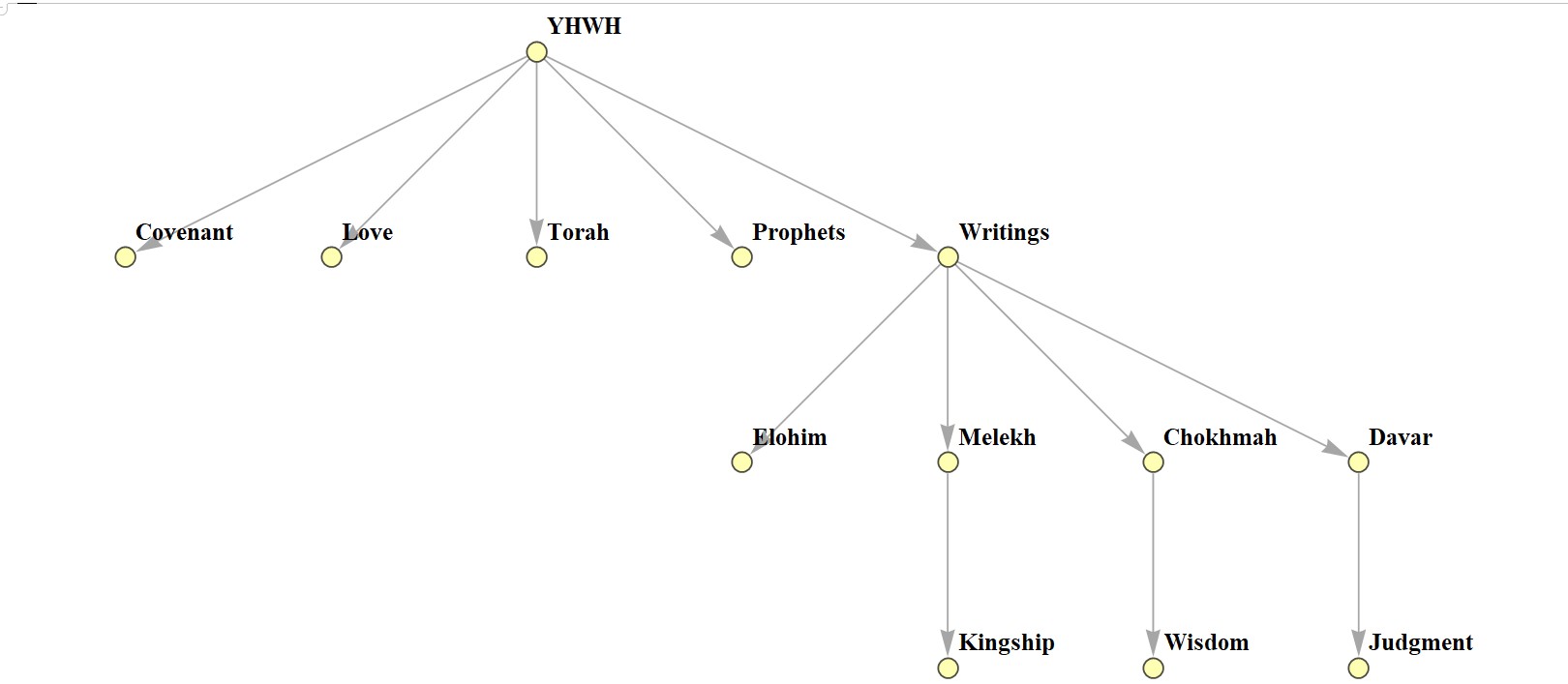
In the above cascade YHWH stands at the summit as the Covenantal root of Revelation.
From YHWH emerge branches into:
Covenant, Love (semantic fields[2])
Torah, Prophets, Writings (literary groupings)
Within Writings, we descend further into:
Elohim, Melekh, Chokhmah, Davar
And each of these seeds more semantic themes: Kingship, Wisdom, Judgment
This cascade reflects a God who speaks through structure—Covenant unfolds into Commandment, Wisdom blooms in poetry, Judgment echoes in Law and Story. It’s a descending canopy of meaning, rooted in sacred identity and blossoming through genre.
Figure 2. New Testament Lexical Cascade Rooted in TheoS.
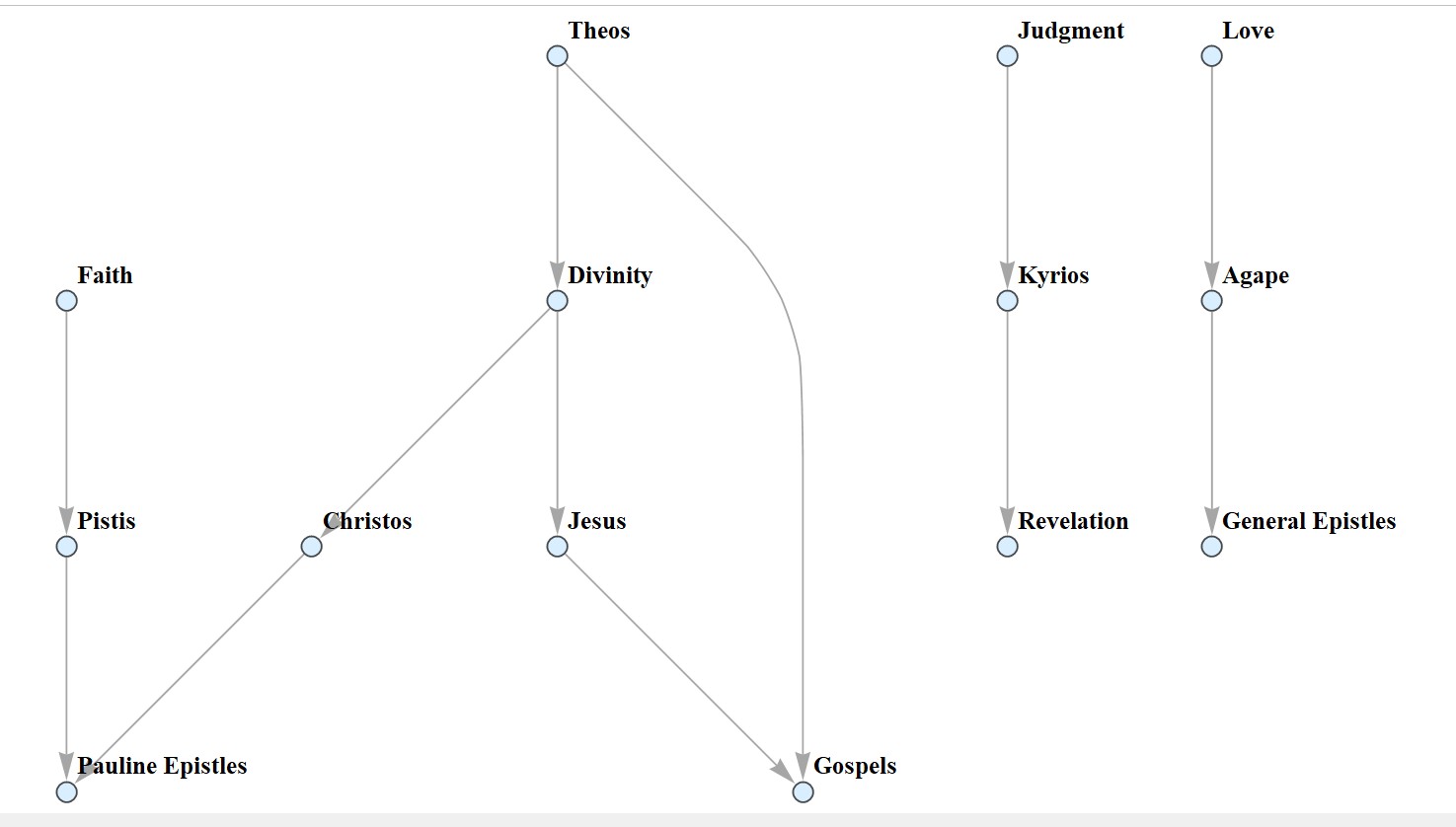
This NT lexical cascade quite mirrors the OT flow above, placing Theos | God at the summit, just as YHWH stands atop the OT structure. From Theos, the cascade flows downward through Divinity, echoing the semantic layer found in the OT’s Covenant and Love. One branch from Theos also drops directly into the Gospels, marking the incarnational descent without mediation—a theological through-line from divine source to narrative witness. This divinity unfolds into the embodied names Jesus and Christos, paralleling the OT’s movement into Melekh, Davar, and Chokhmah. Branching alongside are the great New Testament themes of Faith, Love, and Judgment—mapped to the Greek lemmas[3] Pistis, Agape, and Kyrios—which then flow into distinct literary expressions: Pauline Epistles, General Epistles, and Revelation, just as the Old Testament cascade descends into Torah, Prophets, and Writings. Together, these twin cascades depict a symmetrical “theology of descent”—from divine identity through thematic expression into canonical form. They are lexical liturgies, revealing how Scripture speaks across Testaments with mirrored breath.
Works Cited and References
Academic and Pastoral Tools by BibleHub.com and BlueLetterBible.org.
Easy access to Strong’s numbers and lemma counts across translations.
< https://biblehub.com/concordance/ >
< https://www.blueletterbible.org/help/BLBStrongs.cfm/ >
Brown-Driver-Briggs Hebrew and English Lexicon (BDB).
For semantic fields and nuances of Hebrew terms like YHWH, Davar, Melekh, Chokhmah.
< https://www.blueletterbible.org/resources/lexical/bdb.cfm/ >
BibleWorks / Accordance / Logos Bible Software.
Digital tagging and search capabilities for frequency analysis.
OT base text: Biblia Hebraica Stuttgartensia (BHS).
NT base text: Nestle-Aland 28th Edition (NA28) or SBL Greek NT.
< https://www.ligonier.org/posts/bibleworks-logos-and-accordance-a-comparison/ >
< https://timotheeminard.com/accordance-vs-logos-a-new-version-of-the-comparative-review/ >
Greek-English Lexicon of the New Testament and Early Christian Literature (BDAG).
Frequency-informed definitions of terms like Theos, Pistis, Logos, Agapē.
Microsoft Copilot AI Assistant.
June 2025.
Open Scriptures Hebrew Bible & MorphGNT Projects.
Open-source, machine-readable tagging for morph frequency comparison.
< https://hb.openscriptures.org/ >
< https://github.com/openscriptures/morphhb/ >
Strong’s Exhaustive Concordance of the Bible.
Frequency data for Hebrew and Greek root words.
Based on the King James Version, but widely used for morphological indexing.
< https://www.biblestudytools.com/concordances/strongs-exhaustive-concordance/ >
< https://biblehub.com/strongs.htm/ >
Tyndale House Scripture Tools (STEPBible).
Frequency data export and tagging of lexical occurrences.
< https://www.stepbible.org/ >
< https://academic.tyndalehouse.com/research/tools-and-links/ >
Wolfram Research Inc.
Mathematica.
Notes
[1] A note on the Methodology. The lexical cascades shown in the figures wasn’t imagined—it was discovered. Built on the foundation of the most frequently used content words in the Hebrew Old Testament and Greek New Testament, it excludes common function words (like articles, conjunctions, and prepositions —“glue words”) to reveal the core semantic heavy lifters of Scripture. From this frequency analysis, a striking pattern emerged: divine names—YHWH in Hebrew, Theos in Greek—appear not only as the most frequent terms, but as semantic origins from which themes like Covenant, Kingship, Faith, Love, and Judgment cascade naturally. These, in turn, root themselves in literary bodies—Torah, Gospels, Epistles, and beyond—forming a structure not imposed upon the text but unveiled by it. What began as a simple word count exercise became a “theology in descent,” where frequency revealed not just linguistic priority, but spiritual architecture between and throughout the Testaments. So the graphs in the figures are, if you will, “visual midrash” on that unfolding symmetry. It becomes clear therefore that even before interpretation begins, the biblical text speaks through its sheer lexical gravity. The most frequently used words—those spoken again and again by prophets, psalmists, apostles, and by Jesus Himself—form the “semantic load-bearing beams” of Scripture. When tallied and traced, these lexical patterns betray a divine design: not random repetition, but resonance. What rises to the top of the word count—names like YHWH and Theos, and themes like Covenant, Faith, Love, and Judgment—does so not merely as common language, but as canonical emphasis. And because frequency aligns with thematic centrality, the cascades one sees are more than charts—they are “semantic seismographs,” registering the theological pulse shared between the Testaments. In short, the more a word appears in Scripture, the louder its theological echo. Thus by following the most frequently used content words—stripped of grammatical noise—we find that the Old and New Testaments emphasize the same themes, often with nearly identical root words. What begins as a word count becomes a window into unity. (Be sure to read the blurb under the figures for cascade flow description.)
[2] Semantic fields are words that are related in meaning and revolve around a shared concept or domain—like a constellation of vocabulary orbiting a central theme.
[3] A lemma is essentially the “dictionary form” or root word of a term, used to group all its grammatical variations under a single entry. If the Bible were a symphony, lemmas are the musical motifs—one can hear them in different keys and rhythms, but they’re rooted in a shared theme.