
Introduction
Continuity with Chapter Eight
(See “John Chapter Eight Commentary”). John 8:59, the final verse of that chapter, flows directly into John 9:1 in most early manuscripts without interruption. Chapter eight closes with Jesus hidden from sight by divine concealment, slipping through the midst of His accuser-opponents and leaving the temple. That narrative motion continues seamlessly: “…and as He passed by, He saw a man blind from birth…” There’s no editorial pause, no change of setting in the Greek syntax—only a fluid transition from confrontation to compassion. Jesus is embroiled in conflict with the religious leaders, declares Himself the Light of the World (John 8:12), and then puts into motion His divine Light Being by giving sight to the blind (John 9:5–7). The participial phrase in John 9:1, KAI ARAGWN (“and passing by”), signals ongoing motion—Jesus is still moving within the narrative stream of chapter eight. There’s no syntactic reset, which supports the idea of continuous transmission. The theological continuity is equally fluid—and striking. Jesus had declared “I am the light of the world,” and repeats it in John 9:5, notably just before healing the blind man. That isn’t merely thematic—it’s theology in shoe leather. In chapter eight, Jesus speaks Light into moral darkness; in chapter nine, He embodies it, restoring both physical and spiritual sight—indeed, another kind of blindness is being addressed besides physical. In chapter eight, the Pharisees claim to “see” and understand the Law (Torah: Genesis 1:1ff–Deuteronomy 1:1ff), yet they reject the Truth upon which Torah is anchored. In chapter nine, the man born blind gains sight and progressively confesses Jesus as Lord, while the Pharisees are revealed as spiritually blind. Spiritually, this inversion is a recursive echo: those who claim vision are blind; those who admit blindness receive Light. Chapter eight ends with Jesus asserting His preexistence—“…Before Abraham was, I am…”—and nearly being stoned. Chapter nine culminates with Jesus revealing Himself as the Son of God to the healed man, in a moment of intimate recognition and worship. There’s also a striking continuity in the motif of divine interaction with the earth. In chapter eight, Jesus stoops to write in the dust, in chapter nine, He uses clay to heal the blind man—a Genesis echo; both scenes involve the divine hand in the dust, suggesting re-creation and judgment. The Pool of Siloam (Siloam means “Sent”) presents another continuing theological thread. It reinforces Jesus’ repeated claims in chapter eight that He was “sent” by the Father. The healed man becomes a living metaphor of “sentness”—awakened, washed, and testifying.
So, while chapter eight is dialogic and confrontational, chapter nine is dramatic and testimonial. Yet both modulate around the same axis: Who truly sees? Who truly knows? Who truly belongs?
The Scaffolding
Our chapter opens not with a teaching, but with a touch. A man blind from birth becomes the canvas upon which Jesus paints His claim from the previous chapter: “…I am the Light of the World…” This is no abstract metaphor. The Light now moves—stoops, spits, shapes clay, and sends—the declaration of chapter eight finds its incarnation in chapter nine. The man’s blindness is not incidental. It is congenital, symbolic, and narratively loaded. He has never seen light, never glimpsed form or color. His condition mirrors the spiritual state of humankind—born into darkness, unable to perceive the divine unless illuminated from without. In this way of thinking, Jesus’ healing is not merely medical, it is theological, it is the manifestation of the “works of God…”, a phrase that signals divine agency breaking into human limitation. The urgency of Jesus’ statement—“…must work the works of him that sent me, while it is day…”—frames the healing as a moment of divine necessity. The “day” is not just time; it is Presence: Jesus, the Incarnate Light, is still in the world. But “night cometh”—a symbolic dusk when the embodied works will pause (No Jesus, no Spirit), and no man can replicate them. The healing, then, is a last flare of clarity before the coming shadow (Pentecost do come quickly). And the pool of Siloam—“Sent”—is no mere location. It is a recursive echo of Jesus’ own identity as the One sent by the Father. The man is sent to “Sent,” to receive sight, just as Jesus is sent to give it. (Notice how the narrative folds in on itself, layering symbol upon symbol).
So, the man who once sat in darkness—like we all— now walks in Light and speaks with growing clarity— not like we all—even as the religious “elite” descend into growing denial. The Light does not flatter, it reveals, divides, and ultimately judges. It exposes the blindness of those who claim to see, while illuminating the path for those who confess their need. In this healed man, Light becomes testimony; in the Pharisees, it becomes indictment.
We will primarily be focusing on the movement, the action—verbs—in this commentary, so this note[1] may be helpful.
We will follow this format:
Verse of Scripture utilizing the KJV text followed by an NKJV mouse- over of that verse. Key words in the KJV text will be footnoted with a link to a word study based on the Greek text, and/or a general discussion relative to the given word.
Commentary We shall always be commenting on this passage keeping before us the crucial fact that every jot and every tittle comprising these verses came forth under the inspiration of the blessed Holy Spirit. We pray that He, by His grace, helps us along the way.
John Chapter Nine Commentary Verses
9:1-5-Seeing Differently: Reframing Suffering
(John 9:1-5 KJV) 1 And as [Jesus] [2] passed by[3], he saw[4] a man which was blind from [his] birth[5]. 2 And his disciples[6] asked[7] him, saying[8], Master[9], who did sin[10], this man, or his parents, that he was born[11] blind? 3 Jesus answered[12], Neither hath this man sinned[13], nor his parents: but that the works[14] of God should be made manifest[15] in him. 4 I must[16] work[17] the works of him that sent[18] me, while it is day[19]: the night[20] cometh[21], when no man can work[22]. 5 As long as I am in the world, I am the light of the world[23]. (John 9:1-5 NLT)
Commentary: Who messed up? Was it this blind man? His parents? Can the reader feel how the disciples are trying to make sense of suffering the way most of us do—by tracing it to a mistake? It’s a “tidy” little theology isn’t it: bad things happen because someone did something wrong… But Jesus doesn’t play the blame game uh uh. He’s not interested in assigning blame. He’s about to show them—and us—that sometimes the darkness isn’t punishment. Sometimes, it’s preparation.
And as Jesus passed by, he saw a man which was blind from his birth. And his disciples asked him, saying, Master, who did sin, this man, or his parents, that he was born blind?
Jesus flips the whole conversation: “…This happened so that the works of God might be displayed in him…” Huh? The blindness isn’t a curse or some cause and effect after all? That’s right. It’s not about Guilt right here in this context, it’s about Glory. Jesus is saying, “…Watch and be amazed, watch what God can do with this…” He wants us to stop asking Why? and start asking What Now? That is, what might God be up to in this space and in the spaces we’ve written off? Okay, fine, we can go with that, but let’s try to assemble it and feel it from the sufferer’s perspective. Even though Jesus reframes the man’s blindness as a stage for God’s glory, that’s not how it feels in the moment, in his moments. Real-time suffering just flat out doesn’t come with a “divine footnote.” You know, we don’t get a pop-up that says, “…Dear saint so and so, this will be used for good, hang in there beloved of God…” We just get the ache, the confusion, the waiting. But isn’t that what makes Jesus’ response so radical here? He doesn’t just correct the disciples’ theology—he interrupts their instinct to explain. He says, in effect, “…Don’t look backward for blame, look forward for beauty…” But for the man born blind? He’s lived his whole life in the dark. He didn’t know he was a stage. He didn’t know he was part of a story that would be told for centuries. That’s the tension we live in: glory is often retrospective, we see it after the fact. In the moment, often very long moments, it’s mystery, and usually not a whole lot of fun. But Jesus meets us there friend—not with answers always, but with Presence. He “touches the dirt,” He enters our story and says to us “…Dearest saint so and so, let’s begin this journey together all the way through even, what do you say, shall we begin, hand in hand?…”
Jesus answered, Neither hath this man sinned, nor his parents: but that the works of God should be made manifest in him.
See how the Master of Practicality gets very practical: “…I [we so some] must do the works of Him who sent me while it is day…” There’s a sense of “holy hustle” here. Right now, in this moment, the Light is still on, the window is still open, and Jesus is saying, “…Let’s get busy, let’s move beloved…” He’s not just talking about bringing Light to this man—He’s talking about every moment we’re given to bring light, even Light, into someone’s Darkness. But then comes the warning: “…Night is coming…” There’s a Pause ahead. A time when the Work will stop. Our Lord knows His time is short, very short. Ahead lies a stretch of silence, a time when the Light will seem gone and the works will stall. It’s not forever, but it’s real. Jesus is leveling with His hearers, He’s saying in effect, “…There’s a window right now. Let’s use it…” Because the Cross is coming, the Tomb is looming. And for a little while, it will feel like the Story’s gone Dark. But even in that Pause, God is not absent, He’s just preparing the next chapter. Pentecost is on the horizon, the Light will rise again. But for now, in this moment, in context? Jesus is modeling what it looks like to live with Purpose: no panic. no pressure, just Radiant Presence—Jesus Himself, manifestly so—as the Anchor in the Ache, the Calm in the Chaos, the Clarity in the Conundrum, the Wisdom in the Work, the One who moves with intention, not anxiety.
I must work the works of him that sent me, while it is day: the night cometh, when no man can work. As long as I am in the world, I am the light of the world.
9:6-7-Mud and Motion: Holding Back the Night
(John 9:6-7 KJV) 6 When he had thus spoken[24], he spat[25] on the ground, and made[26] clay[27] of the spittle, and he anointed[28] the eyes of the blind man with the clay, 7 And said[29] unto him, Go[30], wash[31] in the pool of Siloam[32], (which is by interpretation, Sent.) He went[33] his way therefore, and washed[34], and came seeing[35]. (John 9:6-7 NLT)
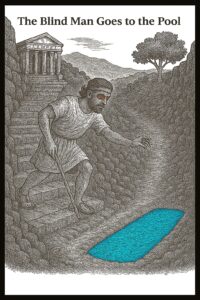
Commentary: Dirt, spit, and touch—that right there ain’t your average healing technique. It’s earthy, it’s different. But O my is it ever intimate. And then Jesus says, “…Go, wash in the Pool of Siloam…” That’s it! No explanation. No promise. No nothing. Just a command and a direction. And the man goes. He doesn’t argue, he doesn’t ask for details, he doesn’t even know who Jesus is. But he flat moves, somehow, groping, feeling his way. Then he washes, and O my he comes back seeing. This moment is all about faith, Faith in Motion (Fig. 1). Jesus doesn’t just heal here—He gives the man a part to play, and the man, still blind, gropes his way toward Hope. That’s faith, faith in motion. It’s not flashy, just careful, hopeful steps in the direction of Light. The night is being held back here—by the sheer fact that Jesus, the Light, is still here. The Light hasn’t left yet. He’s present, active, touching the dirt, holding back the night. While He’s in the world, the night waits its turn.
When he had thus spoken , he spat on the ground, and made clay of the spittle, and he anointed the eyes of the blind man with the clay, And said unto him, Go, wash in the pool of Siloam, (which is by interpretation, Sent.) He went his way therefore, and washed, and came seeing.
9:8-12-Clay, Clarity, and Community Confusion
(John 9:8-12 KJV) 8 The neighbours[36] therefore, and they which before had seen[37] him that he was blind, said[38], Is not this he that sat and begged[39]? 9 Some said[40], This is he: others [said], He is like him: [but] he said[41], I am [he]. 10 Therefore said[42] they unto him, How were thine eyes opened[43]? 11 He answered[44] and said[45], A man that is called[46] Jesus[47] made clay, and anointed mine eyes, and said unto me, Go to the pool of Siloam, and wash: and I went and washed, and I received[48] sight. 12 Then said[49] they unto him, Where is he? He said[50], I know[51] not. (John 9:8-12 NLT)
Commentary: So the man comes back seeing, and suddenly the neighborhood is buzzing. Folks that done been walkin’ past him for years—maybe even stepped over him—start whispering: “’…Looky here, isn’t this the guy who used to sit and beg?…” Some say “…yup…” Others aren’t so sure. “…Nah, it just looks like that feller….” And the man? He doesn’t launch into a speech, he doesn’t try to prove anything, he simply says, “…I am [he]…” (EGW EIMI “I am” in the Greek.) That’s it, two little words, but they pack a “testimony-punch.” It’s all about recognition and resistance in this here moment. The neighbors are trying to fit a miracle into their old categories—ain’t gonna’ work—the man’s transformation flat doesn’t fit. It’s not just about sight here, it’s about identity: he’s not just the guy who used to beg, he’s the guy who’s been touched by Jesus, and that changes everything. He’s not the same dude, and he knows it, senses it, beyond being able to physically see. “…It’s me folks, the new me, I am [he]…”
The neighbours therefore, and they which before had seen him that he was blind, said, Is not this he that sat and begged? Some said, This is he others said, He is like him: but he said, I am he.
The neighbors are still trying to make sense of it all. “…How then were your eyes opened?…” It’s the natural question, right? People want the method, the mechanism, the play-by-play scoop. They want to know how the impossible just happened on their street. And the man? He doesn’t give a theology lecture, he doesn’t speculate, he just tells the story straight up: “…a man called Jesus made mud [note he names Jesus], put it on my eyes, told me to go wash, and I did. And now I see…” That’s it. No French pastry, no drama, just a simple, honest account of Grace in Motion. And when they ask, “…Where is he?…” he shrugs his shoulders and says, “…don’t know ya’ll…” He really doesn’t know. But he for sure knows what happened. How could he not? He flat out knows what changed bigtime. And that’s enough to start telling the story, which is the beginning of Testimony—not polished, not complete, but very real. It’s what happens when someone’s life gets touched by Jesus and they start speaking from experience, not expertise. And maybe that’s the thing here: we don’t have to know everything to say something. We don’t have to have it all figured out to point to the Light. Sometimes, “…don’t know ya’ll…” is the most honest and holy thing we can say—especially when it’s followed by, “…But I was blind, and now I see…”
Therefore said they unto him, How were thine eyes opened? He answered and said, A man that is called Jesus made clay, and anointed mine eyes, and said unto me, Go to the pool of Siloam, and wash: and I went and washed, and I received sight. Then said they unto him, Where is he? He said, I know not.
9:13-17-From Healing to Hearing
(John 9:13-17 KJV) 13 They brought[52] to the Pharisees[53] him that aforetime was[54] blind. 14 And it was the sabbath[55] day when Jesus made the clay, and opened his eyes. 15 Then again the Pharisees also asked[56] him how he had received his sight. He said[57] unto them, He put clay upon mine eyes, and I washed, and do see. 16 Therefore said[58] some[59] of the Pharisees, This man is not of God, because he keepeth[60] not the sabbath day. Others said, How can a man that is a sinner do[61] such miracles? And there was a division[62] among them. 17 They say[63] unto the blind man again, What sayest[64] thou of him, that he hath opened[65] thine eyes? He said[66], He is a prophet[67]. (John 9:13-17 NLT)
Commentary: Enter the Pharisees; the man’s neighbors bring him to the Pharisees. Why? Various reasons no doubt, but brown-nosing and gaining favor seem most likely—after all, the man mentioned Jesus whom the Pharisees revile and target. Maybe they just don’t know what to do with a miracle that doesn’t fit their categories. Either way, they hand him off to the religious “gatekeepers.” And here’s the kicker: it’s a Sabbath. Cue the tension and watch it escalate from here. Jesus healed on the “wrong” day, again (!) And not just healed—He made mud. That’s work according to their centuries-long outworking of what it means to honor Shabbat. It’s a violation of Sabbath Law in their estimation, and that’s a problem for people who’ve built their faith around rules and rhythms more than Relationship. So, the Pharisees ask the man how it happened, and he tells them, just like he told the neighbors with one very important exception: “…He put mud on my eyes, I washed, and now I see…” Note that the man uses “he” and not “Jesus” this time—that’s how the manuscripts have it. Jesus may be understood here, but the omission feels intentional. We’ll hit this again and complete the thought in the “Strategic Silence” section below. Anyway, his response is simple, honest, flat undeniable. But here’s the thing: when you’re committed to control, even a miracle can feel like a threat. The man’s story is clear, but the Pharisees are already looking for a way to discredit it. They’re more focused on the mud than the mercy. And maybe that’s the not so quiet warning here: when we get too caught up in protecting our systems, we risk missing the Savior standing right in front of us—mud still on His hands, Light still in His eyes.
They brought to the Pharisees him that aforetime was blind. And it was the sabbath day when Jesus made the clay, and opened his eyes. Then again the Pharisees also asked him how he had received his sight. He said unto them, He put clay upon mine eyes, and I washed, and do see.
The Pharisees, stuck in Shabbat, start arguing among themselves, and just like that, the room splits. It’s getting ugly for them. Not because of the miracle per se—but because the miracle doesn’t fit. Jesus is messing with their centuries-old categories, and they don’t like it. The Light is shining, inconveniently here, it’s exposing more than they’re ready to see. So, they turn to the healed man again looking for a crack, a toehold, anything by which to douse this very inconvenient Light. And here’s the moment: the man speaks up. “…He is a prophet…” That’s pretty bold, and brave. It’s the beginning of clarity. He doesn’t have a full theology yet, he doesn’t know everything, but he knows this: something holy happened. And the One who touched him…isn’t ordinary. This is the first time the man starts to name-associate what he’s experienced (some man called Jesus<>prophet). He’s not just healed—he’s awakening. And while the religious leaders are busy debating, dismissing, and dividing, the man is starting to see more than just the world around him—He’s starting to see Jesus as more than “some” man.
Therefore said some of the Pharisees, This man is not of God, because he keepeth not the sabbath day. Others said, How can a man that is a sinner do such miracles? And there was a division among them. They say unto the blind man again, What sayest thou of him, that he hath opened thine eyes? He said, He is a prophet.
9:18-23-Strategic Silence
(John 9:18-23 KJV) 18 But the Jews did not believe[68] concerning him, that he had been blind, and received his sight, until they called[69] the parents of him that had received his sight. 19 And they asked them, saying[70], Is this your son, who ye say[71] was born[72] blind? how then doth he now see[73]? 20 His parents answered[74] them and said, We know[75] that this is our son, and that he was born[76] blind: 21 But by what means he now seeth[77], we know[78] not; or who hath opened his eyes, we know not: he is of age; ask[79] him: he shall speak[80] for himself. 22 These [words] spake[81] his parents, because they feared[82] the Jews: for the Jews had agreed[83] already, that if any man did confess[84] that he was Christ, he should be[85] put out of the synagogue. 23 Therefore said his parents, He is of age; ask him. (John 9:18-23 NLT)
Commentary: Now the Pharisees are really grasping. They still don’t believe the man was blind to begin with, so they call in his parents. And the parents, as one would expect, confirm the basics: “…Yes, he’s our son, check. Yes, he was born blind, check…” The checked boxes turned the tide somewhat apparently “…until they called the parents…” But when asked how he now sees, his parents freeze—that box ain’t gettin’ checked. They punt. “…Ask him, he’s of age. He can speak for himself…” Why the dodge? Because they’re afraid. This too is why the healed man did not outright mention Jesus to the Pharisees as mentioned above—fear. A healing like his carried with it Messianic implication, and the religious leaders had already made it clear that anyone who confessed Jesus as Messiah would be thrown out of the synagogue. That’s not just losing a seat in church, that’s losing your place in the community, it’s losing your social circle, your spiritual home, your very identity. So the parents play it safe essentially. They tell the truth, but not the whole truth. They protect themselves, even if it means leaving their son to stand alone. His parents punt, but what’s he gonna’ do when sore pressed? Hung out to dry… That’s the sore ache in this moment: sometimes the people closest to us don’t stand with us when the pressure hits. Sometimes fear wins. But even then, Jesus doesn’t leave us, He’s still near, still working. still holding back the night.
But the Jews did not believe concerning him, that he had been blind, and received his sight, until they called the parents of him that had received his sight. And they asked them, saying, Is this your son, who ye say was born blind? how then doth he now see? His parents answered them and said, We know that this is our son, and that he was born blind But by what means he now seeth, we know not; or who hath opened his eyes, we know not: he is of age; ask him: he shall speak for himself. These words spake his parents, because they feared the Jews: for the Jews had agreed already, that if any man did confess that he was Christ, he should be put out of the synagogue. Therefore said his parents, He is of age; ask him.
9:24-34- Speaking Truth to Power (PARRHSIA)
(John 9:24-34 KJV) 24 Then again called[86] they the man that was blind, and said[87] unto him, Give God the praise:[88] we know[89] that this man is a sinner. 25 He answered and said[90], Whether he be a sinner [or no], I know[91] not: one thing I know[92], that, whereas I was[93] blind, now I see[94]. 26 Then said[95] they to him again, What did he to thee? how opened he thine eyes? 27 He answered[96] them, I have told[97] you already, and ye did not hear[98]: wherefore would ye hear [it] again[99]? will[100] ye also be his disciples? 28 Then they reviled[101] him, and said[102], Thou art his disciple; but we are[103] Moses’ disciples. 29 We know[104] that God[105] spake[106] unto Moses[107]: [as for] this [fellow], we know not from whence heis. 30 The man answered and said unto them, Why herein is a marvellous thing, that ye know not from whence he is, and [yet] he hath opened mine eyes[108]. 31 Now we know that God heareth[109] not sinners: but if any man be a worshipper of God, and doeth his will, him he heareth. 32 Since the world began was it not heard[110] that any man opened the eyes of one that was born blind. 33 If this man were not of God, he could do[111] nothing. 34 They answered and said[112] unto him, Thou wast altogether born[113] in sins, and dost thou teach[114] us? And they cast[115] him out. (John 9:24-34 NLT)
Commentary: So the Pharisees call (nay, more like summon—it’s an aorist EFWNHSAN) the man back in. Yup—again. This time, it’s not curiosity—it’s confrontation. They’ve made up their minds about Jesus: “…Give God the praise, we know that this man is a sinner…” Translation: “…Say what we want to hear…” But this cool cat no doubt toughened inside and out from years of struggling to survive flat doesn’t flinch. He doesn’t theologize, doesn’t argue, he just drops one of the most powerful lines in all of Scripture: “…Whether He is a sinner, I do not know. One thing I do know: that though I was blind, now I see…” That’s his Sermon, it’s his Testimony. That’s the kind of clarity that cuts through all the funk. He’s not trying to win a debate, he’s just telling the truth and the truth is undeniable. This is the moment where his voice starts to rise. He’s not just healed—he’s becoming bold. And while the religious leaders are stuck in their brand of “certainty,” our man of the hour here is standing in his experience. He doesn’t know everything, but he for sure knows what happened, and that’s more than enough. After experiencing the transformation that he did, he couldn’t be pried off that truth with a crowbar. Could you beloved reader if you were in his Birkenstocks?
Then again called they the man that was blind, and said unto him, Give God the praise: we know that this man is a sinner. He answered and said, Whether he be a sinner or no, I know not: one thing I know, that, whereas I was blind, now I see.
The Pharisees aren’t done. They press in harder: “…What did He do to you? How did He open your eyes?…” It’s almost comical—they’ve already heard the story. Twice. But they’re not looking for Truth, they’re looking for a loophole. And our man, well, he be done playin’ nice. “…I already told you and you didn’t listen. Why do you want to hear it again? Do you want to become His disciples too?…” Boom, that lands like a solid left hook. It’s not just sarcasm—it’s holy defiance. Our man is starting to see more than just the world around him. He’s seeing the spiritual landscape. He’s seeing the fear, the pride, the resistance. And he’s not afraid to call it out. Of course the Pharisees punch back: “…You’re His disciple, but we are disciples of Moses..” They’re clinging to credentials, to Tradition, to the old framework. “…We know God spoke to Moses But as for this fellow—we don’t even know where He comes from…” And there it is: the admission, did you catch it beloved reader? They don’t know! They claim certainty, but they’re standing in confusion. The Light is shining, and it’s exposing the cracks in their control. This moment is about spiritual clarity—not from the scholars, but from the formerly blind man. He’s seeing more clearly than they are. And the more they push, the firmer this cool cat stands.
Then said they to him again, What did he to thee? how opened he thine eyes? He answered them, I have told you already, and ye did not hear: wherefore would ye hear it again? will ye also be his disciples? Then they reviled him, and said, Thou art his disciple; but we are Moses’ disciples. We know that God spake unto Moses: as for this fellow, we know not from whence he is.
“…Now that is remarkable! You don’t know where He comes from, yet He opened my eyes…” Another thunderclap, boom. That’s not just a rebuttal—it’s a Sermon. He’s not quoting Scripture, he’s not citing rabbinic tradition, he’s flat out testifying. And his clarity is cutting through their confusion like sunlight through fog. Hear him: “…We know that God doesn’t listen to sinners. He listens to the Godly person who does His will. Nobody has ever heard of opening the eyes of a man born blind. If this man were not from God, He could do nothing…” That is spiritual logic, not theological gymnastics. It’s simple, piercing, and undeniable. And the irony is that the Pharisees, the ones, notice please—trained to interpret miracles—are stumped. But why? Tradition. Meanwhile, this formerly blind man—no credentials, no training—is preaching Truth with Power. Nay, not just that, he’s preaching Truth to Power. All-in-for-Christ preachers preach that way–fearlessly. He’s seeing more than ever, not just physically, but spiritually. He’s connecting the dots. He’s standing in the Light. And he’s not backing down nope—it’s called “The Jesus Touch.” Ya’ either got it by His grace, or ya’ don’t and our man here done flat got it. This here moment is a crescendo of clarity, really. Our man’s voice is rising—up, up, up—and the gap between him and the Pharisees down yonder is widening. He’s walking then sprinting into Truth, they’re retreating into Spiritual Pride.
The man answered and said unto them, Why herein is a marvellous thing, that ye know not from whence he is, and yet he hath opened mine eyes. Now we know that God heareth not sinners: but if any man be a worshipper of God, and doeth his will, him he heareth. Since the world began was it not heard that any man opened the eyes of one that was born blind. If this man were not of God, he could do nothing.
“…You were steeped in sin at birth; how dare you lecture us!…” And they threw him out. There it is. The backlash. Our man’s clarity was too much, his testimony too sharp, his Jesus Touch-courage too convicting. So they did what threatened power always does when it gets a good talkin’ to by Truth: shame, silence, eject. “…You were steeped in sin at birth…” Ouch, it hurts even to read it. That’s not theology, it’s deflection, it’s spiritual bullying dressed up as righteousness. “…How dare you unlearned plebian lecture us…” Translation: “…We don’t want to hear Truth from someone beneath us…” And then, after the shaming, of course, the bounce—excommunication. Not just from the synagogue, but from the social and spiritual center of his world. He’s cast out. But here’s the deeper irony: they think they’re protecting holiness by removing him, in reality, they’re pushing him closer to Jesus. This is the cost of clarity—it costs the proud their illusion; but it’s also the cost of standing in the Light—the boot, rejection, but gained intimacy with Jesus. So, the healed man is now rejected, but he’s not alone. The next verse will show us that Jesus comes looking for him.
They answered and said unto him, Thou wast altogether born in sins, and dost thou teach us? And they cast him out.
9:35-41-From Physical Restoration to Spiritual Resonance
(John 9:35-41 KJV) 35 Jesus heard[116] that they had cast him out; and when he had found[117] him, he said[118] unto him, Dost thou believe[119] on the Son of God[120]? 36 He answered and said[121], Who is he, Lord[122], that I might believe[123] on him? 37 And Jesus said[124] unto him, Thou hast both seen him, and it is he that talketh[125] with thee. 38 And he said, Lord, I believe[126]. And he worshipped[127] him. 39 And Jesus said, For judgment[128] I am come into this world, that they which see not might see[129]; and that they which see might be made blind[130]. 40 And [some] of the Pharisees which were with him heard[131] these words, and said[132] unto him, Are we blind also? 41 Jesus said unto them, If ye were[133] blind, ye should have[134] no sin: but now ye say, We see[135]; therefore your sin remaineth[136]. (John 9:35-41NLT)
Commentary: The healed man has been thrown out on his ear, bounced—discarded by the very system that should’ve celebrated his healing—and when Jesus “hears” about it, what does He do? He goes a huntin’. That’s more than just Compassion, it’s Pursuit—the Shepherd doesn’t wait for the lost to find their way back (Luke 15:4-5). And when He finds him, He doesn’t start with doctrine or defense, He asks him a question that cuts straight to his soul: “…Do you believe on the Son of God?…” (The Greek has it SU PISTEUEIS EIS TON hUION TOU QEOU.) That’s not a pop quiz—it’s an invitation (“A Letter of Invitation”). And the man, with a soul still adjusting to the Light, responds with raw openness: “…Who is he, sir? Tell me so that I may believe…” No pretense, just hunger. Jesus’ response is a stunning affirmation of deity: “…You have now seen him; in fact, he is the one speaking with you…” Wow. This man, who once sat in darkness, now sees the Light of the World—face-to-face. And it’s not just physical sight—it’s spiritual, spiritual recognition, it’s Revelation wrapped in face-to-face Relationship. In turn, this blessed man’s response is simple but soul-rattling— hear him friend, picture the one-on-one scene: “…Lord, I believe…” And he worships. So, his healing led to encounter, and encounter led to white-flag surrender. It’s a microcosm of the Gospel per se: external rejection (or internal rebellion) >> hot pursuit>> revelation>> worship.
Jesus heard that they had cast him out; and when he had found him, he said unto him, Dost thou believe on the Son of God? He answered and said, Who is he, Lord, that I might believe on him? And Jesus said unto him, Thou hast both seen him, and it is he that talketh with thee. And he said, Lord, I believe. And he worshipped him.
Jesus segues from the man’s worship to the watching crowd, and we can hear His tone sharpen dramatically. “…For judgment I have come into this world—not to condemn arbitrarily, but to reveal what’s hidden. The light exposes. Those who know they’re blind can be healed. But those who insist they already see remain in darkness…” The Pharisees, ears laid back, foam at the mouth: “…Are we blind too?…” It’s not a question of course, it’s a defense. They clearly feel the sting here, but won’t admit the wound. Jesus responds with piercing clarity: “…If you were blind, you would not be guilty. But now that you claim you can see, your guilt remains…” This is the paradox of spiritual sight: humility opens the eyes; pride seals them shut. The man born blind saw more clearly than the religious elite—not at all because he had answers, but because he had humble openness—his belief system could flex, it wasn’t brittle per insistent adherence to long-standing, super-added, Tradition. Accordingly, he “saw” the Son of God engaging him. The Pharisees, holding tight-fisted to a brittle, rigid belief system that couldn’t flex per centuries of superadded Tradition, missed the Son of God, even Messiah, standing right in front of them precisely because He didn’t fit into, nay, more, wasn’t allowed into their rigid categories. And Messiah they dearly sought, and their kin in spirit continue to seek, guided by that same rigid old framework (John 8:21—they sought, they seek, they find not, and die in their sins, very sad). Of all the heartbreaks much beloved Israel has endured, this—missing their Messiah—is the most tragic. It’s hard to comprehend because they are God’s beloved covenant People. But the invitation remains, even now, for any who would surrender—not to a system, but to Him, Jesus. (“A Letter of Invitation”). Our Lord doesn’t shame blindness—He heals it. But He confronts the kind of spiritual arrogance that refuses help. And so, the man who was cast out ends up inside the Kingdom. The ones who thought they were gatekeepers find themselves outside, outside the Gate, even the Kingdom.
And Jesus said, For judgment I am come into this world, that they which see not might see; and that they which see might be made blind. And some of the Pharisees which were with him heard these words, and said unto him, Are we blind also? Jesus said unto them, If ye were blind, ye should have no sin: but now ye say, We see; therefore your sin remaineth.
Praised be your great Name in all the earth, Yeshua HaMashiach. Amen.
Illustrations and Tables
Figure 1. A Journey of Faith.
Works Cited and References
“A Letter of Invitation.”
Jesus, Amen.
< http://jesusamen.org/aletterofinvitation.html >
“Did Jesus Take the Fifth Amendment?”
Bible.org.
< https://bible.org/seriespage/41-did-jesus-take-fifth-amendment-john-1812-27 >
“Gihon Spring.”
IraelJerusalem.com.
< https://www.israeljerusalem.com/gihon-spring.htm >
Henry, Matthew.
Commentary on John Chapter Nine.
“Jesus.”
ExplainingTheBible.com
< https://explainingthebible.com/bible-verses-about-who-jesus-is-2/ >
“John Chapter Eight Commentary.”
Jesus, Amen.
< https://development.jesusamen.org/commentary-john8/ >
“Malachot: The 39 Malachot.”
Chabad.org.
< https://www.chabad.org/library/article_cdo/aid/102032/jewish/The-39-Melachot.htm >
Metzger, Bruce M.
A Textual Commentary on the Greek New Testament, 2nd ed.
Stuttgart: Deutsche Bibelgesellschaft, 1994, p. 224.
Microsoft.
Copilot AI Assistant.
September 2025.
“Moses.”
Wikipedia.
< https://en.wikipedia.org/wiki/Moses >
“Siloam Pool.”
Wikipedia.
< https://en.wikipedia.org/wiki/Pool_of_Siloam >
“Siloam Pool Excavation.”
Biblical Archaeology.
< https://biblical-archaeology.org/en/publications/excavation-of-the-entire-siloam-pool-begins/ >
“Siloam Pool in the Bible.”
Christianity.com.
< https://www.christianity.com/wiki/bible/what-is-the-pool-of-siloam-in-the-bible.html >
“The Fifth Amendment.”
ConstitutionAnnotated.
< https://constitution.congress.gov/browse/amendment-5/ >
Notes (the immediate context is bracketed [])
[1] Greek and English tenses, voices, and moods often have similar functions, but they don’t always correlate directly.
Tense
Greek: Greek tenses like aorist, present, and imperfect convey not only time but also aspect (the type of action, such as simple, continuous, or completed).
English: English tenses primarily focus on time (past, present, future) and sometimes aspect (simple, progressive, perfect), but they are generally less nuanced than Greek tenses.
Voice
Greek: Greek has three voices: active, middle, and passive. The middle voice, which can indicate reflexive or reciprocal action, is not always present in English.
English: English mainly uses active and passive voices. The concept of the middle voice is often conveyed through reflexive pronouns—formed by adding “self”—e.g., myself, herself, himself, itself, etc. (‘…she looked at herself in the mirror…’) or through context.
Mood
Greek: Greek moods include indicative (statement of fact—primary use, direct questions—less often), subjunctive (potential or hypothetical), optative (wish or potential—found largely in classical Greek texts dating from 9th-6th century BC, rare in biblical Greek), and imperative (command).
English: English moods include indicative (statement of fact—primary use, direct questions—less often), subjunctive (used less frequently, often in hypothetical or wishful contexts), and imperative (command).
So, while there are similarities, Greek is grammatically richer, i.e., much more nuanced, especially in expressing aspect and voice. English tends to focus more on the time of the action and less on its nature or aspect, which in a sense is like removing constraints, adding freedom of expression when cleverly exploited. Because English has less nuanced grammatical vehicles compared to Greek, it often requires more thought, that is, careful construction and additional context, to convey certain meanings that Greek can express more succinctly and precisely. It is generally true that English, with its straightforward grammar and more non-granular flexibility, often lends itself well to inductive reasoning, moving from specific observations to broader generalizations. Its structure encourages clear, top-level expression that builds up to conclusions (top level expression= precisely hitting the salient points without intricate detail; concise, impactful, linguistically efficient). Conversely, Greek, with its rich grammatical nuances, is more suited for deductive reasoning, moving from general principles to specific details. This detailed and precise language allows for intricate and layered assembly of thoughts and arguments, making it the scientist’s dream language (it’s not an accident that many of the earliest and most influential mathematicians and scientists and philosophers were Greek, their language, with its rich grammatical nuances and precision, provided a robust framework for detailed and systematic thinking). English on the other hand is the storyteller’s stage. English’s versatility and expressiveness allow for a broad and dynamic range of communication, making it perfect for narratives, theoretical expression, and creativity per se. Its top-level expression, non-granular versatility, and its historical and economic influences, cultural impact, and widespread teaching have all contributed to its status as the world’s lingua franca presently.
[2] [And as] Jesus [passed by, he saw a man which was blind from his birth. And his disciples asked him, saying, Master, who did sin, this man, or his parents, that he was born blind? Jesus answered, Neither hath this man sinned, nor his parents: but that the works of God should be made manifest in him. I must work the works of him that sent me, while it is day: the night cometh, when no man can work. As long as I am in the world, I am the light of the world.>>> Centerpiece of Scripture, Friend, Helper, Redeemer, Savior, Son of God… See also.
[3] [And as Jesus] passed by-G3855 [he saw a man which was blind from his birth. And his disciples asked him, saying, Master, who did sin, this man, or his parents, that he was born blind? Jesus answered, Neither hath this man sinned, nor his parents: but that the works of God should be made manifest in him. I must work the works of him that sent me, while it is day: the night cometh, when no man can work. As long as I am in the world, I am the light of the world.]>>> Verbal usage is present, active, participle. The present tense participle conveys ongoing, durative action—not a completed event, but one unfolding in real time. The active voice shows Jesus Himself is the agent of motion, not being moved or led. And as a circumstantial participle, it sets the scene: “…As He was passing by…” It’s not a static snapshot but a pivot—Jesus is in motion, and the participle wants us to walk with Him, not just observe Him. This participle PARAGWN links directly to the end of John 8:59, where Jesus “…went out of the temple…” It bridges these chapters, showing us that Jesus’ departure from conflict led immediately into compassionate action. The verb is a transitional one, but not transitional in the sense of “moving on”—rather, it’s transitional in mission. Jesus moves from being rejected by the religious “elite” to engaging the marginalized. The present participle implies intentional availability, Jesus doesn’t stumble upon the blind man, He sees him as He is passing by. The motion is purposeful, and the encounter is providential. It echoes the Light motif: Jesus, the Light of the World, is not stationary—He moves through darkness, revealing and healing as He goes. The participle also carries a missional undertone, Jesus is not retreating from danger, He is advancing toward Need. In this way the verb becomes a symbol of divine initiative—grace in transit. Chapter 8 ends with Jesus nearly stoned for declaring “…Before Abraham was, I am…” Chapter 9 begins with this PARAGWN—He is still moving, still revealing, still working the works of Him who sent Him. Jesus is never static. Even rejection cannot arrest His mission. He passes by—and in passing, He sees—we may take that to be the case generally. The Grammar suggests a patterned attentiveness.
[4] [And as Jesus passed by] he saw–G3708 [a man which was blind from his birth. And his disciples asked him, saying, Master, who did sin, this man, or his parents, that he was born blind? Jesus answered, Neither hath this man sinned, nor his parents: but that the works of God should be made manifest in him. I must work the works of him that sent me, while it is day: the night cometh, when no man can work. As long as I am in the world, I am the light of the world.]>>> Verbal usage is aorist, active, indicative. The aorist tense expresses a simple, undefined action—often used to describe a past event without focusing on its duration or repetition. It’s like a snapshot rather than a video. The active voice shows the subject (Jesus) is the one performing the action—He is the one who is seeing, and the indicative mood is the mood of reality, it states a fact. The verb utilized is ORAW in its third person, singular, aorist, indicative form “EIDEN” meaning “he saw” in a straightforward, past-tense sense: Jesus perceived the man born blind. This verb leans more toward observation and perception than another choice not utilized, namely BLEPW, which is more about basic, physical, visual observation (BLEPW can convey profound meaning though, it’s context dependent, e.g., John 9:41). From this special moment of perception, the entire chapter unfolds. This seeing launches the healing, the theological reframing, the social interrogation, and ultimately the spiritual revelation. Everything that follows—mud, washing, testimony, worship—flows from this moment. The aorist form relates this, it marks the verb’s role as a decisive, initiating act—Jesus sees, and that seeing leads to healing, testimony, and theological confrontation. The aorist also suggests a deliberate, significant perception, it’s not a casual glance. Jesus doesn’t just notice the man—He discerns him, recognizes his condition, and prepares to act. And this “seeing” contrasts with the disciples’ question that follows, which frames the man’s blindness as a sort of theological puzzle (more aptly, a theodical inquiry), and contrasts with the Pharisees’ claim to “see”—they are shown to in fact be blind.
[5] [And as Jesus passed by, he saw a man which] was blind–G5185 from his birth. [And his disciples asked him, saying, Master, who did sin, this man, or his parents, that he was born blind? Jesus answered, Neither hath this man sinned, nor his parents: but that the works of God should be made manifest in him. I must work the works of him that sent me, while it is day: the night cometh, when no man can work. As long as I am in the world, I am the light of the world.]>>> “…was blind from birth…” functions adjectivally describing the man’s condition. The verb “was” is supplied in English, not the Greek, to clarify the temporal aspect of his blindness. This phrase sets up the chapter’s recursive theme: [Born blind>> healed] || [sees>> testifies>> worships>> loop]
The man’s condition is not the result of Sin, but a vehicle for divine work. “Blind” here is the Greek TUFLOS meaning opaque, “raise or rising smoke.” It is literal physical blindness in context.
[6] [And as Jesus passed by, he saw a man which was blind from his birth. And his] disciples–G3101 [asked him, saying, Master, who did sin, this man, or his parents, that he was born blind? Jesus answered, Neither hath this man sinned, nor his parents: but that the works of God should be made manifest in him. I must work the works of him that sent me, while it is day: the night cometh, when no man can work. As long as I am in the world, I am the light of the world.]>>> Literally “learners” or “pupils.” It refers here to a group of committed followers—likely including some of the Twelve, but not limited to them. The absence of names suggests a broader circle of learners traveling with Jesus. Their question—“…Who sinned, this man or his parents, that he was born blind?…”—reflects a common theological assumption of the time: that suffering must be the result of Sin. This framing reveals not deep insight, but a mindset still in formation; these disciples are in process, learning to see as Jesus sees. Jesus’ response reframes suffering—not as punishment, but as a vehicle for divine Work. The anonymity of the questioners is actually very fitting: they stand in for all learners who wrestle with inherited theodic frameworks and are invited into deeper Revelation. Their question becomes a foil for Jesus’ transformative vision—a shift from blame to Purpose, from speculation to Light.
[7] [And as Jesus passed by, he saw a man which was blind from his birth. And his disciples] asked–G2065 [him, saying, Master, who did sin, this man, or his parents, that he was born blind? Jesus answered, Neither hath this man sinned, nor his parents: but that the works of God should be made manifest in him. I must work the works of him that sent me, while it is day: the night cometh, when no man can work. As long as I am in the world, I am the light of the world.]>>> Verbal usage is aorist, active, indicative. The aorist marks the action as a complete, punctiliar event—The disciples asked, once, directly. And per the active voice, they themselves initiated the question. The indicative mood relates this as a statement of fact, not hypothetical or conditional. So grammatically, this isn’t a drawn-out debate or a skeptical interrogation. It’s a single, earnest question, posed with the expectation of a meaningful answer. The verb HRWTHSAN is a nuance of ERWTAW, which tends to carry a respectful tone; it’s frequently used in contexts of genuine inquiry, especially between teacher and student (e.g., Luke 11:1, John 14:5). This fits beautifully with the framing of the disciples as learners in process. Their question—though shaped by inherited theodic assumptions—is not combative. It’s quite sincere, if limited. The aorist form supports this: They ask once, directly, and await Jesus’ reframing. One could even say the aorist here reflects a moment of openness—a snapshot of theological vulnerability. They don’t yet see clearly, but they’re willing to ask. They ask once here, but we will see that they were “saying” in this context, a present participle which must be paired to this verb, and the latter suggests that after they asked once decisively, they asked a few more times, kept asking.
[8] [And as Jesus passed by, he saw a man which was blind from his birth. And his disciples asked him] saying–G3004 [Master, who did sin, this man, or his parents, that he was born blind? Jesus answered, Neither hath this man sinned, nor his parents: but that the works of God should be made manifest in him. I must work the works of him that sent me, while it is day: the night cometh, when no man can work. As long as I am in the world, I am the light of the world.]>>> Verbal usage is present, active, participle form of LEGW—LEGONTES—which bespeaks a purposeful, structured speech; they really sought clarity here. The present participle suggests that their speaking was ongoing—perhaps repeating or even pressing the question. This grammatical pairing paints a vivid picture: the disciples ask once (asked-aorist active), but their words linger (saying-present participle), circling the question of Blame; one can feel their theological urgency here. We can put ourselves right into this scene. The aorist relates a moment of openness—”they ask.” The present participle “saying” is like a process of wrestling, trying to work it out; they speak, still trying to see. They are disciples after all, they are learning to see as Jesus sees, and so they hit all around the target missing the bullseye in their “saying.” And Jesus? One can picture the great Teacher patiently fielding their scattered present, participle “saying” and slowly pulling it toward the bullseye.
[9] [And as Jesus passed by, he saw a man which was blind from his birth. And his disciples asked him, saying] Master–G4461 [who did sin, this man, or his parents, that he was born blind? Jesus answered, Neither hath this man sinned, nor his parents: but that the works of God should be made manifest in him. I must work the works of him that sent me, while it is day: the night cometh, when no man can work. As long as I am in the world, I am the light of the world.]>>> They addressed our Lord as Rabbi. It means “my Great One,” “my Honored Teacher.” It’s a title of honor and respect, especially for religious leaders. It conveys more than just authority—it implies intellectual trust, relational reverence, and spiritual submission. The disciples are not just asking a theological question—they’re wanting Jesus to teach, trusting that He will respond with clarity and compassion. The verbal usage betrays:
- Their recognition of Jesus’ authority as a teacher
- Their confidence in His patience and insight
- Their willingness to learn, even if their framework is flawed (Sin-Blame).
It’s a moment of “discipleship in motion”—they bring a question shaped by flawed Tradition, and Jesus reframes it with Revelation. See also.
[10] [And as Jesus passed by, he saw a man which was blind from his birth. And his disciples asked him, saying, Master, who] did sin–G264, [this man, or his parents, that he was born blind? Jesus answered, Neither hath this man sinned, nor his parents: but that the works of God should be made manifest in him. I must work the works of him that sent me, while it is day: the night cometh, when no man can work. As long as I am in the world, I am the light of the world.]>>> Verbal usage is aorist, active, indicative. The aorist is punctiliar, expressing a completed action without reference to duration or repetition. The subject (either the man or his parents) is the one who committed the action per the active voice, and the indicative is relating a statement of fact or reality, not hypothetical or conditional. So grammatically, the disciples are asking about a specific, completed act of sin—not an ongoing condition or habitual behavior. “…Rabbi, who sinned, this man or his parents, that he was born blind?…” The use of the aorist here reflects their assumption that blindness must be the result of a past, discrete transgression—a moment of sin that triggered divine punishment. It’s a classic retributive framework: cause and effect, sin and suffering. They’re not asking whether the man or his parents were generally sinful, they’re asking whether a specific sin caused this condition. This fits with certain strands of Jewish thought at the time, where suffering—especially congenital conditions—was often interpreted as divine response to sin, either personal or ancestral. Jesus’ response reframes the question entirely: “…Neither hath this man sinned, nor his parents: but that the works of God should be made manifest in him…” He rejects the punctiliar blame model and introduces a purposeful unfolding—not sin, but divine work. The grammar of the disciples’ question reflects their limited lens; Jesus answers with a broader, redemptive vision.
[11] [And as Jesus passed by, he saw a man which was blind from his birth. And his disciples asked him, saying, Master, who did sin, this man, or his parents, that] he was born–G1080 [blind? Jesus answered, Neither hath this man sinned, nor his parents: but that the works of God should be made manifest in him. I must work the works of him that sent me, while it is day: the night cometh, when no man can work. As long as I am in the world, I am the light of the world.]>>> Verbal usage is aorist, passive, subjunctive. In the following, Q is theta, H is eta, Hi is iota-scripted eta, W is omega, the other capitals are straightforward. The aorist is punctiliar, a completed event, viewed as a whole. The passive voice has the subject (the blind man) receiving the action, and the subjunctive is the mood of possibility or purpose, often used with hINA (“that” or “so that”) as it is here. The disciples ask: “…Who sinned, this man or his parents, that/hINA he was born/GENNHQHi blind?…” Their use of GENNHQHi reveals a theological assumption:
- That blindness is the result of a specific, completed act of sin (aorist)
- That the man was acted upon—his condition was imposed (passive)
- That this happened with purpose or consequence (subjunctive + hINA)
In other words, they’re not just asking who sinned—they’re asking whose sin caused this man to be born blind, as if his condition were a divinely orchestrated consequence. Jesus’ response reframes this: GENNHQHi becomes a theological pivot, from punishment logic to works of God logic. But how could this man have sinned since his blindness is congenital! That is, the disciples’ question including the man in it almost seems silly does it not? How are we to understand it? For starters, the question matters. This isn’t just a question about cause and effect—it’s a window into a worldview. In Second Temple Judaism, suffering was often interpreted as the result of Sin—either personal or ancestral. The disciples are voicing a cultural assumption: if someone is afflicted, someone must be to blame. But Jesus doesn’t just reject the premise—He reframes the entire system: “…Neither this man nor his parents sinned, but that the works of God might be revealed in him…” Friends, that statement is seismic. It shifts the lens from retributive logic to revelatory purpose. Even though the man couldn’t have sinned prenatally, the disciples’ question reveals a recursive feedback loop of guilt and blame. It betrays a system where suffering demands explanation, and explanation demands moral fault. Our Lord interrupts that flawed loop—not with denial, but with redirection. What began as a question shaped by assumption becomes a doorway to revelation—and all because of a passive (retributive imposition) subjunctive (divine purpose) tucked into the text. In the Word of God, even the smallest strokes matter. Every jot and tittle carries the weight of glory. (Just as not one jot or tittle of the Law will pass away [Matthew 5:18, cf. Psalms 119:160, Proverbs 30:5, John 10:35], so too the smallest strokes of the Great Grammarian’s New Testament Greek grammar carry weight in the unfolding of revelation. In the Gospel, even a passive subjunctive can open a door to divine disclosure.)
[12] [And as Jesus passed by, he saw a man which was blind from his birth. And his disciples asked him, saying, Master, who did sin, this man, or his parents, that he was born blind? Jesus] answered–G611 [Neither hath this man sinned, nor his parents: but that the works of God should be made manifest in him. I must work the works of him that sent me, while it is day: the night cometh, when no man can work. As long as I am in the world, I am the light of the world.]>>> Verbal usage is aorist, middle deponent, indicative. The disciples are looking for a causal link—sin as input, blindness as output. Jesus responds with APEKRIQH, a verb that doesn’t just denote speech but often marks a decisive, revelatory reply, and the aorist tense signals this decisive moment. Jesus isn’t dialoguing or musing—He’s delivering a definitive reframing of their flawed cause-effect assumption. Though grammatically middle in form, the verb functions actively. This subtly reinforces Jesus’ agency: He’s not passively responding but actively dismantling their binary logic. Often in the Gospel, especially in John, this APEKRIQH introduces revelatory speech, it’s not just an answer—it’s a theological unveiling. Jesus doesn’t just reply here, He reorients, and His response—“…Neither this man nor his parents sinned, but that the works of God might be displayed in him…”—is a recursive inversion. The disciples offer a closed loop of blame, but Jesus opens a feedback loop of divine purpose. The aorist deponent form punctuates this important shift: a single, complete act of interpretive authority.
[13] [And as Jesus passed by, he saw a man which was blind from his birth. And his disciples asked him, saying, Master, who did sin, this man, or his parents, that he was born blind? Jesus answered, Neither hath this man] sinned–G264 [nor his parents: but that the works of God should be made manifest in him. I must work the works of him that sent me, while it is day: the night cometh, when no man can work. As long as I am in the world, I am the light of the world.]>>> Verbal usage is second aorist, active, indicative. The aorist tense denies any discrete, completed sin that could be causally linked to the man’s blindness. Jesus affirms that neither party actively committed a sin that resulted in this condition (active voice role—subject is man or parents). He’s rejecting the premise of moral causality—in this instance. And this isn’t speculation, it’s a declarative correction; Jesus is asserting a theological truth, not entertaining a hypothesis (via the indicative mood He utilizes). The disciples present Jesus with a linear equation essentially: sin>>suffering. Jesus uses the aorist to flat cut that causal thread. He reframes the blindness not as punishment but as purpose: “…But that the works of God might be made manifest in him…” The second aorist active indicative here becomes a grammatical scalpel if you will, severing the assumed link between past sin and present suffering in this instance. It’s not just denial—it’s consummate reorientation. Jesus’ response here doesn’t just reject a specific causal link—He reframes the interpretive lens particular to this worldview entirely. Instead of asking, “What caused this suffering?” He redirects toward, “What might be revealed through it?” (Spiritual conditioning, impact on others, unfolding of divine purpose per se, etc.) The reorientation Jesus puts forth is not a denial of causality in general—Sin does have consequences—but a refusal to reduce suffering entirely to moral fault (God’s purposes are myriad and hard to fathom oftentimes).
[14] [And as Jesus passed by, he saw a man which was blind from his birth. And his disciples asked him, saying, Master, who did sin, this man, or his parents, that he was born blind? Jesus answered, Neither hath this man sinned, nor his parents: but that] the works of God [should be made manifest in him. I must work the works of him that sent me, while it is day: the night cometh, when no man can work. As long as I am in the world, I am the light of the world.]>>> the “works of God” include:
- The restoration of sight to the man born blind is the immediate, visible work.
- The miracle reveals Jesus’ identity and mission—He is the Light of the World (John 8:12, 9:5).
- The man’s journey from blindness to belief mirrors spiritual awakening. His growing boldness and clarity reflect inner transformation.
- His testimony becomes a catalyst for division, dialogue, and ultimately worship. The work isn’t just in his eyes—it’s in his voice.
So in this context, the “works of God” are manifested through healing, testimony, and transformation—a feedback loop of divine action and human response.
[15] [And as Jesus passed by, he saw a man which was blind from his birth. And his disciples asked him, saying, Master, who did sin, this man, or his parents, that he was born blind? Jesus answered, Neither hath this man sinned, nor his parents: but that the works of God] should be made manifest–G5319 [in him. I must work the works of him that sent me, while it is day: the night cometh, when no man can work. As long as I am in the world, I am the light of the world.]>>> Verbal usage is aorist, passive, subjunctive. In this verbal dress the verb FANERWQHi that captures this (busy in English) phrase “should be made manifest” strongly conveys outside agency and settled possibility. The aorist marks the action as punctiliar—complete/whole, without reference to duration. It’s not about an ongoing revelation but a decisive manifestation of the works of God in the blind man. The subject (the blind man) is acted upon per the passive voice, he is not the agent of revelation but the medium through which divine agency operates. The subjunctive mood introduces contingency or purpose. It’s not a declaration of what has happened, but what might or should happen—dependent on divine initiative. Together, this verbal form suggests a potential, divinely initiated event—not a result of human merit or action, but a moment where God’s works break into the human condition. Jesus is responding to a question steeped in cause-and-effect logic: “Who sinned, this man or his parents?” The disciples are seeking a human explanation for suffering, but Jesus redirects the frame entirely—not toward blame, but toward purpose. The hINA clause (“in order that”) introduces divine intentionality. It’s not that the man was born blind because of Sin, but that his condition becomes the “stage” for divine revelation. The subjunctive mood adds a layer of openness—this is not deterministic fate but a possibility that is now being realized in Jesus’ presence. This grammar subtly but powerfully shifts the theological lens: from retributive causality to redemptive possibility. This moment feels like a feedback loop inversion. The disciples expect a backward-looking loop (sin>> consequence). Jesus introduces a forward-looking modulation (condition>> revelation), where the man’s blindness becomes a signal amplifier for Divine Light. If we may stretch the metaphor a bit further via a simple circuits analogy, one could say that this verbal form is like a switch (aorist) in a circuit: it doesn’t guarantee flow, but it allows for it (subjunctive)—when the right voltage (divine initiative) is applied. And the man is not the source, but the conduit (passive).
[16] [And as Jesus passed by, he saw a man which was blind from his birth. And his disciples asked him, saying, Master, who did sin, this man, or his parents, that he was born blind? Jesus answered, Neither hath this man sinned, nor his parents: but that the works of God should be made manifest in him. I] must–G1163 [work the works of him that sent me, while it is day: the night cometh, when no man can work. As long as I am in the world, I am the light of the world.]>>> Verbal usage is present, impersonal, active, indicative. The present tense indicates ongoing necessity here—not a one-time obligation, but a continual imperative. The verb itself expresses the necessity directly (active voice), not through a passive construction. And this is not hypothetical or potential necessity—it’s a statement of fact that Jesus relates per the indicative mood. “Must” (DEI) doesn’t have a personal subject, instead of “I must” (which would be expressed with a personal verb form), it’s more like “it is necessary” or “there is a necessity.” The subject is the situation itself, not the speaker. In Greek, impersonal verbs like must/DEI function almost like existential statements in that they declare that something must happen—not because someone wills it, but because the structure of reality (or divine purpose) demands it. This is not Jesus saying “I feel compelled,” it’s more like “there exists a divine necessity that we (He and hearers) participate in—the works of the Sender.” the works of God must be done because, well, because they are the works of God…. Symbolically, this impersonal DEI feels like a modulating signal—not originating from the agent, but from the system itself. The necessity is embedded in the structure of divine purpose, and Jesus and His followers are responders, not initiators. It’s like a thermostat receiving a signal from the environment: the action is triggered not by personal desire, but by systemic need. The “must” is baked into the design.
[17] [And as Jesus passed by, he saw a man which was blind from his birth. And his disciples asked him, saying, Master, who did sin, this man, or his parents, that he was born blind? Jesus answered, Neither hath this man sinned, nor his parents: but that the works of God should be made manifest in him. I must] work–G2038 [the works of him that sent me, while it is day: the night cometh, when no man can work. As long as I am in the world, I am the light of the world.]>>> Verbal usage is present middle/passive deponent, indicative. The present tense indicates ongoing or habitual action—“…must continually be working…” The voice is middle/passive in form but active in meaning. The indicative mood relates a factual statement, not hypothetical or potential. So while ERGAZESQAI looks like a middle/passive verb morphologically, it functions actively: “to work,” not “to be worked” or “to work for oneself.” The voice is labeled like this because the present tense middle and passive endings are identical in many verbs, and because some verbs do take passive meaning in certain contexts, even if they’re usually deponent. Is it redundant this middle/passive deponent verbiage? Somewhat, but best to err on the side of completeness, listing both possibilities unless the context rules one out. In this case, ERGAZESQAI is a true deponent—it never appears in the active voice, but always carries active meaning. ERGAZESQAI in this context is not reflexive (middle) or receptive (passive), it’s flat out active: Jesus and his followers are actively doing the works of God for sure. The deponent form subtly reinforces that this work is not self-generated—it’s received as a mission, yet executed actively. It’s like a feedback loop where the signal is divine, but the modulation is human; that is, in this dress, it reminds us that the action/work is ours but…the source/works is not (it’s from the Sender). Grammatically the voice says: “this is my action…”, morphologically it says: “but I am not the source of the attendant works…”
[18] [And as Jesus passed by, he saw a man which was blind from his birth. And his disciples asked him, saying, Master, who did sin, this man, or his parents, that he was born blind? Jesus answered, Neither hath this man sinned, nor his parents: but that the works of God should be made manifest in him. I must work the works of him that] sent–G3992 [me, while it is day: the night cometh, when no man can work. As long as I am in the world, I am the light of the world.]>>> Verbal usage is aorist, active, participle. This Greek verb PEMPSANTOS is elegant in its compactness whilst being narratively and theologically loaded. The aorist indicates a completed action—not ongoing sending, but a decisive moment of commissioning. The subject (the Father) is the One who performs the action of sending per the active voice, and the participle functions adjectivally, modifying “the one [who sent]” (TOU), it elegantly embeds the sending action within the identity of the sender. So grammatically, this participle doesn’t just describe what the Father did—it defines Him in relation to Jesus’ mission. The Father is “the Sender,” and that sending is complete, authoritative, and mission-defining—all of that meaning is sitting in PEMPSANTOS. In this way PEMPSANTOS anchors ”the works” in a prior, decisive act—the sending of Jesus. It’s not just that Jesus is working, it’s that His work is rooted in a completed commissioning. So the participle is doing some heavy lifting, it affirms:
- That the works are not self-generated; they flow from the Sender.
- That the sending was not tentative or partial—it was full and final per the aorist form.
- That although the sending is complete, its effects are ongoing through Jesus’ active obedience.
So, the verbal form inherent in PEMPSANTOS quietly but powerfully reinforces the divine initiative behind Jesus’ earthly ministry. He is not freelancing, He is enacting a mission that was decisively launched. The participle doesn’t just describe a past event—it defines the Sender in terms of that event. It’s as if the Father’s identity, in this moment, is grammatically fused with the act of sending. That’s a subtle but elegant and profound link. Thinking about it symbolically, this aorist participle is like a triggered signal—a one-time pulse (aorist) that initiates a sustained modulation (active, participle). The sending is the initial condition, and the works are the output waveform.
[19] [And as Jesus passed by, he saw a man which was blind from his birth. And his disciples asked him, saying, Master, who did sin, this man, or his parents, that he was born blind? Jesus answered, Neither hath this man sinned, nor his parents: but that the works of God should be made manifest in him. I must work the works of him that sent me, while it is] day–G2250 [the night cometh, when no man can work. As long as I am in the world, I am the light of the world.]>>> What does Jesus mean by “day” here? He means KAIROS (the opportune moment= Radiant Divine Visitation in this context), not a literal twenty-four hour day. In this context, “day” is not just chronological daylight—it’s symbolic of the time when Jesus, the radiant Light of the World (John 8:12, 9:5), is manifestly present and active personally. Thus, it’s when the works of God are manifested unlike never before or since. Immediately after this statement, Jesus declares, “…As long as I am in the world, I am the light of the world…” That links “day” directly to His radiant Divine presence. And the phrase itself “…while it is day…” implies a limited window, Jesus is emphasizing the need to act /tether while the Light—His manifest presence—is available. The declaration is specifically directed at that generation, those whom our Lord addresses, but of course it also extends to all generations as a radiant spiritual principle. Every generation has its “Day”—a season of divine opportunity, of “Day-clarity,” and of “Day-calling.” The “works of God” are not confined to Jesus’ lifetime but shine through His followers, empowered by the blessed Spirit—the Timeless Worker. That original “day” (Jesus’ ministry) initiated a pattern of Light-bearing work that echoes forward; each generation receives Light, responds (or resists), and modulates its own “Day” or “Night.” The grammar and semantics may be anchored in the first-century moment, but the symbolic resonance is timeless.
[20] [And as Jesus passed by, he saw a man which was blind from his birth. And his disciples asked him, saying, Master, who did sin, this man, or his parents, that he was born blind? Jesus answered, Neither hath this man sinned, nor his parents: but that the works of God should be made manifest in him. I must work the works of him that sent me, while it is day: the] night–G3571 [cometh, when no man can work. As long as I am in the world, I am the light of the world.]>>> If “Day” is the radiant presence of Jesus—the moment of Divine Visitation, clarity, and Resonance—then, consistent with that thinking, “Night” is not merely the absence of daylight, but the absence of Jesus Himself, even the Shekinah Glory, and, importantly, the failure to resonate with that Light not just in the moment (Luke 19:44), but across generations. This “Night” is like a circuit designed to carry divine current where Jesus is the Voltage Source. In that analogy “Day” is when the circuit is live, responsive, and modulating. “Night” is when the Source is cut off or the resistance is too high—no current, no illumination, no Works.
[21] [And as Jesus passed by, he saw a man which was blind from his birth. And his disciples asked him, saying, Master, who did sin, this man, or his parents, that he was born blind? Jesus answered, Neither hath this man sinned, nor his parents: but that the works of God should be made manifest in him. I must work the works of him that sent me, while it is day: the night] cometh–G2064 [when no man can work. As long as I am in the world, I am the light of the world.]>>> ERXETAI (“cometh”) is present, middle/passive deponent, indicative. Typically, the future tense would be utilized to signal an event that is coming, but since we have the present tense here—married to a deponent that forces active meaning—“cometh” means Night is manifestly approaching; it’s not distant and unsure, it’s flat out on its way, inevitable, irreversible, unstoppable. It’s definitely on the move (indicative), and nothing can change that approach; the best one can do is tether to the Light. Notice too how Jesus frames His mission within a temporal feedback loop in this context: Day = loop of divine activity, revelation, healing || Night = loop of obscurity, judgment, and halted labor. The present tense conveys the looping, and the semantics convey a loop switch, namely, that the Day-loop is fading, the Night-loop is intensifying. It means simply that the window of Divine Work is closing; it’s a call to urgency by Jesus: the works of the One who sent Jesus must be done now, before the fast encroaching Night-loop renders action impossible. Jesus asserts this as fact via the indicative mood He utilizes.
[22] [And as Jesus passed by, he saw a man which was blind from his birth. And his disciples asked him, saying, Master, who did sin, this man, or his parents, that he was born blind? Jesus answered, Neither hath this man sinned, nor his parents: but that the works of God should be made manifest in him. I must work the works of him that sent me, while it is day: the night cometh, when no man] can work–G1410+2038 [As long as I am in the world, I am the light of the world.]>>> Verbal usage is present middle/passive deponent, indicative+ present middle/passive deponent, infinitive. We have OUDEIS [‘not a one’] + DUNATAI [‘has power’]+ERGAZESQAI [to work=energy in motion], literally, ‘…not a one has the power for manifest kinetic energy…’ That is, energized participation in divine motion will be nil, zilch. In this context it means that the Night is already pressing in and…overcoming the Day. This “Night” culminates in Jesus’ arrest, crucifixion, and burial—a period when the Light of Revelation seems extinguished, and the disciples sense it and scatter. So symbolically, Night overcomes Day—but not permanently. It’s a pause, not a conclusion. At Pentecost, the Spirit descends, and the Works of God resume—but now through the Body of Christ. The “…no man can work…” constraint is flat lifted, the power to energize divine motion is restored. Pentecost becomes the new dawn, the re-ignition of kinetic energy, the reversal of Night’s inertia. The verbal form for its part bespeaks more than mere labor, it suggests energized participation, a kind of manifest kinetic agency. The present tense places this inability in real time: when Night encroaches, the capacity for divine motion is already suspended. The middle/passive voice adds nuance—it’s not just that no one will work, but that no one is empowered to engage, no one is internally activated for the work. It’s not just external darkness, it’s a loop-level shutdown. The Day-loop of revelation and healing is fading, and the Night-loop of obscurity and halted energy is asserting itself. Jesus speaks from within this narrowing margin—where Work is still possible, but only for a moment longer.
[23] [And as Jesus passed by, he saw a man which was blind from his birth. And his disciples asked him, saying, Master, who did sin, this man, or his parents, that he was born blind? Jesus answered, Neither hath this man sinned, nor his parents: but that the works of God should be made manifest in him. I must work the works of him that sent me, while it is day: the night cometh, when no man can work.] As long as I am in the world, I am the light of the world.]>>> when Jesus says this He’s not just making a metaphysical claim about identity—He’s declaring a temporal restraint. He is, in effect, holding back the night-loop. The phrase sets a temporal boundary: Jesus’ physical presence is the active condition for Light’s persistence. It’s not Eternal Light yet—it’s Incarnational Light, tied to Jesus’ embodied mission. It’s a counterbalance: “While I am here, the Night cannot fully take over.” Jesus is the active Agent sustaining the Day-loop: revelation, healing, divine work. His presence delays the full onset of the Night-loop: obscurity, halted labor, spiritual blindness. Once He departs (crucifixion, burial), the Night-loop intensifies—until Pentecost, when the Spirit re-ignites divine agency through the Body of Christ, the Church. Jesus is holding back the Night-loop as He speaks, His embodied presence is the modulating force that keeps the feedback loop of divine work open. And at this moment, the candle is still burning and giving off radiant Light, but the wick is short.
[24] [When he had thus] spoken–G2036 [he spat on the ground, and made clay of the spittle, and he anointed the eyes of the blind man with the clay, And said unto him, Go, wash in the pool of Siloam, (which is by interpretation, Sent.) He went his way therefore, and washed, and came seeing.]>>> Verbal usage is second aorist, active, participle. The aorist indicates completed action, without specifying duration or repetition. The active voice clearly shows Jesus as the agent—He is the One who has spoken, and the participle functions adverbially, modifying the main verb EPTUSEN (“He spat”). This participle EIPWN (“having spoken”) links directly to Jesus’ declaration in verse five: “…As long as I am in the world, I am the light of the world…” This is not just a transition—it’s a grammatical hinge in that it makes clear that Jesus’ speaking is complete, and now the action begins. It’s as if the “Verbal Light” has been declared, and now the manifest “Physical Light” will walk in shoe leather, i.e., be enacted. The grammar compresses the speech into a completed unit, allowing the context to pivot from revelation…to restoration. It shows that Jesus’ words in verse five are not idle theology (also known as lip service to some)—they are a prelude to manifest “kinetic grace.” The participle signals that the Light-Claim has been made, and now the Light-Work begins. So, this EIPWN marks the “verbal trigger” that initiates the healing cycle; the loop here switches from Declarative Light to Embodied Light. Aside, note that we have the aorist participle of EIPON (EIPWN), not (participles of) LALEW or LEGW—Why this choice? The LEGW root would imply ongoing or habitual speech; LALEW would emphasize the act of speaking itself, but EIPON is decisive and punctiliar—it “puts a period” on the speech, it wraps it up as a unit and sets the stage for what follows.
[25] [When he had thus spoken] he spat–G4429 [on the ground, and made clay of the spittle, and he anointed the eyes of the blind man with the clay, And said unto him, Go, wash in the pool of Siloam, (which is by interpretation, Sent.) He went his way therefore, and washed, and came seeing.]>>> Verbal usage is aorist, active, indicative. If ever there was an onomatopoeia this has got to be it: ”PTUW” where W is omega! It’s semantically descriptive and “sonically” evocative this here PTUW. The aorist indicates a completed action, punctiliar—one decisive moment, not ongoing or repeated. The active voice shows Jesus as the Agent, He initiates the action directly. And the indicative presents this is a factual statement—not hypothetical, not potential. “…Having spoken these things, he spat on the ground…” The aorist tense here is part of a sequence of decisive actions:
- EIPWN (having spoken) is aorist participle
- EPTUSEN (He spat) is aorist indicative
- EPOIHSEN (He made) is aorist indicative
- EPEXRISEN (He anointed) is aorist indicative
This string of aorists creates a compressed “narrative burst”—Jesus speaks, then acts with deliberate, kinetic grace. The spitting is not incidental; it’s part of a ritualized modulation from Word to Work. Our verb EPTUSEN, with its onomatopoetic force, adds visceral immediacy. It’s earthy, embodied, and confronts us with the materiality of healing. The aorist tense reinforces that this is not theoretical theology—it’s Incarnational Action, already done. So, Speech (EIPWN) closes the Day-loop declaration. Spitting (EPTUSEN) initiates the healing loop, a burst of divine energy before the Night-loop fully asserts itself and stalls the Divine Kinetics.
[26] [When he had thus spoken , he spat on the ground, and] made–G4160 [clay of the spittle, and he anointed the eyes of the blind man with the clay, And said unto him, Go, wash in the pool of Siloam, (which is by interpretation, Sent.) He went his way therefore, and washed, and came seeing.]>>> Verbal usage is aorist, active, indicative. The aorist marks a completed, punctiliar action. It’s not durative or iterative, it’s decisive. Jesus is the direct Agent per the active voice, forming the clay with intentionality. And via the indicative we understand this is a narrative assertion, not possibility or command. It’s a factual moment in the unfolding scene. The action unfolds as a compressed burst of kinetic grace, with the four aforementioned aorist verbs in tight succession (spoken, spat, made, anointed). It’s a sequence that creates a rhythmic cascade: Jesus speaks, then acts with deliberate, embodied motion. Please notice that the aorists compress time—that’s their punctiliar nature at work—giving the sense that these actions are linked, purposeful, and certainly complete. Notice too that our “…He made clay…” reflects Genesis creation language: forming man from the dust (Genesis 2:7). In context, the Agent of Creation Jesus is re-creating sight here not just repairing it (this verb POIEW carries creative weight—not just “do” but “bring into being.” [See a sort of “dust to life” imagery across the Testaments]). This EPOIHSEN (“he made”) marks the materialization of the Day-loop’s final energy burst. It’s the moment of Divine Craftsmanship, where Speech becomes Substance, and Light begins to take form in…Clay. So, grammatically, EPOIHSEN is the pivot verb—it’s the one that turns spoken urgency into embodied restoration, it’s not just part of the aorist sequence, it’s the creative fulcrum.
[27] [When he had thus spoken , he spat on the ground, and made] clay=G4081 [of the spittle, and he anointed the eyes of the blind man with the clay, And said unto him, Go, wash in the pool of Siloam, (which is by interpretation, Sent.) He went his way therefore, and washed, and came seeing.]>>> The Greek word is PHLOS, it can mean both potter’s clay and mud. This clay-making act recalls Genesis 2:7—God forms man from the dust and breathes life into him. Something comes from God (breath) and something comes from the earth (dust). Similarly here, incarnate God’s spittle is mixed in the ground. Jesus (= God with skin on), by mixing earth and His own bodily fluid, reenacts the divine formation He instilled in the Beginning, but the Genesis Breath is here replaced by Spit—incarnate, visceral , and ever so earthy. It’s not just divine creation this time around, it’s enfleshed recreation of a divine creation (the blind man). The clay is not just symbolic—it’s “messy” tactile, and very human. Jesus doesn’t heal with a Word here, He uses the mundane, which “grounds” this miracle in decided physicality. The Word became flesh (John 1:14), and now the Word uses quite fleshly means to restore sight. It’s a theology of touch: divine power mediated through the mundane. The man is blind, then doubly blind (clay-covered), then sees. The clay obscures the man’s vision before it restores it, he must go wash it off in Siloam (“Sent”), showing obedience and cleansing. It’s a recursive movement typical of the unregenerate human condition—darkness>> deeper darkness>> loop || obey>> loop || wash (no loop)>> then Light>> recreated | regenerated. The clay thus becomes a transitional medium: from blindness to sight, nay, from spiritual confusion to clarity. Paul later uses PHLOS in Romans 9:21 to speak of the potter’s authority over the clay. Jesus here acts as that Potter—shaping not just eyes, but identity. The healing is spiritual, not just physical, the blind man is remade, not just healed. And his testimony is sparked, and it matures; his courage grows, and he becomes a witness. But as can be expected, it irked the religious intelligentsia. John 9:14 notes that this happened on the Sabbath, and making clay was considered work—specifically one of the thirty-nine prohibited Melachot in rabbinic tradition. So Jesus isn’t just healing here, He is deliberately violating flawed human Sabbath-norms to provoke a reevaluation of what “work” means when it restores Life. In this way, the clay also becomes a flashpoint for controversy—’…is he of God or not?…’ (John 9:16).
[28] [When he had thus spoken , he spat on the ground, and made clay of the spittle, and] he anointed–G2025 [the eyes of the blind man with the clay, And said unto him, Go, wash in the pool of Siloam, (which is by interpretation, Sent.) He went his way therefore, and washed, and came seeing.]>>> Verbal usage is aorist, active, indicative. The aorist conveys simple past action—punctiliar, not continuous or repeated. The active voice indicates that Jesus Himself (the subject) is performing the action of touching the man and applying and forming the spittle-clay, actively, directly. And the indicative mood presents the action as a fact, as embodied history, historical reality. So, the aorist tense is signaling a discrete, completed act. Jesus did this—once, intentionally, and with purpose. The snapshot it relates is the moment of physical contact. The Greek verb utilized—EPHXRISEN—shares roots with CHRISM and CHRISTOS—though not the same word; it relates anointing as a sacred act. In this context, Jesus anoints not with oil but with clay—suggesting a re-creation rather than a coronation. The aorist form supports this: it’s a decisive moment of transformation, not a gradual sanctification. This single verb, in aorist, active, indicative form anchors the miracle in incarnational (the God-man Jesus+active voice) immediacy (aorist+active). Jesus doesn’t just speak healing—He touches, forms, and anoints. The Great Grammarian’s grammar reinforces the theology: the historical reality of a decisive act of embodied divine-human recreation.
[29] [When he had thus spoken , he spat on the ground, and made clay of the spittle, and he anointed the eyes of the blind man with the clay, And] said–G2036 unto him, Go, wash in the pool of Siloam, (which is by interpretation, Sent.) He went his way therefore, and washed, and came seeing.]>>> Verbal usage is second aorist, active, indicative. The second aorist form of EIPEN (“he said) is punctiliar—it marks a single, completed utterance. Jesus speaks once, decisively. This is not a dialogue or ongoing instruction, it’s a command, delivered with authority and finality The active voice reinforces Jesus’ agency, He’s not relaying someone else’s words—He’s issuing a directive as the very Source of healing. The indicative mood grounds the moment in historical reality; this isn’t symbolic speech or internal thought—it’s a spoken act that initiates transformation. Jesus’ speech here is performative—it doesn’t just inform, it initiates. The command to “…Go, wash…” sets the healing in motion. This second aorist form of EIPEN is used frequently in the gospels to mark decisive divine speech—moments where Jesus speaks and reality shifts. In this case, the speech is paired with the clay anointing. Together, they form a two-part healing ritual: Embodied Touch and Authoritative Word. In this moment, divine authority is not just spoken but enacted, as the command to go and wash becomes the hinge between clay-covered blindness and sent-into-sight obedience.
[30] [When he had thus spoken , he spat on the ground, and made clay of the spittle, and he anointed the eyes of the blind man with the clay, And said unto him] Go–G5217 [wash in the pool of Siloam, (which is by interpretation, Sent.) He went his way therefore, and washed, and came seeing.]>>> Verbal usage is? What would you expect (this one is tricky)? It’s present, active, imperative. The present imperative here is striking. Jesus could have used an aorist imperative (go once, decisively), but instead He uses present, which implies ongoing or habitual action—why? In this context, it likely emphasizes intentional movement—not just a momentary step, but a purposeful journey. It’s not “go and be done,” but “go in a way that begins a process.” The imperative mood makes this a command, not a suggestion. It’s part of the healing ritual: clay + command + obedience = transformation. The present tense may subtly suggest discipleship—a life of going, being sent, responding. It reflects Jesus’ own identity as the One “Sent” (Siloam means “Sent”), and now He sends the man. The blind man’s obedience becomes a symbolic echo of (a present tense) Mission Embraced: he goes, he washes, he sees. The grammar supports this movement from Darkness to Light, from passivity to participation. The verb utilized (hUPAGE—ancient Greek has an initial upsilon, the U, taking a “rough breathing” sound—like saying how or who or hot or healthy—it’s an aspirated sound) in this verbal form therefore bespeaks not just a momentary response but a purposeful beginning to present tense-Mission. Jesus doesn’t merely instruct the man to leave—He sends him into a process, a journey of obedience that mirrors the Incarnate Mission of the One who was Himself Sent. The grammar here reinforces the theology: healing begins with obedient movement.
[31] [When he had thus spoken , he spat on the ground, and made clay of the spittle, and he anointed the eyes of the blind man with the clay, And said unto him, Go] wash–G3538 [in the pool of Siloam, (which is by interpretation, Sent.) He went his way therefore, and washed, and came seeing.]>>> Verbal usage is? Aorist, middle, imperative. Why the switch to the aorist? It’s grammatically and theologically significant. The aorist is punctiliar— it emphasizes a single, decisive, complete action. The middle voice means that the subject acts with reference to self—either for benefit or involvement. And the imperative indicates this is a command—Jesus is instructing the man directly. hUPAGE (“go,” present imperative) suggests ongoing or intentional movement—a journey, a process. It directs the man into a path of obedience, not just a momentary step. Then comes NIPSAI (“wash,” aorist imperative) which signals a single, complete action—a moment of transformation. It means that washing is not a process here; it’s a threshold. Once done, the man’s condition changes. The middle voice implies personal participation, it implies that the man washes himself, and that this act is for his own benefit. It’s not passive reception from an outside agent—it’s active participation in the healing. He must respond to Jesus’ command with embodied obedience. The grammar mirrors the theology: Jesus sends (present imperative), the man goes (ongoing obedience—he stays on the path to the pool undeterred), and then he washes himself (aorist middle)—a decisive, self-involved act that completes the healing. It’s a movement from being sent to being transformed, with the middle voice highlighting the man’s agency in the process. So, the shift from present to aorist imperative here marks a transition from journey to transformation. Jesus commands the man to “go”—an ongoing act of obedience—and then to “wash”—a decisive, self-involved act that completes the healing.
[32] [When he had thus spoken , he spat on the ground, and made clay of the spittle, and he anointed the eyes of the blind man with the clay, And said unto him, Go, wash in the] pool of Siloam–G4611 [(which is by interpretation, Sent.) He went his way therefore, and washed, and came seeing.]>>> A rock-cut reservoir in Jerusalem fed by the Gihon Spring via Hezekiah’s Tunnel (eighth century BC) to secure the city’s water supply during siege. In Jesus’ time, it likely served both as a source of fresh water and as a mikveh—a ritual purification pool. John notes that “Siloam” means “Sent”—the blind man is sent to the pool and returns seeing—reflecting the motif of divine commissioning and revelation. Archaeological excavations in 2004 uncovered the actual Second Temple-era pool, confirming its historical location near the City of David. Aside, Is the name Siloam=”Sent” an accidental coincidence? From a theological standpoint, the convergence of name, location, healing, and symbolism in John chapter nine is flat out too rich to be accidental. It reflects a divine narrative where geography, prophecy, and personal transformation all align to reveal the identity of Jesus and the nature of faith. See also.
[33] [When he had thus spoken , he spat on the ground, and made clay of the spittle, and he anointed the eyes of the blind man with the clay, And said unto him, Go, wash in the pool of Siloam, (which is by interpretation, Sent.) He] went his way–G565 [therefore, and washed, and came seeing.]>> Verbal usage is second aorist, active, indicative. The second aorist like the aorist indicates a completed action without specifying duration or repetition; it’s like a snapshot rather than a video, the active voice shows the subject (the blind man) is the one performing the action, and the indicative mood presents this as a fact, as historical reality. This verb is part of a triple-action sequence:
- APHLQEN– He went
- ENIPSATO – He washed
- HLQEN | BLEPWN – He came back seeing
The use of aorist indicative for each verb emphasizes that these were definite, decisive actions. The blind man didn’t hesitate or delay—he acted immediately and completely in response to Jesus’ command. So, the aorist tense here drives home the transformative power of obedience. The man’s journey to the Pool of Siloam wasn’t just physical—it was symbolic of spiritual awakening derived from non-hesitant, determined obedience. His “going” marks the turning point from blindness to sight, from darkness to revelation. And the fact that “Siloam” means “Sent” (APESTALMENOS) ties beautifully into this: the man is sent to Sent, he goes, and he returns changed.
[34] [When he had thus spoken , he spat on the ground, and made clay of the spittle, and he anointed the eyes of the blind man with the clay, And said unto him, Go, wash in the pool of Siloam, (which is by interpretation, Sent.) He went his way therefore, and] washed–G3538 [and came seeing.]>>> Verbal usage is aorist, middle, indicative. The aorist indicates a completed action, it’s like a snapshot: the washing happened, decisively and once. The subject (the blind man) performs the action with reference to himself per the middle voice, it implies personal involvement or benefit. And this is presented as a fact per the indicative mood, the mood of fact/reality, So, grammatically, washed in this context means he washed himself—a completed, personal action. This middle voice is especially powerful here because it points out that the blind man actively participated in the healing process. Jesus didn’t wash him—he washed himself, in obedience to Jesus’ command. The middle voice reinforces the theme of faith-in-action—the man trusts Jesus enough to follow through, and his obedience leads to revelation (=”seeing”). It’s not just physical healing/seeing—it’s a metaphor for spiritual awakening through personal response to divine instruction.
[35] [When he had thus spoken , he spat on the ground, and made clay of the spittle, and he anointed the eyes of the blind man with the clay, And said unto him, Go, wash in the pool of Siloam, (which is by interpretation, Sent.) He went his way therefore, and washed, and] came seeing.]>>> Verbal usage is second aorist, active, indicative + present, active, participle. The grammar tells us that the blind man came decisively and factually, and please notice—he was seeing as he came. The aorist verb marks the moment of transformation—he came, a completed journey from blindness to sight—and the present participle captures the continuing result—he came seeing, he was seeing, not just once, but now as a new state of being. He doesn’t just arrive physically—he arrives with vision, both literal and symbolic. In essence, the grammar itself preaches: the man who was blind now walks in Light. His journey is not just geographic—from the Pool of Siloam back to the temple area and ultimately to his community—but existential, from darkness into revelation. The grammar of “he came seeing” is not just descriptive—it’s transformative in that it marks the moment when a man steps into his own story, no longer defined by his condition, but by his response to Divine Encounter. He becomes a seer, a witness, and a participant in the unfolding revelation of our Lord Jesus. So he came back seeing, but wait just a pondering minute—how did he know where to “come back” to? After all, he was blind when he left and never saw the environs to which he returned? The descent to the Pool of Siloam from the temple is a known feature (archaeologically and narratively). For a blind person, the steps leading down would have been a key tactile marker. And though he may not have ever seen the temple, he knew it—through rhythm, soundscape, slope, and stone. When he “came back,” it’s plausible he retraced his known path upward, guided by muscle memory and spatial familiarity. So, he descended the steps blind, likely guided by memory and a tapping cane (if not assisted Fig. 1). He ascended seeing, guided by light, sight, blessed vision. The descent was memory, the ascent was miracle. The same steps and stones, now visible. The same path, now reinterpreted—imagine the wonder! Imagine the joy in his heart! His return was not to Jesus, but to the world that had once known him only by limitation. So the steps are a sort of bridge—between darkness and light, rejection and testimony, between blindness and level playing field-boldness.
[36] [The] neighbours–G1069 [therefore, and they which before had seen him that he was blind, said, Is not this he that sat and begged? Some said, This is he others said, He is like him: but he said, I am he. Therefore said they unto him, How were thine eyes opened? He answered and said, A man that is called Jesus made clay, and anointed mine eyes, and said unto me, Go to the pool of Siloam, and wash: and I went and washed, and I received sight. Then said they unto him, Where is he? He said, I know not.]>>> The Greek word for “neighbors” here is GEITWN, which refers to those living in close physical proximity—people who shared the same street, courtyard, or village space. Unlike the broader ethical term PLHSION, which often means “neighbor” in the sense of moral obligation (like “love your neighbor”), GEITWN emphasizes geographic closeness. So who were these neighbors? Likely residents of the same community who had seen the blind man regularly begging. They were eyewitnesses to his former condition, which makes their recognition and confusion significant. Their role is to authenticate the miracle—they knew him before, and now they see him after. But they struggle to reconcile the man’s new identity with his old one. Their uncertainty—“…Is this he?…”—sets the stage for the man’s own declaration: “…I am he…” It’s a dramatic moment of existential emergence, where the healed man steps into a new self–understanding, witnessed by those who knew his past.
[37] [The neighbours therefore, and they which before] had seen–G2334 [him that he was blind, said, Is not this he that sat and begged? Some said, This is he others said, He is like him: but he said, I am he. Therefore said they unto him, How were thine eyes opened? He answered and said, A man that is called Jesus made clay, and anointed mine eyes, and said unto me, Go to the pool of Siloam, and wash: and I went and washed, and I received sight. Then said they unto him, Where is he? He said, I know not.]>>> Verbal usage is? Present, active, participle. The verb is QEWROUNTES. The present tense indicates ongoing or habitual action, and the active voice has the subject (neighbors, others) doing the seeing, and the participle shows the verb functioning adjectivally to describe “they.” The present tense works well here amen? Even though the English translation uses “had seen” (which sounds like past perfect), the Greek present participle emphasizes that these neighbors were regular observers of the blind man. They didn’t just see him once—they habitually saw him sitting and begging. This aligns with the narrative’s logic: they knew him well enough to be flat shocked by his transformation. This grammatical choice reinforces the existential rupture of the healing. Those who had always seen him as blind now see him as changed—and they struggle to reconcile the two. It’s a moment of serious cognitive dissonance, where habitual perception collides with Divine Intervention (always shocking to the mundane mind, to the point of disbelief if not witnessed firsthand). So, this present, active, participle is not only grammatically sound, but also narratively and theologically resonant. It sets the stage for the man’s declaration: “…I am he…” A vital new identity, breaking through stagnant old patterns of recognition.
[38] [The neighbours therefore, and they which before had seen him that he was blind] said–G3004 [Is not this he that sat and begged? Some said, This is he others said, He is like him: but he said, I am he. Therefore said they unto him, How were thine eyes opened? He answered and said, A man that is called Jesus made clay, and anointed mine eyes, and said unto me, Go to the pool of Siloam, and wash: and I went and washed, and I received sight. Then said they unto him, Where is he? He said, I know not.]>>> Verbal usage is imperfect, active, indicative. The imperfect denotes ongoing or repeated action in the past. It’s not a one-time statement—it’s a pattern of speech, a sustained reaction. The neighbors themselves are isolated as the ones speaking per the active voice. And it’s what they’re actually saying per the indicative. The verb ELEGON doesn’t just mean “they said”—it means “they kept saying,” “they were saying,” or they repeatedly said. The imperfect tense here reflects the shock and confusion of the community. The implication of the grammar is that they had long known this man as blind and begging. His condition was part of their collective memory, and now that memory is being disrupted. They had seen him blind over time, and their speech reflects that embedded recognition. The imperfect captures their ongoing debate—some say it’s him, others say it’s someone like him. The community is wrestling with the implications of what they see. And given that the root is LEGW, which suggests contextually precise speech, their statements were contextually grounded in what they knew—namely, that this man had always been blind and begging.
[39] [The neighbours therefore, and they which before had seen him that he was blind, said, Is not this he that] sat and begged?-G2521+G4319 [Some said, This is he others said, He is like him: but he said, I am he. Therefore said they unto him, How were thine eyes opened? He answered and said, A man that is called Jesus made clay, and anointed mine eyes, and said unto me, Go to the pool of Siloam, and wash: and I went and washed, and I received sight. Then said they unto him, Where is he? He said, I know not.]>>> Verbal usage is present, middle/pass deponent, participle + present, active, participle. Though it’s middle/passive in form, KAQHMAI is deponent, meaning it’s passive in form but active in meaning: “sitting” or “the one who sat.” This participle describes the man’s habitual posture or state—he was known for sitting, likely in a public place where begging was permitted. It’s descriptive and functions adjectivally, modifying (“the one”). PROSAITWN (“begging”) does not grammatically complement KAQHMENOS, but rather stands as a coordinated participle—joined by KAI (“and”)—to describe a second, simultaneous action. He wasn’t just sitting—he was actively begging. Both participles are present tense, indicating ongoing or habitual action up to the narrative moment, which is typical in descriptive passages. The complete phrase: hO KAQHMENOS KAI PROSAITWN literally means: “…The one sitting and begging…” In context, the neighbors are trying to identify the man who was formerly blind. They recognize him by his past habitual actions—he was the one who used to sit and beg. The use of present participles in Greek narrative often conveys past continuous action, especially when describing someone’s typical behavior. This use of the present participle to describe past, ongoing action is consistent with both Classical and Koine Greek. But in the New Testament, it often serves a vivid, narrative purpose—bringing the scene to life as if it’s unfolding before the reader. Bottom line, the present tense isn’t just about “now”—it’s about character, continuity, and vividness.
[40] [The neighbours therefore, and they which before had seen him that he was blind, said, Is not this he that sat and begged? Some] said–G3004, This is he others said, He is like him: but he said, I am he. Therefore said they unto him, How were thine eyes opened? He answered and said, A man that is called Jesus made clay, and anointed mine eyes, and said unto me, Go to the pool of Siloam, and wash: and I went and washed, and I received sight. Then said they unto him, Where is he? He said, I know not.]>>> Verbal usage is imperfect, active, indicative of LEGW (contextually precise speech). We know what’s going on with the voice and the mood—direct agency here, and factual assertion, respectively, but what’s up with the imperfect tense? The imperfect ELEGON paints a picture of ongoing speculation: some people were repeatedly or continuously saying, “…This is he…” It’s conversational, almost like background chatter. Others also use ELEGON—not aorist, not present—but the same imperfect form, showing that they too were caught in the swirl of discussion: “…He is like him…” So both groups are speaking in the imperfect, suggesting a scene of communal uncertainty rather than sharp contradiction. And finally, the healed man himself uses ELEGEN (also imperfect): “…I am he…” His speech, too, is part of the ongoing exchange—he’s not just declaring, he’s insisting, perhaps repeating himself in the face of disbelief. Aside, as touching LEGW and contextually precise speech in a confused narrative setting as this one, please consider the following. The Greek is grammatically precise—everyone is “LEGW-speaking” in the imperfect, showing ongoing, repeated speech. But the speech itself is confused. The crowd is trying to make sense of what they see, and the grammar helps us hear that buzz of uncertainty. Precision in form doesn’t mean clarity in understanding—it means we’re watching the moment unfold in real time, with all its human ambiguity. When someone “LEGW-speaks” in Greek, especially in narrative contexts like this one, they are typically expressing contextually precise speech from their own perspective. That is, the verb LEGW signals that the speaker is making a deliberate, direct statement—but it doesn’t guarantee that the statement is factually accurate, with one exception—when Jesus LEGW-speaks or speaks per se, it is hands down factually accurate.
[41] [The neighbours therefore, and they which before had seen him that he was blind, said, Is not this he that sat and begged? Some said, This is he others said, He is like him: but he said–G3004 [I am he. Therefore said they unto him, How were thine eyes opened? He answered and said, A man that is called Jesus made clay, and anointed mine eyes, and said unto me, Go to the pool of Siloam, and wash: and I went and washed, and I received sight. Then said they unto him, Where is he? He said, I know not.]>>> Verbal usage is imperfect, active, indicative. This imperfect is quietly devastating. It’s not just “he said”—it’s “he was saying,” over and over, in the face of disbelief, dismissal, and doubt. The imperfect tense here doesn’t just convey repetition—it betrays emotional persistence, one can almost hear him pleading: “…I am he, I really am, I’m the one…” It’s the grammar of someone trying to be seen, trying to be believed. Not a one-time declaration, but a trembling human insistence—a voice straining to break through the fog of skepticism. The man isn’t just asserting his healed state—he’s defending his existence, his new existence.
[42] [The neighbours therefore, and they which before had seen him that he was blind, said, Is not this he that sat and begged? Some said, This is he others said, He is like him: but he said, I am he. Therefore] said they–G3004 [unto him, How were thine eyes opened? He answered and said, A man that is called Jesus made clay, and anointed mine eyes, and said unto me, Go to the pool of Siloam, and wash: and I went and washed, and I received sight. Then said they unto him, Where is he? He said, I know not.]>>> Again we have the imperfect, active, indicative verbal form of LEGW (ELEGON). They didn’t just ask once, the imperfect implies a persistent, ongoing “interrogation.” It’s not neutral speech here, it’s shock, disbelief, and maybe even frustration. They’re trying to reconcile what they see with what they thought they knew. The healed man is being pressed—not just by one person, but by a group. The plural ‘they’ and the imperfect tense together create a reverberating chorus of incredulity. This isn’t a calm Q&A nope; it’s a moment of communal cognitive dissonance trying to work itself out. The crowd is seriously grappling with the impossible: a man they’ve always known as blind is now seeing. Their repeated questioning—“…How were your eyes opened?…”—isn’t just curiosity, it’s a challenge to reality. And the healed man’s response, “…I am he…”, also in the imperfect earlier (ELEGEN), mirrors that imperfect tense rhythm coursing through the scene; he’s not just answering, he’s insisting, defending, repeating his crisp truth against their drawn-out disbelief.
[43] [The neighbours therefore, and they which before had seen him that he was blind, said, Is not this he that sat and begged? Some said, This is he others said, He is like him: but he said, I am he. Therefore said they unto him, How were thine eyes] opened–G455? [He answered and said, A man that is called Jesus made clay, and anointed mine eyes, and said unto me, Go to the pool of Siloam, and wash: and I went and washed, and I received sight. Then said they unto him, Where is he? He said, I know not.]>>> this verbal usage is telling, it’s aorist, passive, indicative—note that aorist and particularly the passive voice utilized here. The crowd doesn’t ask, “…How did you open your eyes?…” but “…How were your eyes opened?…” That’s a subtle but powerful shift—it implies outside agency (pre the passive voice). And the action is viewed by them as complete, decisive, not gradual per the aorist. It’s a moment of perceived transformation, not process. The crowd assumes someone did this to him bottom line. They don’t yet know who, and they don’t necessarily assume divinity—but they do assume intentional intervention. Early in the chapter, the crowd is simply stunned. Their question is open-ended, not yet theological. Later, the Pharisees interrogate the miracle’s legitimacy, and even the man’s parents hedge—“…we know not who opened his eyes…” So, the verb “opened” becomes a refrain—used by the crowd, the Pharisees, the healed man, and even Jesus. It’s the linguistic battleground over who has the authority and ability to restore sight. This “opened” is the narrative hinge-word, It’s the word that carries the shock, the search for agency, and eventually the revelation of divine power.
[44] [The neighbours therefore, and they which before had seen him that he was blind, said, Is not this he that sat and begged? Some said, This is he others said, He is like him: but he said, I am he. Therefore said they unto him, How were thine eyes opened?] he answered–G611 [and said, A man that is called Jesus made clay, and anointed mine eyes, and said unto me, Go to the pool of Siloam, and wash: and I went and washed, and I received sight. Then said they unto him, Where is he? He said, I know not.]>>> Verbal usage is aorist, middle deponent, indicative. The aorist signals a decisive, completed response; the middle voice indicates personal involvement or agency. But this verb is deponent—grammatically middle, yet functionally active. And the healed man’s reply asserts a fact, a reality, from his own perspective. What we have here is non-hesitant grammar. It’s grammatical confidence in verse: he’s not speculating, not negotiating, not deflecting—he’s owning his answer. Yet, the crowd remains caught in the imperfect—ELEGON, “they were saying”—a rhythm of repeated questioning, uncertainty, and incredulity. But the healed man responds with APEPEKRINATO—aorist, middle, indicative. It’s as if he’s saying: “…Look ya’ll, I’ve answered. Fully. From myself. And I flat stand by it…” And that’s coming from someone fully dependent on others before, formerly a beggar—what the grammar seems to support is a shift in power. This dear man, who was once a dependent soul and the object of pity, becomes the subject of testimony. His grammar reflects his emerging spiritual and rhetorical confidence, even authority. Can you see him friend? He’s a new creation standing pat…
[45] [The neighbours therefore, and they which before had seen him that he was blind, said, Is not this he that sat and begged? Some said, This is he others said, He is like him: but he said, I am he. Therefore said they unto him, How were thine eyes opened? He answered and] said–G2036 [A man that is called Jesus made clay, and anointed mine eyes, and said unto me, Go to the pool of Siloam, and wash: and I went and washed, and I received sight. Then said they unto him, Where is he? He said, I know not.]>>> Verbal usage is second aorist, active, indicative of LEGW—EIPON. Unlike other forms of LEGW, which were used earlier to reflect ongoing speech, repeated questioning, and narrative tension—like the crowd’s ELEGON (“they were saying”) and the man’s ELEGEN (“he was saying”), EIPON is utilized here to mark a decisive, completed utterance. It’s not part of the imperfect rhythm—it’s a break from it. The healed man is no longer caught in the dizzying swirl of repeated speech, he’s “snapshot-declaring” what happened (recall: aorist tense = snapshot). He’s not narrating a process, he’s actively delivering a fact. It’s paired with APEKRINATO (“answered,” aorist middle deponent of APOKRINOMAI)—so the whole construction is grammatically self-assured and rhetorically final, that’s the takeaway. It paints this moment as a pivot. The healed man moves from being the object of continued interrogation to the active subject of direct, decisive testimony. The switch to EIPON signals that shift—he’s not just responding anymore, he’s declaring truth. It’s as if the grammar itself is saying: “Enough repetition already. Here’s the answer. Full stop.”
[46] [The neighbours therefore, and they which before had seen him that he was blind, said, Is not this he that sat and begged? Some said, This is he others said, He is like him: but he said, I am he. Therefore said they unto him, How were thine eyes opened? He answered and said] A man that is called–G3004 [Jesus made clay, and anointed mine eyes, and said unto me, Go to the pool of Siloam, and wash: and I went and washed, and I received sight. Then said they unto him, Where is he? He said, I know not.]>>> Verbal usage is present, passive, participle of LEGW—ANQRWPOS LEGOMENOS ([“…[a—no article=indefiniteness] man [that] is being called…”). The present tense indicates an ongoing or current designation. He’s not referring to a historical figure or someone with a fixed title—he’s describing someone actively known or referred to as “Jesus.” The passive voice suggests that the name “Jesus” is something given to our Lord by others. It’s not self-claimed in this context—it’s how people identify Him. The participle functions adjectivally, modifying “man” (ANQRWPOS), but it also subtly implies a process or reputation being formed. The healed man doesn’t yet know Jesus deeply; Jesus is “a” man, “some” man—he’s speaking from experience, not theology at this point. To him Jesus is just “a man,” not “the Messiah” or “the Son of God.” His language is observational and tentative. He’s just reporting what happened, not preaching doctrine. The use of LEGOMENOS (“is being called”) reflects his limited but growing awareness. Later in the chapter, his understanding grows—from “a man” to “a prophet,”, and eventually to worship. So, this grammar is telling in that it captures the man’s initial distance from Jesus’ identity, while also revealing a communal recognition of Jesus’ Name. It’s a linguistic contour of someone on the threshold of revelation.
[47] [The neighbours therefore, and they which before had seen him that he was blind, said, Is not this he that sat and begged? Some said, This is he others said, He is like him: but he said, I am he. Therefore said they unto him, How were thine eyes opened? He answered and said, A man that is called] Jesus–G2424 [made clay, and anointed mine eyes, and said unto me, Go to the pool of Siloam, and wash: and I went and washed, and I received sight. Then said they unto him, Where is he? He said, I know not.]>>> The Greek IHSOUS is a transliteration of the Hebrew YESHUA, meaning “Yahweh saves” or “The Lord is salvation.” It’s a common name in first-century Judea, which adds to the accessibility and humility of Jesus’ identity—He’s not introduced with grandeur, but as “a man.” The healed man refers to Jesus simply as “a man”—not “the Christ,” “the Son of God,” or even “a prophet.” This shows his limited awareness at this stage. The man says …“called Jesus…”, but by the end of the chapter, it’s clear that Jesus is more than what people call Him—He is the One who reveals Truth, confronts religious blindness, and receives worship. This phrase “…a man called Jesus…” captures the gap between name and knowledge, between hearing about Jesus and encountering Him. See also.
[48] [The neighbours therefore, and they which before had seen him that he was blind, said, Is not this he that sat and begged? Some said, This is he others said, He is like him: but he said, I am he. Therefore said they unto him, How were thine eyes opened? He answered and said, A man that is called Jesus made clay, and anointed mine eyes, and said unto me, Go to the pool of Siloam, and wash: and I went and washed, and I received sight. Then said they unto him, Where is he? He said, I know not.]>>> All three verbs are aorists. I went (APHLQON) is active voice (direct agency, probably with arms outstretched to “feel” where he is on the Pilgrims’ Road, inching his way down the long, steep, stone-stepped descent to the pool some 2000 feet/600 meters—it would be tough even for a fully sighted person; picture the “groping obedience” friend), indicative mood (thus asserts the healed man), having washed (NIPSAMENOS) is middle voice (acting on himself, washed himself—as directed—no outside agency), participle mood (a thorough washing—he took his time to complete the washing, decisively clean—careful obedience), and I received sight (ANEBLEPSA, literally “I looked up”) is active voice (he himself actively sees=transformation), indicative mood (book it as a fact says the healed man to us). Did not Jesus test this man’s faith and obedience, a man who barely knew Jesus? See how need can be good for us friend?
[49] [The neighbours therefore, and they which before had seen him that he was blind, said, Is not this he that sat and begged? Some said, This is he others said, He is like him: but he said, I am he. Therefore said they unto him, How were thine eyes opened? He answered and said, A man that is called Jesus made clay, and anointed mine eyes, and said unto me, Go to the pool of Siloam, and wash: and I went and washed, and I received sight. Then] said they–G2036 unto him, Where is he? He said, I know not.]>>> Verbal usage is the second aorist, active, indicative of LEGW—EIPON. Note the crowd’s change in tone—from imperfect wondering sort of chatter to aorist demand. The imperfect tense (e.g., ELEGON) was used earlier in the chapter to describe ongoing, repeated, or background speech like murmuring, debating, or questioning among the crowd. It painted a “motion-picture of conversation.” The aorist EIPON is utilized here to mark a single, decisive utterance—a snapshot moment. It’s the “narrative punch,” it shows the crowd rocked back on their heels for the first time. The imperfect swirl of voices earlier gives way to a clear, direct question here: “…Where is he?…” This is no longer background chatter—it’s a pointed inquiry; they’re starting to “get it”—this was indeed the blind man who now can see. The healed man had just used EIPON (“I said”) in his own testimony. The crowd now follows that form in theirs, creating a dialogue rhythm—a kind of “verbal volley.” The crowd is no longer wondering if this is the man—and they’re now demanding answers. They are rocked back on their heels as the reality of what has happened begins to sink in—‘…where is this Miracle Worker?…’
[50] [The neighbours therefore, and they which before had seen him that he was blind, said, Is not this he that sat and begged? Some said, This is he others said, He is like him: but he said, I am he. Therefore said they unto him, How were thine eyes opened? He answered and said, A man that is called Jesus made clay, and anointed mine eyes, and said unto me, Go to the pool of Siloam, and wash: and I went and washed, and I received sight. Then said they unto him, Where is he?] He said–G3004 [I know not.]>>> Verbal usage is present, active, indicative. They “demand” with an aorist, he actively, factually, answers with a present tense, but why? This present tense in this context signals what’s called a “historic present,” the so-called “ever-present now” playing itself out, emphasis on the “playing.” They asked with an aorist (“…said they where is he?…”), the man responds with a sort of cinematic cut—the Great grammarian wants to put us into the scene and actually hear/picture it unfold—that’s the historic present here. The man is not repeating himself with an ongoing train of ‘…I don’t know fellers…’ And as we shall see in a moment “know” (OIDA) is perfect tense but is (necessarily) functioning like a present to communicate his present state of knowledge to the questioners—he’s just flat out telling them I don’t know, which sounds well-suited to put into the aorist tense, amen? True, and that’s the glaring cue—it ain’t aorist for a reason—Koine Greek readers back in the day would pick that up in an instant. Koine Greek readers in the first century were steeped in the rhythms of the language, and the historic present was a familiar narrative device. It wasn’t confusing—it was picturesque. Much like how we shift into present tense in storytelling even today (“…So he walks in, looks around, and says…”—it puts the reader right into the scene—that’s the motivation here). Bottom line, Greek authors used the historic present to animate a scene, especially dialogue. The Great Grammarian wants us to hear and feel/experience the dialogue here. But why this cinematic emphasis in this particular context? To emphasize a Disconnect at this point. Jesus heals the man without fanfare, without dialogue, without even staying to witness the result. The man is sent, obeys, and returns seeing—but Jesus is gone! The sacred text wants us to understand that the healing is not contingent on relationship right here. It’s not earned, not explained, not even witnessed. That starkness makes it feel raw and authentic—almost unsettlingly so; it’s not what one would expect. The man’s transformation is physical first, relational later, spiritual last. He sees before he knows. He testifies before he understands. That disconnect sets up the spiritual reconnect at the finish line: only later (John 9:35) does Jesus seek him out. That reconnection is deliberate, not incidental. In short, this healing isn’t cozy—it’s disruptive. It fractures expectations. The man is healed into a world that doesn’t know what to do with him. And he doesn’t yet know the One who healed him. That tension makes the eventual recognition later (John 9:38) all the more powerful. Enter the cinema and hear his decided disconnect friend: LEGEI OUK OIDA, translated literally as “…He said not I know…”
[51] [The neighbours therefore, and they which before had seen him that he was blind, said, Is not this he that sat and begged? Some said, This is he others said, He is like him: but he said, I am he. Therefore said they unto him, How were thine eyes opened? He answered and said, A man that is called Jesus made clay, and anointed mine eyes, and said unto me, Go to the pool of Siloam, and wash: and I went and washed, and I received sight. Then said they unto him, Where is he? He said] I know–G1492 [not.]>>> Verbal usage here is perfect, active, indicative of EIDW (“to see”): OIDA (“I know”), which derives from the idea of “having seen.” Though morphologically perfect, it functions as a present tense in meaning. How can a perfect (a completed action with ongoing relevance) function as a present (an ongoing or habitual state)? It’s no surprise—it’s precisely the relevance aspect of the perfect that allows for this. In this case, OOIDA behaves like a stative verb—expressing a current state of knowledge–not a completed action per se. The “seeing” may have occurred in the past (literally or metaphorically), but the result is a settled epistemic condition. In usage, it’s not treated like a past event; it’s treated as a present awareness or ignorance—a condition that is currently true. So when the blind man says OUK OIDA, he’s not saying “I didn’t know back then,” He’s saying, “I do not know now.” It’s grammatically perfect, but logically and narratively present. In this context, the man is actively declaring his not-knowing as a fact. He has received sight (a completed physical transformation), but not yet insight; His spiritual recognition is still unfolding. In this way, OUK OIDA becomes a kind of theological placeholder—a moment of not-yet-knowing that will be resolved later (John 9:38), when the physical, relational, and spiritual converge and he finally says, PISTEUW (“I believe”). The man doesn’t just regain sight—he’s drawn into a progressive unveiling that culminates in worship. This speaks to the “slow burn” of spiritual formation. Faith isn’t always instant—it unfolds, often through tension and trial, until it culminates in clarity by God’s grace all along the way.
[52] [They brought–G71 [to the Pharisees him that aforetime was blind. And it was the sabbath day when Jesus made the clay, and opened his eyes. Then again the Pharisees also asked him how he had received his sight. He said unto them, He put clay upon mine eyes, and I washed, and do see. Therefore said some of the Pharisees, This man is not of God, because he keepeth not the sabbath day. Others said, How can a man that is a sinner do such miracles? And there was a division among them. They say unto the blind man again, What sayest thou of him, that he hath opened thine eyes? He said, He is a prophet.>>> Verbal usage is present, active, indicative—a classic example of the historic present. It’s cinematic: the Great Grammarian is pulling us into the immediacy of the scene. We’re not reading about something that happened (past)—we’re watching it unfold (present). An ambiguous “they” drives the action—actively and factually presented. We must picture it: the formerly blind man is being escorted—“they bring”—not wandering in on his own. Who are “they?” The text doesn’t name them, but context gives us clues. From John 9:8–12, we know it includes neighbors and those who had seen him begging. But it likely extends beyond that—to Pharisee sympathizers and brown-nosers, and the generally curious or puzzled. Whoever “they” were, they serve as a hinge—turning the focus from miracle to interrogation. So, this “bring-action” conveyed by AGOUSIN is vivid and immediate—as if the action is happening right now in front of us. We’re not just observers, we’re pulled into the movement.
[53] [They brought to the] Pharisees–G5330 [him that aforetime was blind. And it was the sabbath day when Jesus made the clay, and opened his eyes. Then again the Pharisees also asked him how he had received his sight. He said unto them, He put clay upon mine eyes, and I washed, and do see. Therefore said some of the Pharisees, This man is not of God, because he keepeth not the sabbath day. Others said, How can a man that is a sinner do such miracles? And there was a division among them. They say unto the blind man again, What sayest thou of him, that he hath opened thine eyes? He said, He is a prophet.]>>> the Pharisees who interrogate the healed man are not just generic members of the sect—they represent a particularly hostile subset within the broader Pharisaic movement. They are “institutional gatekeepers”—those who feel threatened by Jesus’ authority, popularity, and signs. They’re not monolithic, though, John 9:16 shows internal division. This subset likely overlaps with the same Pharisees who appear in John 7:32 and John 8:13—those already plotting against our Lord and questioning His authority. Their hostility is not just theological, it’s institutional and political. And here, a verifiable miracle outside their control threatens their interpretive monopoly and they will have none of it See also.
[54] [They brought to the Pharisees him that aforetime] was–G2258 [blind. And it was the sabbath day when Jesus made the clay, and opened his eyes. Then again the Pharisees also asked him how he had received his sight. He said unto them, He put clay upon mine eyes, and I washed, and do see. Therefore said some of the Pharisees, This man is not of God, because he keepeth not the sabbath day. Others said, How can a man that is a sinner do such miracles? And there was a division among them. They say unto the blind man again, What sayest thou of him, that he hath opened thine eyes? He said, He is a prophet.]>>> Verbal usage is imperfect, indicative of the “being verb” EIMI (“to be,” no voice)—HN. This verb anchors the man’s identity in his former blindness. It’s not just a descriptor—it’s a theological timestamp, he was blind, but now he sees. The imperfect tense keeps the memory of his condition alive, even as the miracle has already occurred. So, when the text here says “…aforetime was blind…”, it’s not just a snapshot—it’s a durative state. He was continually blind, not just momentarily. Together with “they bring” (AGOUSIN), these verbs form a grammatical and symbolic threshold: AGOUSIN moves the man physically, while HN reminds us of his former state. One verb carries him forward not blind, the other holds his past in view. That tension—between sighted movement and non-sighted memory—marks the threshold of transformation. In this moment, grammar becomes grace: the man is brought forward not merely as one who sees, but as one who once did not—and that “once” is never forgotten. The verbs do not compete, they collaborate, bearing witness to a life rewritten in motion and memory—by the gracious Savior who owns both.
[55] [They brought to the Pharisees him that aforetime was blind. And it was the] sabbath day–G4521 [when Jesus made the clay, and opened his eyes. Then again the Pharisees also asked him how he had received his sight. He said unto them, He put clay upon mine eyes, and I washed, and do see. Therefore said some of the Pharisees, This man is not of God, because he keepeth not the sabbath day. Others said, How can a man that is a sinner do such miracles? And there was a division among them. They say unto the blind man again, What sayest thou of him, that he hath opened thine eyes? He said, He is a prophet.]>>> Sabbath here refers to the seventh day of the week, rooted in the Hebrew SHABBAT, designated as a sacred day of rest from labor (Exodus 20:10, Deuteronomy 5:14), a day of quiet communion with God and family. In this context its mention is not merely calendrical—it intensifies the narrative tension. The healing occurs on a day traditionally reserved for cessation, highlighting the clash between Restorative Grace and Rigid Legalism. The Sabbath here becomes a stage where divine initiative confronts human regulation.
[56] [They brought to the Pharisees him that aforetime was blind. And it was the sabbath day when Jesus made the clay, and opened his eyes. Then again the Pharisees also] asked–G2065 [him how he had received his sight. He said unto them, He put clay upon mine eyes, and I washed, and do see. Therefore said some of the Pharisees, This man is not of God, because he keepeth not the sabbath day. Others said, How can a man that is a sinner do such miracles? And there was a division among them. They say unto the blind man again, What sayest thou of him, that he hath opened thine eyes? He said, He is a prophet.]>>> Verbal usage is imperfect (ongoing, repeated action in the past), active (the Pharisees directly are questioning), indicative (this questioning is presented as factual). It’s a barrage, not a single question per the imperfect HRWTWN root ERWTAW. The healed man is under verbal siege. This is not a one-off, it’s a pattern. And though the mood is indicative indeed, it feels imperative in tone. The man who now sees is being “seen through” by those spiritually blind. Note that the ongoing-ness of the imperfect is functioning like a distilling verbal feedback loop—each question amplifies the Pharisees’ resistance to the miracle, while the healed man’s responses grow in clarity and courage. Each question isn’t just informational—it’s reactive, shaped by the previous answer and designed to provoke or corner. The healed man’s responses meanwhile distill down in lockstep, they grow in clarity and defiance. So the loop isn’t just verbal—it’s spiritual and rhetorical. Imperfects are powerful punctuators because they are inherently recursive—and recursion is power in shoe leather.
[57] [They brought to the Pharisees him that aforetime was blind. And it was the sabbath day when Jesus made the clay, and opened his eyes. Then again the Pharisees also asked him how he had received his sight] He said–G2036 [unto them, He put clay upon mine eyes, and I washed, and do see. Therefore said some of the Pharisees, This man is not of God, because he keepeth not the sabbath day. Others said, How can a man that is a sinner do such miracles? And there was a division among them. They say unto the blind man again, What sayest thou of him, that he hath opened thine eyes? He said, He is a prophet.]>>> Verbal usage is second aorist (complete, immediate, decisive, direct response), active (the healed man himself acts/speaks), indicative (he states what he knows to be factual). The Pharisees’ questioning—marked by the imperfect—feels recursive, almost ritualistic. It’s not a single inquiry but a repeated probing, circling the event without resolution. Their grammar mirrors their posture: suspicious, stuck in a feedback loop, unwilling to land. The man’s response—with the aorist—is clean, decisive, and unambiguous. It slices smack through the recursive fog with a single, completed act of speech; his grammar matches his clarity. Truth often plays out in aorist form—direct, unembellished, and unafraid to land. The imperfect asks. The aorist answers. One loops the other lands.
[58] [They brought to the Pharisees him that aforetime was blind. And it was the sabbath day when Jesus made the clay, and opened his eyes. Then again the Pharisees also asked him how he had received his sight. He said unto them, He put clay upon mine eyes, and I washed, and do see. Therefore] said–G3004 [some of the Pharisees, This man is not of God, because he keepeth not the sabbath day. Others said, How can a man that is a sinner do such miracles? And there was a division among them. They say unto the blind man again, What sayest thou of him, that he hath opened thine eyes? He said, He is a prophet.]>>> Verbal usage is? What’s the pattern so far? It’s imperfect (the loop widens), active (Pharisees as agents), indicative (they really said thus and so). We have the imperfect, active, indicative ELEGON (“they were saying”) here, root LEGW. It’s easy to see what’s happening—their first “imperfect loop” tied to questioning collapsed under the dagger-like truth-response of the healed man, so they straightaway recycle with a second imperfect loop prefaced by a surety OUN (“therefore”). How’s that for punk-swagger? We have a second feedback loop trying to shore up and salvage the first. In short, The Pharisees’ imperfect barrage collapsed under the weight of aorist-Truth. But instead of recalibrating, they reinitiate the loop—this time with self-righteous force, trying to reinforce the very failure they refuse to acknowledge. It’s called rhetorical entrenchment: a feedback loop collapsing into dogma. It’s important to note that it was “some” of the Pharisees that were doing this. More on that in just a bit.
[59] [They brought to the Pharisees him that aforetime was blind. And it was the sabbath day when Jesus made the clay, and opened his eyes. Then again the Pharisees also asked him how he had received his sight. He said unto them, He put clay upon mine eyes, and I washed, and do see. Therefore said] some –G5100 [of the Pharisees, This man is not of God, because he keepeth not the sabbath day. Others said, How can a man that is a sinner do such miracles? And there was a division among them. They say unto the blind man again, What sayest thou of him, that he hath opened thine eyes? He said, He is a prophet.]>>> TINES (“some”) is crucial—it signals that the rhetorical entrenchment is not universal. The imperfect ELEGON marks ongoing speech, but it’s not settled, universal conviction. The division is explicitly stated: “…there was a schism among them…” This isn’t just disagreement—it’s a fractured feedback loop, where one subgroup doubles down (rhetorical entrenchment), while another subgroup hesitates, questioning the logic of condemning a Miracle Workier. It shows that spiritual belief systems can fracture under the weight of Truth that confronts but is not received—that’s a direct commentary on how belief systems respond to Revelation. In short, the schism here isn’t just among the Pharisees—it’s within their entrenched belief system’s interpretive loop. Truth presses in, but their belief system rejects it along contours—some double down; others hesitate. The formerly monolithic interpretive feedback loop fractures, revealing not just disagreement, but profound spiritual dissonance. Here’s the takeaway as we move from the specific to the general: It is generally and profoundly true that when Truth is revealed but not assimilated, it generates a kind of spiritual turbulence—a dissonance between what is verifiably true and what the heart or system is willing to receive. Said from another angle, when spiritual belief systems fracture, it is often because Truth has been introduced, but the system’s entrenched belief-framework cannot resolve it, so it splinters along mundane human “resolutions.” Truth doesn’t always shatter belief systems from the outside—it often fractures them from within, and in this context, the Pharisees’ belief structure was once monolithic: confident, recursive, and self-reinforcing, but when the healed man’s testimony entered the scene, it pressed hard against their interpretive loop with a clarity they simply would not and frankly could not resolve given their entrenched belief framework. And the result wasn’t simple rejection of that testimony—it was contoured, internal, system-wide dissonance because of it. Some Pharisees doubled down, reinforcing their failed logic with louder certainty (OUN, “therefore,” rhetorical entrenchment), while others hesitated, sensing the anomaly but were unable to reconcile it given their tight tether to their belief system. So what happened, and is typical, even today, that entrenched belief system began to “echo itself”—not in pursuit of experiential, firsthand-experienced Truth—but in defense against it (hence the tough questioning). This is what we mean by “the system’s own echo”: it’s a recursive feedback loop that amplifies its own assumptions, all the while enfolding them, hoping repetition and volume will resolve Contradiction. But instead of harmonizing, it SCREECHES (like a microphone picking up and feeding back/enfolding its own signal). So, the schism here isn’t just among individuals, it’s much, much deeper, it’s existential with respect to the belief system—it’s within the system’s intimate interpretive circuitry itself—which is the very heartbeat of the belief system. They will ultimately kill to keep that heart beating as Verifiable Truth per se presses in harder and harder—we’re looking at just a few months until the Crucifixion from this particular Truth Press. And they justify their actions—mocking Truth, killing—by convincing themselves they are defending God, defending God’s Name. Freak off the rails belief systems that cannot assimilate Truth and kill always convince themselves they are upholding Truth, and very God’s Name. So is there anything new under the sun here two-thousand years hence in our day? Here’s all this note verbiage compacted as a sort of flow chart: Truth enters>> Echo amplifies>> Dissonance escalates>> Violence erupts…unless, unless what? Unless the system (personal, corporate/institutional, cultural/societal, theological, etc.) is healthy enough to absorb anomaly, adapt, and transform. Consider:
- Matthew 5–7 – Sermon on the Mount
- Matthew 8:5–13 – Centurion’s faith
- Matthew 12:1–14 – Lord of the Sabbath
- Matthew 8:1-4 Touching the” unclean.”
- Mark 1:40-45 Touching the “unclean”
- Mark 2:22 – New wine in new wineskins
- Luke 7:36–50 – Sinful woman anoints Jesus
- Luke *:26-39 –Casting out demons
- Luke 19:1–10 – Zacchaeus’ transformation
- John 3:1–21 – You must be born again
- John 4:1–42 – Samaritan woman at the well
[60] [They brought to the Pharisees him that aforetime was blind. And it was the sabbath day when Jesus made the clay, and opened his eyes. Then again the Pharisees also asked him how he had received his sight. He said unto them, He put clay upon mine eyes, and I washed, and do see. Therefore said some of the Pharisees, This man is not of God, because] he keepeth–G5083 [not the sabbath day. Others said, How can a man that is a sinner do such miracles? And there was a division among them. They say unto the blind man again, What sayest thou of him, that he hath opened thine eyes? He said, He is a prophet.]>>> Verbal usage is present, active, indicative. What else but a present tense here, no surprise. They are (presumptuous) perfectionists, amen? Their mind is tuned to perfectionist “keeping” of the Sabbath and the Law per se. That’s rough.
[61] [They brought to the Pharisees him that aforetime was blind. And it was the sabbath day when Jesus made the clay, and opened his eyes. Then again the Pharisees also asked him how he had received his sight. He said unto them, He put clay upon mine eyes, and I washed, and do see. Therefore said some of the Pharisees, This man is not of God, because he keepeth not the sabbath day. Others said, How can a man that is a sinner] do–G4160 [such miracles? And there was a division among them. They say unto the blind man again, What sayest thou of him, that he hath opened thine eyes? He said, He is a prophet.]>>> We have the present, active, infinitive “POIEIN” of POIEW. Note that it’s present tense—not aorist, it’s not punctiliar—very important to tuck away. This suggests ongoing capacity or habitual action, not a one-off miracle. The infinitive here functions as the object of DUNATAI (“is able”), forming a verbal phrase that strongly implies sustained ability to perform SHMEIA (“signs,” miracles). It’s not just “did” but “does”—as if the speaker is acknowledging a pattern of miraculous activity. Here’s the telling twist: it is spoken by some of the Pharisees who are part of the antagonistic chorus—so this line introduces serious incoherence within the chorus. While the speaker may be skeptical, the grammar betrays a grudging recognition: this “sinner” seems to keep doing signs that defy their categories. It’s a moment that shows feedback breakdown: the Pharisees’ strict theological system can’t reconcile the ongoing output (SHMEIA) with their input assumption (hAMARTWLOS-“sinner”). Theological systems rooted in literalism and perfectionism tend to form rigid, stiff, feedback loops—designed more to preserve human ideas of this or that than to process Revelation. When confronted with dynamic, disruptive input (like ongoing signs or embodied grace), these loops flat falter. The feedback is inefficient of necessity. Here, inefficiency emerges not from the sign itself, but from the system’s inability to process ambiguity, imperfection, and particularly recursive agency (=the Divine manifest—present and active). This context clearly exposes the system’s gross weakness: the feedback fails not because the miracle is unclear, but because the framework cannot accommodate Living Modulation.
[62] [They brought to the Pharisees him that aforetime was blind. And it was the sabbath day when Jesus made the clay, and opened his eyes. Then again the Pharisees also asked him how he had received his sight. He said unto them, He put clay upon mine eyes, and I washed, and do see. Therefore said some of the Pharisees, This man is not of God, because he keepeth not the sabbath day. Others said, How can a man that is a sinner do such miracles? And there was a] division–G4978 among them. They say unto the blind man again, What sayest thou of him, that he hath opened thine eyes? He said, He is a prophet.]>>> We’ve touched on this in another note but want to hit it again briefly here. The word SCHISMA (“division”) carries more than the idea of division—it bespeaks a cleft, a tear, a structural rupture. Not merely “disagreement,” but a rent in the fabric of the interpretive system itself (= the heart of the belief system). This ain’t a surface-level dispute uh uh, it’s a fault line exposed by Truth pressing into a system too rigid to flex. What happens to brittle things that can’t flex when stressed by the way? The recursive “echo loop”—once self-reinforcing—is here feedback “mic-screeching,” unable to harmonize with the SHMEIA “anomaly.” This SCHISMA thus points not just to interpersonal division, but existential fracture within the belief system’s core circuitry. It’s the moment when the system begins to rip and tear from the inside, not because Truth is unclear but because the system is too brittle, too crusted, to absorb it. Our Lord is trying to fix this rigidity complex, greasing and massaging that stiffness, not just here but all throughout His ministry, and the “guardians” of Torah, the so-called Torah “experts,” are going to kill Him for it. But He will fix it. And how? It turned out to be more than a lube-job, by removing their rigid, super-added Judaism out of His sight and replacing it with a People, a Church, that He personally keeps rubbery soft because it’s willing to be so and appreciates the massaging and lubing.
[63] [They brought to the Pharisees him that aforetime was blind. And it was the sabbath day when Jesus made the clay, and opened his eyes. Then again the Pharisees also asked him how he had received his sight. He said unto them, He put clay upon mine eyes, and I washed, and do see. Therefore said some of the Pharisees, This man is not of God, because he keepeth not the sabbath day. Others said, How can a man that is a sinner do such miracles? And there was a division among them.] They say–G3004 [unto the blind man again, What sayest thou of him, that he hath opened thine eyes? He said, He is a prophet.]>>> Verbal usage is present, active, indicative LEGOUSIN, root LEGW. We had this as an imperfect before, which suggested the sort of background chatter that attends division, but now we have it as a present tense, why the switch? What is the Great Grammarian directing our attention to? The present tense is grammatically more immediate and direct. It’s not just speech happening in the background now, it’s speech aimed directly at the healed man, it’s a fresh volley in the questioning. More generally, this present is marking a narrative pivot: the system isn’t just echoing itself anymore—screeching—it’s now targeting the “anomaly” behind the screech (SHMEIA, the healed man’s testimony). The imperfect (ELEGON “they were saying,” they said”) relates a sort of internal back and forth with recursive echo, it’s a system trying to stabilize. But the present LEGOUSIN is showing us a sort of externalized pressure, it’s rhetorical targeting—the system isn’t stabilizing, and now attempts to correct the anomaly face up. So, while both tenses suggest repetition, the present tense intensifies the engagement. It’s not just that they’re still talking—it’s that they’re now actively pressing the healed man to conform to their interpretive loop. The feedback loop isn’t just inefficient here—it’s now aggressively compensating, dithering, trying to reassert control. It’s like a driver trying to gain control over a skidding car by turning the steering wheel left, then right , then left again, and so on, where the car is their system/Judaism, and the healed man is the steering wheel.
[64] [They brought to the Pharisees him that aforetime was blind. And it was the sabbath day when Jesus made the clay, and opened his eyes. Then again the Pharisees also asked him how he had received his sight. He said unto them, He put clay upon mine eyes, and I washed, and do see. Therefore said some of the Pharisees, This man is not of God, because he keepeth not the sabbath day. Others said, How can a man that is a sinner do such miracles? And there was a division among them. They say unto the blind man again, What] sayest–G3004 [thou of him, that he hath opened thine eyes? He said, He is a prophet.]>>> Verbal usage is present, active, indicative. The present tense typically conveys ongoing or current action, in interrogative contexts like this one, it can also imply a current stance or opinion being asked for in the moment. It’s like: “…What do you say (right now) about him?…”—with an undertone of “…What is your present assessment, given what has happened?…” They are pressing the man for a personal, active declaration. His response—“…He is a prophet…”—is also in the present indicative (ESTIN “is”), signaling a current, active affirmation. It’s not just a passing thought, it’s a declaration of identity. Those two present tenses do more than coexist—they mutually reinforce the immediacy and theological weight of the moment, lending credence to the man’s experiential conviction born of encounter inherent in his testimony…which is under fire. Together they form a closed loop of credibility—his words and his healing reinforce each other.
[65] [They brought to the Pharisees him that aforetime was blind. And it was the sabbath day when Jesus made the clay, and opened his eyes. Then again the Pharisees also asked him how he had received his sight. He said unto them, He put clay upon mine eyes, and I washed, and do see. Therefore said some of the Pharisees, This man is not of God, because he keepeth not the sabbath day. Others said, How can a man that is a sinner do such miracles? And there was a division among them. They say unto the blind man again, What sayest thou of him, that] he hath opened–G455 [thine eyes? He said, He is a prophet.]>>> Verbal usage is aorist, active, indicative. The aorist tense typically denotes a completed action, often without specifying duration or repetition. In this case, it points to the fact of the healing, not its process or ongoing effects. So the Pharisees’ question: “…What do you say about him, that he opened your eyes?…” is not affirming the miracle in a theological sense—it’s acknowledging the event as a completed reality, likely echoing the man’s own testimony: “…I went and washed, and I received sight…” They’re not celebrating it—they’re questioning it. The aorist allows them to reference the event without committing to its divine origin or meaning. It’s a rhetorically slick move—“…You say he opened your eyes. Fine. What do you say about him?…” The Pharisees are caught in a feedback loop of evidence without acceptance. The irony, of course, is that the man’s physical eyes were opened in a moment (aorist), but his spiritual sight unfolds progressively (present tense verbs, culminating in worship), and the Pharisees meanwhile…remain blind.
[66] [They brought to the Pharisees him that aforetime was blind. And it was the sabbath day when Jesus made the clay, and opened his eyes. Then again the Pharisees also asked him how he had received his sight. He said unto them, He put clay upon mine eyes, and I washed, and do see. Therefore said some of the Pharisees, This man is not of God, because he keepeth not the sabbath day. Others said, How can a man that is a sinner do such miracles? And there was a division among them. They say unto the blind man again, What sayest thou of him, that he hath opened thine eyes?] He said–G2036 [He is a prophet.]>>> Verbal usage is aorist, active, indicative. There is no hesitancy In this answer, it’s decisive, direct, and immediate per the aorist. It’s like a signal spike, a moment where internal conviction becomes external declaration. It’s the linguistic equivalent of flipping a switch—the light is on, and it ain’t turnin’ off. The healed man himself declares (flips the switch) per the active voice, and he presents it as a fact per the indicative (experiential conviction buttressed by seeing eyes): “…He is a prophet…” Note his deeper-agency identifier choice “prophet.” Why? For starters, his understanding of Jesus is in it’s infancy, its growing. But practically from his perspective, “prophet” is both strategic and symbolic—it’s a term that affirms divine agency without provoking immediate theological backlash. It reflects his experiential conviction while staying within a framework the Pharisees might tolerate. It’s a bridge-word: bold enough to assert meaning, cautious enough to avoid direct Messianic claims—for now.
[67] [They brought to the Pharisees him that aforetime was blind. And it was the sabbath day when Jesus made the clay, and opened his eyes. Then again the Pharisees also asked him how he had received his sight. He said unto them, He put clay upon mine eyes, and I washed, and do see. Therefore said some of the Pharisees, This man is not of God, because he keepeth not the sabbath day. Others said, How can a man that is a sinner do such miracles? And there was a division among them. They say unto the blind man again, What sayest thou of him, that he hath opened thine eyes? He said, He is a] prophet–G4396]>>> By calling Jesus a “prophet,” the man aligns his healing with divine agency while sidestepping direct Messianic claims. In Israel’s tradition, prophets were God’s authorized spokesmen—often healers, truth-tellers, and challengers of religious power. His choice of term is both reverent and strategic: it affirms what has happened to him without overreaching into contested theological territory. In a moment of questioning, “prophet” becomes a shield and a signal—born of experiential conviction, yet calibrated for survival.
[68] [But the Jews] did not believe–G4100 [concerning him, that he had been blind, and received his sight, until they called the parents of him that had received his sight. And they asked them, saying, Is this your son, who ye say was born blind? how then doth he now see? His parents answered them and said, We know that this is our son, and that he was born blind But by what means he now seeth, we know not; or who hath opened his eyes, we know not: he is of age; ask him: he shall speak for himself. These words spake his parents, because they feared the Jews: for the Jews had agreed already, that if any man did confess that he was Christ, he should be put out of the synagogue. Therefore said his parents, He is of age; ask him.]>>> Verbal usage is aorist, active, indicative. The aorist signals a definite, punctiliar action—not ongoing disbelief, but a settled, decisive rejection. The active voice shows the Jewish leaders are the agents of disbelief, they’re not passively confused—they’re actively rejecting the testimony, and the indicative mood asserts this as a factual stance. The aorist here doesn’t imply an incomplete belief—it marks a complete non-belief, a refusal to accept that the man had truly been blind and now sees. It’s not a process of doubt—it’s a closed door.
[69] [But the Jews did not believe concerning him, that he had been blind, and received his sight, until] they called–G5455 [the parents of him that had received his sight. And they asked them, saying, Is this your son, who ye say was born blind? how then doth he now see? His parents answered them and said, We know that this is our son, and that he was born blind But by what means he now seeth, we know not; or who hath opened his eyes, we know not: he is of age; ask him: he shall speak for himself. These words spake his parents, because they feared the Jews: for the Jews had agreed already, that if any man did confess that he was Christ, he should be put out of the synagogue. Therefore said his parents, He is of age; ask him.]>>> “They called” (EFWNHSAN) is aorist, active, indicative—marking a decisive, completed action. The leaders didn’t gradually seek clarity, they issued a formal summons. The phrase “…until they called the parents…” marks a threshold, not a shift in belief. The aorist signals a move to verify facts, not to embrace them. Their disbelief held firm until external testimony was summoned—yet even that produced no faith, only further questioning. It’s a procedural pause, not a theological pivot; the leaders maintain control—they’re managing the situation rather than receiving it.
[70] [But the Jews did not believe concerning him, that he had been blind, and received his sight, until they called the parents of him that had received his sight. And] they asked them, saying–G2065+G3004 [Is this your son, who ye say was born blind? how then doth he now see? His parents answered them and said, We know that this is our son, and that he was born blind But by what means he now seeth, we know not; or who hath opened his eyes, we know not: he is of age; ask him: he shall speak for himself. These words spake his parents, because they feared the Jews: for the Jews had agreed already, that if any man did confess that he was Christ, he should be put out of the synagogue. Therefore said his parents, He is of age; ask him.]>>> The leaders “asked” (HRWTHSAN)—aorist, active, indicative—marks a formal, completed act of questioning. Yet it’s paired with “saying” (LEGONTES)—a present, active, participle—suggesting a persistent, probably pressuring tone. The grammar paints a scene of decisive authority wrapped in ongoing verbal demand: they didn’t just ask once—they kept pressing, managing the moment with rhetorical momentum. This pairing isolates their control of the situation: the aorist sets the stage, the present keeps the pressure on.
[71] [But the Jews did not believe concerning him, that he had been blind, and received his sight, until they called the parents of him that had received his sight. And they asked them, saying, Is this your son, who] ye say-‘G3004 [was born blind? how then doth he now see? His parents answered them and said, We know that this is our son, and that he was born blind But by what means he now seeth, we know not; or who hath opened his eyes, we know not: he is of age; ask him: he shall speak for himself. These words spake his parents, because they feared the Jews: for the Jews had agreed already, that if any man did confess that he was Christ, he should be put out of the synagogue. Therefore said his parents, He is of age; ask him.]>>> Verbal usage is present, active, indicative LEGETE, root LEGW, implying an ongoing or repeated assertion. The leaders aren’t neutrally verifying facts—they’re framing the parents’ claim as persistent, perhaps exaggerated. The tone carries a hint of sneer: “…You people keep saying he was born blind…” as if to cast doubt or expose inconsistency. The grammar subtly shifts the burden of proof, turning testimony into suspicion. This present tense contrasts sharply with the aorist “was born” (EGENNHQH), which simply states the completed fact. LEGETE keeps the pressure on—rhetorically and grammatically—while EGENNHQH quietly affirms the man’s condition as settled and unchosen.
[72] [But the Jews did not believe concerning him, that he had been blind, and received his sight, until they called the parents of him that had received his sight. And they asked them, saying, Is this your son, who ye say] was born–G1080 [blind? how then doth he now see? His parents answered them and said, We know that this is our son, and that he was born blind But by what means he now seeth, we know not; or who hath opened his eyes, we know not: he is of age; ask him: he shall speak for himself. These words spake his parents, because they feared the Jews: for the Jews had agreed already, that if any man did confess that he was Christ, he should be put out of the synagogue. Therefore said his parents, He is of age; ask him.]>>> “Was born” (EGENNHQH) is aorist, passive, indicative—marking a completed event in the past, with the subject (the man) as recipient, not agent. The passive voice emphasizes that his blindness was not chosen or caused by him—it simply was. In the Pharisees’ framing, this construction reinforces the man’s innocence and the factuality of his condition, while sidestepping theological blame. Yet the Gospel has already given its interpretive lens (John 9:3): he was born blind so that the works of God might be manifested in him. The grammar affirms that he didn’t make himself blind—he was born that way, and that birth became the “stage” for divine revelation.
[73] [But the Jews did not believe concerning him, that he had been blind, and received his sight, until they called the parents of him that had received his sight. And they asked them, saying, Is this your son, who ye say was born blind?] how then doth he now see? [His parents answered them and said, We know that this is our son, and that he was born blind But by what means he now seeth, we know not; or who hath opened his eyes, we know not: he is of age; ask him: he shall speak for himself. These words spake his parents, because they feared the Jews: for the Jews had agreed already, that if any man did confess that he was Christ, he should be put out of the synagogue. Therefore said his parents, He is of age; ask him.]>>> The leaders’ question to the parents—“…Is this your son… how then doth he now see?…”—may come across as purely fact-finding, but it likely serves a deeper agenda. Given the Sabbath context and the division over Jesus’ actions (John 9:14–16), the questioning seems designed to elicit a statement that implicates Jesus in Sabbath-breaking. Because of the lack of direct witnesses to the healing who could be summoned (neighbors and others became aware of his healed condition afterward), the parents are likely being positioned not just as fact witnesses, but as potential contributors to a theological indictment—under threat. Their cautious reply, shaped by fear of expulsion (John 9:20–22), reflects awareness of the trap. This reading aligns with the Gospel’s portrayal of escalating tension at this point: the healing is undeniable, so the strategy shifts to discrediting and removing the healer through procedural and theological means.
[74] [But the Jews did not believe concerning him, that he had been blind, and received his sight, until they called the parents of him that had received his sight. And they asked them, saying, Is this your son, who ye say was born blind? how then doth he now see? His parents] answered–G611 [them and said, We know that this is our son, and that he was born blind But by what means he now seeth, we know not; or who hath opened his eyes, we know not: he is of age; ask him: he shall speak for himself. These words spake his parents, because they feared the Jews: for the Jews had agreed already, that if any man did confess that he was Christ, he should be put out of the synagogue. Therefore said his parents, He is of age; ask him.]>>> “They answered” (APEKRIQHSAN) is aorist, middle deponent, indicative—marking a completed, active response with a middle-form nuance. While deponent verbs function actively, the middle form may subtly suggest personal involvement or guarded intentionality. In this context, the parents’ reply is not casual—it’s measured, self-protective, and shaped by fear. The grammar hints that their answer is not just given—it’s managed, reflecting both agency and caution. This middle-form deponent fits beautifully with the tone of their reply: factual, limited, and deliberately non-theological.
[75] [But the Jews did not believe concerning him, that he had been blind, and received his sight, until they called the parents of him that had received his sight. And they asked them, saying, Is this your son, who ye say was born blind? how then doth he now see? His parents answered them and said] We know–G1492 [that this is our son, and that he was born blind But by what means he now seeth, we know not; or who hath opened his eyes, we know not: he is of age; ask him: he shall speak for himself. These words spake his parents, because they feared the Jews: for the Jews had agreed already, that if any man did confess that he was Christ, he should be put out of the synagogue. Therefore said his parents, He is of age; ask him.]>>> Verbal usage is perfect, active, indicative OIDAMEN, root EIDW. This expresses enduring, intimate, and settled knowledge. The perfect tense bespeaks the kind of intimate certainty expected between parents and child: they know this is their son, and they know he was born blind. This is not speculative or recent knowledge—it’s rooted in lived experience. Their use of OIDAMEN affirms what cannot be denied, even as they carefully avoid naming the Healer. This perfect tense stands in contrast to their later refusals—“…we do not know…” (OUK OIDAMEN John 9:21)—which are shaped by fear, not ignorance. The shift from confident affirmation to cautious deflection is contextually and grammatically very striking.
[76] [But the Jews did not believe concerning him, that he had been blind, and received his sight, until they called the parents of him that had received his sight. And they asked them, saying, Is this your son, who ye say was born blind? how then doth he now see? His parents answered them and said, We know that this is our son, and that] he was born–G1080 [blind But by what means he now seeth, we know not; or who hath opened his eyes, we know not: he is of age; ask him: he shall speak for himself. These words spake his parents, because they feared the Jews: for the Jews had agreed already, that if any man did confess that he was Christ, he should be put out of the synagogue. Therefore said his parents, He is of age; ask him.]>>> Verbal usage is aorist, passive, indicative EGENNHQH—marking a completed, factual event with the man as recipient, not agent. The passive voice affirms that his blindness was not chosen or caused by him—it simply was (John 9:3). The aorist tense bears out the finality of that condition from birth. In this moment, the parents couldn’t make their point any clearer: they affirm what they know intimately and indisputably, while carefully avoiding any theological interpretation. The grammar becomes their shield—precise, factual, and deliberately limited. Please notice that although the parents speak cautiously to protect themselves, their evasiveness ironically protects Jesus as well (it can be reasonably inferred that the parents knew who healed their son since he names Jesus directly [John 9:11], and hardly would he have withheld that information from his parents). By refusing to name the Healer, they prevent the leaders from securing a direct witness to Sabbath-breaking. Human fear here becomes a tool in Divine Orchestration. The tables begin to turn—not through bold confession, but through strategic silence. As often in the Gospel, opposition sets the stage for Revelation, and attempts to trap Jesus only deepen the testimony about Him.
[77] [But the Jews did not believe concerning him, that he had been blind, and received his sight, until they called the parents of him that had received his sight. And they asked them, saying, Is this your son, who ye say was born blind? how then doth he now see? His parents answered them and said, We know that this is our son, and that he was born blind But by what means he now] seeth–G991, [we know not; or who hath opened his eyes, we know not: he is of age; ask him: he shall speak for himself. These words spake his parents, because they feared the Jews: for the Jews had agreed already, that if any man did confess that he was Christ, he should be put out of the synagogue. Therefore said his parents, He is of age; ask him.]>>> Verbal usage is present, active, indicative BLWPEI, root/lexical form BLEPW. The parents aren’t just acknowledging a momentary flash of vision, they’re affirming a new, sustained state —heir son now has sight, and it’s ongoing (present nuance). The adverb NUN (“now”) buttresses this: it’s not just a past miracle, it’s a present reality. “Seeing” also resonates with the chapter’s broader motif of spiritual perception. The formerly blind man doesn’t just receive physical sight — he begins to “see” Jesus more clearly, culminating in his confession of faith. So, the parents’ use of BLEPEI may carry more than grammatical weight; it subtly marks a transition from blindness to a new, enduring mode of perception. One might liken it to a system that’s been recalibrated. The “sensor” (his eyes) was offline, but now it’s not just reactivated — it’s functioning in real time, feeding data forward. The present tense reflects that modulated continuity.
[78] [But the Jews did not believe concerning him, that he had been blind, and received his sight, until they called the parents of him that had received his sight. And they asked them, saying, Is this your son, who ye say was born blind? how then doth he now see? His parents answered them and said, We know that this is our son, and that he was born blind But by what means he now seeth] we know–G1492 [not; or who hath opened his eyes, we know not: he is of age; ask him: he shall speak for himself. These words spake his parents, because they feared the Jews: for the Jews had agreed already, that if any man did confess that he was Christ, he should be put out of the synagogue. Therefore said his parents, He is of age; ask him.]>>> Verbal usage is perfect, active, indicative, first person plural OIDAMEN of OIDA, root EIDW. The perfect tense here implies settled, complete knowledge — not just awareness, but deep, internalized certainty. So when the parents say: “…But how he now sees, we do not know…”, they’re not saying, …“We haven’t heard…” They’re saying, “…We do not possess the kind of knowledge that would allow us to speak with certainty…” The parents are “pleading the fifth” if you will, this we can deduce from their follow-on remark: “…These things said his parents, because they feared the Jews…” It’s almost a given that they did know how their son received sight (he surely told them!), but they’re flat withholding that knowledge. The use of OIDAMEN ironically emphasizes this: they’re claiming not to have the very kind of intimate, settled knowledge that this verb usually implies. It’s rhetorical dodgeball wrapped in grammatical precision. In a chapter focused on sight and insight, the parents’ denial of “knowing” becomes a kind of willful blindness. They see the facts, but they won’t fess up. Their “sensor” is receiving data but refusing to transmit. Their internal system has registered the truth no question, but the output is deliberately suppressed —because the consequences of transmission are much too costly. They’re “pleading the fifth.”
[79] [But the Jews did not believe concerning him, that he had been blind, and received his sight, until they called the parents of him that had received his sight. And they asked them, saying, Is this your son, who ye say was born blind? how then doth he now see? His parents answered them and said, We know that this is our son, and that he was born blind But by what means he now seeth, we know not; or who hath opened his eyes, we know not: he is of age] ask–G2065 [him: he shall speak for himself. These words spake his parents, because they feared the Jews: for the Jews had agreed already, that if any man did confess that he was Christ, he should be put out of the synagogue. Therefore said his parents, He is of age; ask him.]>>> Verbal usage is aorist, active, imperative. The verbal form right here lays one’s ears back. The aorist is blunt, decisive, without regard for process or duration. It’s not “keep asking,” or “try asking,” it’s “ask,” boom. One-and-done. And the imperative mood bespeaks a command — not a request, not a shrug (wow). Imagine how this must have come off—surely as a kind of grammatical “end of story.” The parents here aren’t just deflecting, they’re shutting down this here “tribunal” with a command, and it feels almost dismissive. But here’s the twist: they feared the Jews! So, this cannot be boldness—it’s a form of “strategic silence.” They’re caught between a rock and a hard place, between Truth and Consequence, and they know it, and are cleverly wriggling their way out. This imperative isn’t in your face defiance, it’s face up deflection. What they’re saying is: “…He’s of age. You want answers fellers? Go ask him. We’re not getting involved…” It’s the ancient equivalent of “…hey boys, go talk to my lawyer…” In a chapter loaded with sight and confession content, the parents’ use of the aorist imperative becomes a kind of “grammatical firewall.” They know the truth, they’ve likely heard the story, but they choose not to bear witness—and the aorist imperative becomes their escape hatch (he’s of age, go ask him, see ya’, end of story). Imagine a system under pressure—a sensor that’s receiving input but refusing to transmit. The imperative is the manual override, rerouting the inquiry to another node (the son) to avoid triggering a costly alarm (expulsion from the synagogue=anathema—cut off from the communal, cultural, and spiritual lifeblood of the Jewish identity—Symbolic Exile).
[80] [But the Jews did not believe concerning him, that he had been blind, and received his sight, until they called the parents of him that had received his sight. And they asked them, saying, Is this your son, who ye say was born blind? how then doth he now see? His parents answered them and said, We know that this is our son, and that he was born blind But by what means he now seeth, we know not; or who hath opened his eyes, we know not: he is of age; ask him] he shall speak–G2980 [for himself. These words spake his parents, because they feared the Jews: for the Jews had agreed already, that if any man did confess that he was Christ, he should be put out of the synagogue. Therefore said his parents, He is of age; ask him.]>>> Verbal usage is future, active, indicative LALHSEI, root LALEW. The son’s parents aren’t hedging, they’re saying, “…He will speak…” Not “might,” not “could.” They’re transferring the burden of testimony directly to their son. It’s dodgeball, yes—but also a recognition of the son’s voice. The future tense primes us for what he says next, and when the Pharisees question him again (John 9:24-34), he delivers a masterclass in Witness. His parents say “…he shall speak…” and O my he does—but not just about his eyes, he speaks Truth to Power (PARRHSIA), and in doing so, he becomes the true seer in a chapter full of blind authorities.
[81] [But the Jews did not believe concerning him, that he had been blind, and received his sight, until they called the parents of him that had received his sight. And they asked them, saying, Is this your son, who ye say was born blind? how then doth he now see? His parents answered them and said, We know that this is our son, and that he was born blind But by what means he now seeth, we know not; or who hath opened his eyes, we know not: he is of age; ask him: he shall speak for himself. These words] spake–G2036 [his parents, because they feared the Jews: for the Jews had agreed already, that if any man did confess that he was Christ, he should be put out of the synagogue. Therefore said his parents, He is of age; ask him.]>>> Verbal usage is second aorist, active, indicative. The second aorist uses an irregular stem (from LEGW>> EIPON), but still functions like the first aorist (“aorist” oftentimes) — it marks a completed event, without specifying duration. The parents are the ones doing the speaking — it’s volitional and direct per the active voice. And this is factual, not hypothetical or conditional, it happened according to how it is being presented. This is decisive speech. The parents aren’t fumbling or stalling, they’ve calculated their response and delivered it. It’s settled, strategic, and certain — not emotionally raw, but socially calibrated. It’s a tight, deliberate statement. The aorist form EIPAN reinforces that this wasn’t a drawn-out dialogue — it was a single, resolved utterance, shaped by fear and framed to avoid consequence.
[82] [But the Jews did not believe concerning him, that he had been blind, and received his sight, until they called the parents of him that had received his sight. And they asked them, saying, Is this your son, who ye say was born blind? how then doth he now see? His parents answered them and said, We know that this is our son, and that he was born blind But by what means he now seeth, we know not; or who hath opened his eyes, we know not: he is of age; ask him: he shall speak for himself. These words spake his parents, because] they feared–G5399 [the Jews: for the Jews had agreed already, that if any man did confess that he was Christ, he should be put out of the synagogue. Therefore said his parents, He is of age; ask him.]>>> Verbal usage is imperfect, middle/passive deponent, indicative EFOBOUNTO, root FOBEW (English “phobia”—fear, panic, terror—comes from the Greek FOBOS—“flight” as in skedaddle out of harm’s way—as motivated by fear, panic, terror. The imperfect here doesn’t just state that they feared—it suggests they were in a state of fearing, ongoing, durative, and probably habitual. It’s not a flash of panic it’s a sustained posture of apprehension. This bespeaks a long-standing fear, clearly rooted in the social and religious climate surrounding our Lord. The parents didn’t just fear the Pharisees in that moment, they were already living under the shadow of communal threat. Though FOBEOMAI is deponent (middle/passive in form, active in meaning), the middle voice subtly reinforces that this fear was internalized — not just reactive but deeply felt. It’s not fear imposed from outside, it’s fear that shapes their choices from within. This long-standing fear explains their evasive testimony. They knew the stakes — confessing Jesus as Messiah meant Anathema, and that threat had already been publicly agreed upon (John 9:22 SUNETEQEINTO “had agreed”—perfect tense—a settled decision). So, their “imperfect fear” meets the “perfect decree.” The result? Strategic silence: pleading the fifth, go talk to my lawyer… It’s like a system under chronic load this here fear. The pressure isn’t acute — it’s ambient, always humming in the background. Their response isn’t a spike (panicked disclosure)—it’s a modulated output (strategic silence), shaped by long-term constraint (said fear).
[83] [But the Jews did not believe concerning him, that he had been blind, and received his sight, until they called the parents of him that had received his sight. And they asked them, saying, Is this your son, who ye say was born blind? how then doth he now see? His parents answered them and said, We know that this is our son, and that he was born blind But by what means he now seeth, we know not; or who hath opened his eyes, we know not: he is of age; ask him: he shall speak for himself. These words spake his parents, because they feared the Jews: for the Jews] had agreed–G4934 [already, that if any man did confess that he was Christ, he should be put out of the synagogue. Therefore said his parents, He is of age; ask him.]>>> Verbal usage is pluperfect, middle, indicative. This pluperfect verb SUNETEQEINTO signals a prior, finalized decree — a kind of institutional preset that shaped the entire interrogation. The religious authorities had already “stood together” (SUNTIQHMI, literally “to place together”) in a tribunal-like consensus, not for discernment, but for defense. Their posture resembles defensive linemen, pre-positioned to prevent breakthrough. The formation was fixed: confess Jesus as Messiah, and you’re out. This decree wasn’t theoretical, it was hard-coded—a locked control setting in the system. Any input (confession) would trigger the same output (expulsion). The parents’ fear (EFOBOUNTO, imperfect middle/passive) reflects this constraint. It wasn’t a panic spike, it was modulated silence, shaped by long-standing apprehension. Their response was adaptive — not reactive — calibrated to avoid triggering the system’s preset. By contrast, the son’s boldness breaks the loop. He overrides the constraint, speaks Truth to Power, and becomes the unexpected signal of spiritual clarity. His testimony escalates from observation to indictment, from “I was blind, now I see” to “If this man were not from God, he could do nothing.” The system casts him out — but in doing so, it reveals that he alone sees clearly.
[84] [But the Jews did not believe concerning him, that he had been blind, and received his sight, until they called the parents of him that had received his sight. And they asked them, saying, Is this your son, who ye say was born blind? how then doth he now see? His parents answered them and said, We know that this is our son, and that he was born blind But by what means he now seeth, we know not; or who hath opened his eyes, we know not: he is of age; ask him: he shall speak for himself. These words spake his parents, because they feared the Jews: for the Jews had agreed already, that if any man] did confess–G3670 [that he was Christ, he should be put out of the synagogue. Therefore said his parents, He is of age; ask him.]>>> Verbal usage is aorist, active, subjunctive. The aorist here carries a decisive, punctiliar force. It’s not about ongoing confession or wavering allegiance, it targets the moment someone makes the declaration: “…Jesus is the Christ…” That act—once done—triggers the Consequence, namely, Anathema. This aorist focuses on the event of confession, not its duration. It’s the decisive act that matters. The subject ( TIS “anyone”) is doing the confessing—it’s volitional, not accidental per the active voice. The subjunctive mood is utilized in a conditional clause introduced by EAN (“if”), signaling potentiality—”…if anyone should confess Jesus…” The grammar essentially targets those who step forward and own the confession. It’s not about association, implication, or rumor, it’s about intentional, verbal allegiance. This aligns perfectly with the tribunal motif that’s evident underneath the surface. The system isn’t punishing ambiguity—it’s punishing clarity. The moment someone crosses the threshold of public, decisive confession, they’re cast out. Practically, the aorist is like a trigger point in a system (left hand side operator, like a gate, switch, or matrix that converts input to output—but not literally of course, in metaphor). The confession is the input (right hand side stimulus). The preset response—Anathema/expulsion—is the output. The system doesn’t care about nuance or process, it’s wired to react to the event: Confession, Jesus is Messiah/Christ.
[85] [But the Jews did not believe concerning him, that he had been blind, and received his sight, until they called the parents of him that had received his sight. And they asked them, saying, Is this your son, who ye say was born blind? how then doth he now see? His parents answered them and said, We know that this is our son, and that he was born blind But by what means he now seeth, we know not; or who hath opened his eyes, we know not: he is of age; ask him: he shall speak for himself. These words spake his parents, because they feared the Jews: for the Jews had agreed already, that if any man did confess that he was Christ] he should be–G1096 [put out of the synagogue. Therefore said his parents, He is of age; ask him.]>>> Verbal usage is second aorist, middle deponent, subjunctive. The second aorist marks a punctiliar event here—not a process, but a decisive outcome. Though middle in form (GENHTAI), it’s active in meaning — the subject (the one confessing) becomes something. But symbolically, it also reflects agency in the system: the Pharisees have preloaded the consequence, and the subject is acted upon by that decision. The subjunctive mood is used in a conditional clause introduced by EAN (“if”)—signaling potentiality, but with a fixed result once the condition is met. “…that if anyone should confess Him as Christ, he should become expelled from the synagogue…” This isn’t a vague threat, it’s a codified outcome. The subjunctive shows it’s conditional, but the aorist and middle voice show it’s decisive and enacted. Once the confession happens, the subject enters a new state — APOSUNAGWGOS, literally “out-of-synagogue.” The deponent middle subtly reflects Pharisaic control. They’ve created a system where the subject’s action (confession) automatically triggers exclusion. The subject “becomes” expelled, but only because the system is wired to enforce it The linguistic picture is that of a trapdoor: the moment someone steps on the trigger (confession), the system drops them. The middle voice doesn’t mean the subject chooses to fall—it means the system has designed the fall to be self-executing.
[86] [Then again] called they–G5455 [the man that was blind, and said unto him, Give God the praise: we know that this man is a sinner. He answered and said, Whether he be a sinner or no, I know not: one thing I know, that, whereas I was blind, now I see. Then said they to him again, What did he to thee? how opened he thine eyes? He answered them, I have told you already, and ye did not hear: wherefore would ye hear it again? will ye also be his disciples? Then they reviled him, and said, Thou art his disciple; but we are Moses’ disciples. We know that God spake unto Moses: as for this fellow, we know not from whence he is. The man answered and said unto them, Why herein is a marvellous thing, that ye know not from whence he is, and yet he hath opened mine eyes. Now we know that God heareth not sinners: but if any man be a worshipper of God, and doeth his will, him he heareth. Since the world began was it not heard that any man opened the eyes of one that was born blind. If this man were not of God, he could do nothing. They answered and said unto him, Thou wast altogether born in sins, and dost thou teach us? And they cast him out.]>>> Verbal usage is aorist, active, indicative. While grammatically a simple past tense—complete, decisive, immediate—the aorist in this context comes across quite demanding. It doesn’t just convey past action, it lifts out the abruptness and authority of their move. It’s not a request—it’s a summons. The actual verb utilized—EFWNHSAN—is direct, completed, and agent-driven. It asserts: They summoned him. No process, no negotiation. It’s judicial, not conversational. Had the “call” been more a request than a demand we would probably have seen a present tense with either an imperative or subjunctive mood.
[87] [Then again called they the man that was blind, and] said–G2036 [unto him, Give God the praise: we know that this man is a sinner. He answered and said, Whether he be a sinner or no, I know not: one thing I know, that, whereas I was blind, now I see. Then said they to him again, What did he to thee? how opened he thine eyes? He answered them, I have told you already, and ye did not hear: wherefore would ye hear it again? will ye also be his disciples? Then they reviled him, and said, Thou art his disciple; but we are Moses’ disciples. We know that God spake unto Moses: as for this fellow, we know not from whence he is. The man answered and said unto them, Why herein is a marvellous thing, that ye know not from whence he is, and yet he hath opened mine eyes. Now we know that God heareth not sinners: but if any man be a worshipper of God, and doeth his will, him he heareth. Since the world began was it not heard that any man opened the eyes of one that was born blind. If this man were not of God, he could do nothing. They answered and said unto him, Thou wast altogether born in sins, and dost thou teach us? And they cast him out.]>>> Verbal usage is second aorist, active, indicative. The aorist carries the same punctiliar, authoritative tone as EFWNHSAN (“they called”). Together, they form a double strike: a summons followed by a verbal imposition. Again, the aorist signals not just the past, but its “decisively completed” nuance—they didn’t just begin to speak, they spoke, with finality. The Pharisees are the agents asserting control per the active voice, and the indicative’s factual force seals it: This isn’t a dialogue—it’s a declaration.
[88] [Then again called they the man that was blind, and said unto him] Give God the praise [we know that this man is a sinner. He answered and said, Whether he be a sinner or no, I know not: one thing I know, that, whereas I was blind, now I see. Then said they to him again, What did he to thee? how opened he thine eyes? He answered them, I have told you already, and ye did not hear: wherefore would ye hear it again? will ye also be his disciples? Then they reviled him, and said, Thou art his disciple; but we are Moses’ disciples. We know that God spake unto Moses: as for this fellow, we know not from whence he is. The man answered and said unto them, Why herein is a marvellous thing, that ye know not from whence he is, and yet he hath opened mine eyes. Now we know that God heareth not sinners: but if any man be a worshipper of God, and doeth his will, him he heareth. Since the world began was it not heard that any man opened the eyes of one that was born blind. If this man were not of God, he could do nothing. They answered and said unto him, Thou wast altogether born in sins, and dost thou teach us? And they cast him out.]>>> This isn’t just pious language—it’s a judicial formula, recalling a moment of confession under pressure from Joshua 7:19, where Joshua confronts Achan after Israel’s defeat at Ai: “…My son, give glory to the LORD, the God of Israel, and give praise to Him. Tell me now what you have done; do not hide it from me…” In Joshua, the phrase is used to compel confession—Achan is urged to glorify God by admitting his hidden sin. In this context, the Pharisees use the same phrase to pressure the healed man into discrediting Jesus: …Give glory to God; we know this man is a sinner…” It’s not a call to worship—it’s a demand to align with their verdict. They’re invoking a sacred formula to legitimize their accusation, hoping the man will “glorify God” by confessing Jesus as a fraud. The irony is thick: the man does glorify God—but by refusing their narrative. His testimony becomes truer than theirs, even though they wield “the language of Truth” (Joshua 7:19 employed here). The phrase meant to extract guilt ends up exposing their blindness.
[89] [Then again called they the man that was blind, and said unto him, Give God the praise] we know–G1492 [that this man is a sinner. He answered and said, Whether he be a sinner or no, I know not: one thing I know, that, whereas I was blind, now I see. Then said they to him again, What did he to thee? how opened he thine eyes? He answered them, I have told you already, and ye did not hear: wherefore would ye hear it again? will ye also be his disciples? Then they reviled him, and said, Thou art his disciple; but we are Moses’ disciples. We know that God spake unto Moses: as for this fellow, we know not from whence he is. The man answered and said unto them, Why herein is a marvellous thing, that ye know not from whence he is, and yet he hath opened mine eyes. Now we know that God heareth not sinners: but if any man be a worshipper of God, and doeth his will, him he heareth. Since the world began was it not heard that any man opened the eyes of one that was born blind. If this man were not of God, he could do nothing. They answered and said unto him, Thou wast altogether born in sins, and dost thou teach us? And they cast him out.]>>> What else but a perfect tense—active, indicative—could carry such theological self-confidence, even hubris, cloaked in orthodoxy? The verb is OIDAMEN: perfect, active, indicative of OIDA, rooted in EIDW—a perception verb that matured to express intimate, settled knowledge. It’s not just “we learned” here, but “we have come to know—and flat out still know.” It’s epistemological finality. So how did they arrive at such confident, intimate “knowledge” about Jesus? Their theological framework left no room for ambiguity. Jesus healed on the Sabbath, and by their interpretation, that was a violation of Torah. Case closed. Brittle, literal, rigid—a system unable to flex. The Spirit of the Law requires discernment and responsiveness; their halakhic lens offered neither. Grooved into that system, they interpreted by it, measured by it, and judged by it. It was their one and only Standard. And so, they presumed they “knew.”
[90] [Then again called they the man that was blind, and said unto him, Give God the praise: we know that this man is a sinner] He answered and said–G611+G2036 [Whether he be a sinner or no, I know not: one thing I know, that, whereas I was blind, now I see. Then said they to him again, What did he to thee? how opened he thine eyes? He answered them, I have told you already, and ye did not hear: wherefore would ye hear it again? will ye also be his disciples? Then they reviled him, and said, Thou art his disciple; but we are Moses’ disciples. We know that God spake unto Moses: as for this fellow, we know not from whence he is. The man answered and said unto them, Why herein is a marvellous thing, that ye know not from whence he is, and yet he hath opened mine eyes. Now we know that God heareth not sinners: but if any man be a worshipper of God, and doeth his will, him he heareth. Since the world began was it not heard that any man opened the eyes of one that was born blind. If this man were not of God, he could do nothing. They answered and said unto him, Thou wast altogether born in sins, and dost thou teach us? And they cast him out.]>>> Verbal usage is aorist, middle deponent, indicative+second aorist, active, indicative. The aorist marks the action as completed and punctiliar—he answered, decisively. Though middle in form, the verb functions actively in meaning. Deponent verbs take middle/passive forms but carry active force. The indicative mood asserts the action as factual—he did answer. The use of a deponent verb here is telling. This isn’t passive resignation—it’s engaged response. The healed man isn’t being spoken through, he’s stepping forward with his own voice. The middle form may even hint at personal involvement—he’s not just replying, he’s owning the reply. So the whole phrase “he answered and said” isn’t redundant—it’s layered. “Answered” signals formal engagement with the challenge, and “said” adds assertive speech. He’s not just responding—he’s declaring. Together, they mark a tonal shift: from being questioned to becoming a witness. That’s the key takeaway. His grammar is rising to meet the moment, and his words just next will carry that baton forward—in a big way.
[91] [Then again called they the man that was blind, and said unto him, Give God the praise: we know that this man is a sinner. He answered and said, Whether he be a sinner or no] I know–G1492 [not: one thing I know, that, whereas I was blind, now I see. Then said they to him again, What did he to thee? how opened he thine eyes? He answered them, I have told you already, and ye did not hear: wherefore would ye hear it again? will ye also be his disciples? Then they reviled him, and said, Thou art his disciple; but we are Moses’ disciples. We know that God spake unto Moses: as for this fellow, we know not from whence he is. The man answered and said unto them, Why herein is a marvellous thing, that ye know not from whence he is, and yet he hath opened mine eyes. Now we know that God heareth not sinners: but if any man be a worshipper of God, and doeth his will, him he heareth. Since the world began was it not heard that any man opened the eyes of one that was born blind. If this man were not of God, he could do nothing. They answered and said unto him, Thou wast altogether born in sins, and dost thou teach us? And they cast him out.]>>> Verbal usage is perfect, active, indicative, first person singular OIDA, root EIDW. The healed man’s “…I know not…” ([OUK, “not”] OIDA) in this verbal form is no throwaway phrase, it’s grammatically loaded. The perfect tense signals settled, complete knowledge with present relevance, and here, he uses it to say he doesn’t know—really, truly, completely, and presently. Why? Because he doesn’t “know” Jesus—yet—there’s the relevance aspect embedded in our perfect tense “know” (not). There’s no previous relationship therefore (the grammar allows us to infer that; this lack of prior relationship with Jesus makes clear the healing was strictly a divine initiative—Jesus “knew” him not experientially but missionally, as the one chosen for this KAIROS moment in God’s unfolding work), and he hasn’t encountered Jesus as Son of Man, certainly, he hasn’t received Revelation, hasn’t worshiped. What he has is a healing. And that healing is already speaking to him—not in full theological clarity, but in experiential intuition. His head is starting to say, “…My Healer can’t be a sinner and be of God…” ( His heart’s gonna’ catch up real soon.) He’s about to make some theological deductions, yes—but right now, his grammar reflects his spiritual posture: honest, open, unpretentious. He doesn’t claim to know what he doesn’t. And that humility becomes the soil for Revelation.
[92] [Then again called they the man that was blind, and said unto him, Give God the praise: we know that this man is a sinner. He answered and said, Whether he be a sinner or no, I know not: one thing] I know–G1492 [that, whereas I was blind, now I see. Then said they to him again, What did he to thee? how opened he thine eyes? He answered them, I have told you already, and ye did not hear: wherefore would ye hear it again? will ye also be his disciples? Then they reviled him, and said, Thou art his disciple; but we are Moses’ disciples. We know that God spake unto Moses: as for this fellow, we know not from whence he is. The man answered and said unto them, Why herein is a marvellous thing, that ye know not from whence he is, and yet he hath opened mine eyes. Now we know that God heareth not sinners: but if any man be a worshipper of God, and doeth his will, him he heareth. Since the world began was it not heard that any man opened the eyes of one that was born blind. If this man were not of God, he could do nothing. They answered and said unto him, Thou wast altogether born in sins, and dost thou teach us? And they cast him out.]>>> Same verb as just before—OIDA—same verbal usage: perfect, active, indicative. We had “…I know not [if Jesus a sinner]…” just before, and now “…I know [now I see]…” It’s utilized both times with the perfect denoting completed action carrying forward in relevance. The former was rooted in non-experiential past action; this time, the completed action’s relevance is very much experiential—he is a sighted person day-by-day going forward. He knew not Jesus by encounter—experientially, relationally—which shaped his (not) knowing the status of Jesus as a sinner or not. And here, the completed act of the healing carries forward with sighted vision, day-by-day. His testimony isn’t deduction or dogma; it’s simply this here day-by-day embodied truth. He’s living out the reality of sight, and that reality is now the lens through which he begins to interpret Jesus, his Healer. (Wouldn’t you beloved reader, if you never saw the light of day, or color, or a human face?) And that’s the consistent Gospel pattern: encounter>> transformation>> recognition>> worship. So, this OIDA-perfect doesn’t just express conviction—it expresses continuing Consequence. He was blind (present, participle with past reference—the healing has already occurred, the man is relating his transformation looking back in real time/at the moment), now he sees (present: ongoing new reality), and he knows (perfect: settled truth that shapes his present). It’s the Great Grammarian’s Grammar of Grace. His knowing is the fruit of healing (epistemological-mundane), and it’s the first step toward seeing Jesus not just as healer, but as Son of Man (epistemological-spiritual).
[93] [Then again called they the man that was blind, and said unto him, Give God the praise: we know that this man is a sinner. He answered and said, Whether he be a sinner or no, I know not: one thing I know, that] whereas I was–G5607 [blind, now I see. Then said they to him again, What did he to thee? how opened he thine eyes? He answered them, I have told you already, and ye did not hear: wherefore would ye hear it again? will ye also be his disciples? Then they reviled him, and said, Thou art his disciple; but we are Moses’ disciples. We know that God spake unto Moses: as for this fellow, we know not from whence he is. The man answered and said unto them, Why herein is a marvellous thing, that ye know not from whence he is, and yet he hath opened mine eyes. Now we know that God heareth not sinners: but if any man be a worshipper of God, and doeth his will, him he heareth. Since the world began was it not heard that any man opened the eyes of one that was born blind. If this man were not of God, he could do nothing. They answered and said unto him, Thou wast altogether born in sins, and dost thou teach us? And they cast him out.]>>> Verbal usage is present, participle (no outright agency/voice for this “being” verb). This phrase “…whereas I was blind…” uses the present participle of EIMI (“to be”)—WN—with the adjective TUFLOS (“blind”), forming a circumstantial clause (describes the circumstances, how, or when of something that happened in the main clause: TUFLOS WN literally “…blind being…” now I see [he’s looking back presently to the circumstance that was altered, also in the past]). So, although it’s present in form, it decidedly refers to a past condition per the grammar—his former state of blindness. The participle functions narratively to contrast his prior identity with his current reality: “…now I see…” It’s a grammatical hinge between lived experience, his new reality—seeing—and emerging testimony—“…Lord I believe…”
[94] [Then again called they the man that was blind, and said unto him, Give God the praise: we know that this man is a sinner. He answered and said, Whether he be a sinner or no, I know not: one thing I know, that, whereas I was blind, now] I see –G991 [Then said they to him again, What did he to thee? how opened he thine eyes? He answered them, I have told you already, and ye did not hear: wherefore would ye hear it again? will ye also be his disciples? Then they reviled him, and said, Thou art his disciple; but we are Moses’ disciples. We know that God spake unto Moses: as for this fellow, we know not from whence he is. The man answered and said unto them, Why herein is a marvellous thing, that ye know not from whence he is, and yet he hath opened mine eyes. Now we know that God heareth not sinners: but if any man be a worshipper of God, and doeth his will, him he heareth. Since the world began was it not heard that any man opened the eyes of one that was born blind. If this man were not of God, he could do nothing. They answered and said unto him, Thou wast altogether born in sins, and dost thou teach us? And they cast him out.]>>> Verbal usage is present, active, indicative. The verb—BLEPW—in this verbal form expresses ongoing, real-time perception—his new state of sight is not just a past event but a continuing reality. The present tense contrasts sharply with the participial “blind being” (TUFLOS WN), marking the hinge from former circumstance to current experience. His grammar mirrors his transformation: he now sees (present tense, he is the agent, it’s a fact—he sees), and he keeps seeing (ditto). This verbal form is doing “semantic double duty,” it’s compact and elegant.
[95] [Then again called they the man that was blind, and said unto him, Give God the praise: we know that this man is a sinner. He answered and said, Whether he be a sinner or no, I know not: one thing I know, that, whereas I was blind, now I see. Then] said they-G2036 ‘[to him again, What did he to thee? how opened he thine eyes? He answered them, I have told you already, and ye did not hear: wherefore would ye hear it again? will ye also be his disciples? Then they reviled him, and said, Thou art his disciple; but we are Moses’ disciples. We know that God spake unto Moses: as for this fellow, we know not from whence he is. The man answered and said unto them, Why herein is a marvellous thing, that ye know not from whence he is, and yet he hath opened mine eyes. Now we know that God heareth not sinners: but if any man be a worshipper of God, and doeth his will, him he heareth. Since the world began was it not heard that any man opened the eyes of one that was born blind. If this man were not of God, he could do nothing. They answered and said unto him, Thou wast altogether born in sins, and dost thou teach us? And they cast him out.]>>> Verbal usage is second aorist, active, indicative. The aorist infers the same demanding tone as before. The Pharisees are pressing the formerly blind man again, demanding a repeat of his testimony: “…What did he do to you? How did he open your eyes?…” The grammar doesn’t soften the tone—it reinforces their insistence and control over the dialogue. It feels like a recursive questioning, where the system (the Pharisees) tries to reassert dominance by demanding repetition. But the man’s responses soon begin to destabilize that loop.
[96] [Then again called they the man that was blind, and said unto him, Give God the praise: we know that this man is a sinner. He answered and said, Whether he be a sinner or no, I know not: one thing I know, that, whereas I was blind, now I see. Then said they to him again, What did he to thee? how opened he thine eyes?] He answered–G611 [them, I have told you already, and ye did not hear: wherefore would ye hear it again? will ye also be his disciples? Then they reviled him, and said, Thou art his disciple; but we are Moses’ disciples. We know that God spake unto Moses: as for this fellow, we know not from whence he is. The man answered and said unto them, Why herein is a marvellous thing, that ye know not from whence he is, and yet he hath opened mine eyes. Now we know that God heareth not sinners: but if any man be a worshipper of God, and doeth his will, him he heareth. Since the world began was it not heard that any man opened the eyes of one that was born blind. If this man were not of God, he could do nothing. They answered and said unto him, Thou wast altogether born in sins, and dost thou teach us? And they cast him out.]>>> Verbal usage is aorist, middle deponent, indicative. They drop an aorist, demanding; he pushes back with an aorist middle/deponent—a tone shift—declaring: “…Look, I (active agency understood per the deponent) done told you thus and so, even the facts (indicative mood)…” The middle, though only morphologically understood as such here, may nevertheless subtly contrast the Pharisees’ active aggression. It’s as if he’s saying, “…I’ve already done my part. I’ve answered. You’re the ones stuck in the loop….” This aligns with the recursive tension sensed throughout the give-and-take—his response becomes a feedback disruption, not just a reply. How so? The Pharisees are trying to loop him back into submission through repetition, but his aorist reply—especially with middle morphology undertones—breaks the loop. He’s not merely answering, he’s reframing the exchange. One can sense the narrative momentum shifting with this “answer-grammar.” As an aside, from what one can gather from the text per se, this formerly blind man had a head on his shoulders—smart person.
[97] [Then again called they the man that was blind, and said unto him, Give God the praise: we know that this man is a sinner. He answered and said, Whether he be a sinner or no, I know not: one thing I know, that, whereas I was blind, now I see. Then said they to him again, What did he to thee? how opened he thine eyes? He answered them] I have told–G2036 [you already, and ye did not hear: wherefore would ye hear it again? will ye also be his disciples? Then they reviled him, and said, Thou art his disciple; but we are Moses’ disciples. We know that God spake unto Moses: as for this fellow, we know not from whence he is. The man answered and said unto them, Why herein is a marvellous thing, that ye know not from whence he is, and yet he hath opened mine eyes. Now we know that God heareth not sinners: but if any man be a worshipper of God, and doeth his will, him he heareth. Since the world began was it not heard that any man opened the eyes of one that was born blind. If this man were not of God, he could do nothing. They answered and said unto him, Thou wast altogether born in sins, and dost thou teach us? And they cast him out.]>>> Verbal usage is second aorist, active, indicative. Does this verbal form describe his former “telling” or his current “telling that he already told?” The aorist’s function is key; it doesn’t describe his present speech act—but it’s being used in a present speech act to recall and rebuke their failure to heed his earlier testimony. It’s a perfect example of how Greek tense can serve both temporal reference and narrative function. The verb is grammatically retrospective but rhetorically confrontational—he’s not just recalling the past, he’s leveraging it to expose their stiff-necked manner.
[98] [Then again called they the man that was blind, and said unto him, Give God the praise: we know that this man is a sinner. He answered and said, Whether he be a sinner or no, I know not: one thing I know, that, whereas I was blind, now I see. Then said they to him again, What did he to thee? how opened he thine eyes? He answered them, I have told you already, and] ye did not hear–G191 [wherefore would ye hear it again? will ye also be his disciples? Then they reviled him, and said, Thou art his disciple; but we are Moses’ disciples. We know that God spake unto Moses: as for this fellow, we know not from whence he is. The man answered and said unto them, Why herein is a marvellous thing, that ye know not from whence he is, and yet he hath opened mine eyes. Now we know that God heareth not sinners: but if any man be a worshipper of God, and doeth his will, him he heareth. Since the world began was it not heard that any man opened the eyes of one that was born blind. If this man were not of God, he could do nothing. They answered and said unto him, Thou wast altogether born in sins, and dost thou teach us? And they cast him out.]>>> Verbal usage is aorist, active, indicative HKOUSATE (“ye heard” [OU-“not”]) root AKOUW . This verbal form is signaling a decisive, completed failure to hear. The Pharisees’ failure to hear was not ongoing but already accomplished. It’s not that they’re currently struggling to hear, it’s that they already failed to do so and that failure has spiritual consequences.
[99] [Then again called they the man that was blind, and said unto him, Give God the praise: we know that this man is a sinner. He answered and said, Whether he be a sinner or no, I know not: one thing I know, that, whereas I was blind, now I see. Then said they to him again, What did he to thee? how opened he thine eyes? He answered them, I have told you already, and ye did not hear] wherefore would ye hear it again? [will ye also be his disciples? Then they reviled him, and said, Thou art his disciple; but we are Moses’ disciples. We know that God spake unto Moses: as for this fellow, we know not from whence he is. The man answered and said unto them, Why herein is a marvellous thing, that ye know not from whence he is, and yet he hath opened mine eyes. Now we know that God heareth not sinners: but if any man be a worshipper of God, and doeth his will, him he heareth. Since the world began was it not heard that any man opened the eyes of one that was born blind. If this man were not of God, he could do nothing. They answered and said unto him, Thou wast altogether born in sins, and dost thou teach us? And they cast him out.]>>> We have essentially: “…Why do you want to hear it again?…” We just had the aorist HKOUSATE+OU (“”ye heard”+”not”) to signal a completed refusal on their part to hear before, it sets up the loaded probe with the present infinitive AKOUEIN+PALIN (“to hear”+”again”]) which implies ongoing hearing. It’s about a sensed strange repetition—the Pharisees request repetition not to learn, but to entrap, and the healed man’s response indicates that he sees right through it. His tone marks a pivot in the exchange—agency shifts—as the healed man here questions his questioners.
[100] [Then again called they the man that was blind, and said unto him, Give God the praise: we know that this man is a sinner. He answered and said, Whether he be a sinner or no, I know not: one thing I know, that, whereas I was blind, now I see. Then said they to him again, What did he to thee? how opened he thine eyes? He answered them, I have told you already, and ye did not hear: wherefore would ye hear it again?] will ye–G2309 [also be his disciples? Then they reviled him, and said, Thou art his disciple; but we are Moses’ disciples. We know that God spake unto Moses: as for this fellow, we know not from whence he is. The man answered and said unto them, Why herein is a marvellous thing, that ye know not from whence he is, and yet he hath opened mine eyes. Now we know that God heareth not sinners: but if any man be a worshipper of God, and doeth his will, him he heareth. Since the world began was it not heard that any man opened the eyes of one that was born blind. If this man were not of God, he could do nothing. They answered and said unto him, Thou wast altogether born in sins, and dost thou teach us? And they cast him out.]>>> Verbal usage is present (ongoing volition to be Jesus’ disciples is implied), active (precisely they want/will to be Jesus’ disciples is the implication), indicative (it’s not subjunctive, it’s indicative, the man isn’t supposing, he’s asserting, declaring). Why the present tense! It’s a dig with a dozer— his sarcasm is as sharp as the grammar allows— deliberate, precise, and unmistakably defiant. It’s meant to really sting (exposing “secret” admiration of Jesus’ authority, power, self-control, wisdom… (John 12:42, consider Nicodemus, Joseph of Arimathea). The healed man’s “sarcasm” may be spot on and less sarcasm and more fact than one might have thought.
[101] [Then again called they the man that was blind, and said unto him, Give God the praise: we know that this man is a sinner. He answered and said, Whether he be a sinner or no, I know not: one thing I know, that, whereas I was blind, now I see. Then said they to him again, What did he to thee? how opened he thine eyes? He answered them, I have told you already, and ye did not hear: wherefore would ye hear it again? will ye also be his disciples? Then] they reviled–G3058 [him, and said, Thou art his disciple; but we are Moses’ disciples. We know that God spake unto Moses: as for this fellow, we know not from whence he is. The man answered and said unto them, Why herein is a marvellous thing, that ye know not from whence he is, and yet he hath opened mine eyes. Now we know that God heareth not sinners: but if any man be a worshipper of God, and doeth his will, him he heareth. Since the world began was it not heard that any man opened the eyes of one that was born blind. If this man were not of God, he could do nothing. They answered and said unto him, Thou wast altogether born in sins, and dost thou teach us? And they cast him out.]>>> Verbal usage is aorist, active, indicative. The aorist marks the action as complete and decisive—not ongoing insult, but a settled outburst. The Pharisees are the clear agents, they initiated the reviling. And this is a factual assertion, not hypothetical or conditional per the indicative. We have here complete, settled revulsion—a moment where their antagonism crystallizes into verbal attack. The aorist doesn’t just narrate what happened, it punctuates the moment as a turning point in the confrontation. This is more than just insult—it’s institutional rejection. The Pharisees, who represent religious authority, are now fully committed to discrediting the healed man. Their reviling marks the collapse of dialogue and the onset of exclusion.
[102] [Then again called they the man that was blind, and said unto him, Give God the praise: we know that this man is a sinner. He answered and said, Whether he be a sinner or no, I know not: one thing I know, that, whereas I was blind, now I see. Then said they to him again, What did he to thee? how opened he thine eyes? He answered them, I have told you already, and ye did not hear: wherefore would ye hear it again? will ye also be his disciples? Then they reviled him] and said, Thou art his disciple [but we are Moses’ disciples. We know that God spake unto Moses: as for this fellow, we know not from whence he is. The man answered and said unto them, Why herein is a marvellous thing, that ye know not from whence he is, and yet he hath opened mine eyes. Now we know that God heareth not sinners: but if any man be a worshipper of God, and doeth his will, him he heareth. Since the world began was it not heard that any man opened the eyes of one that was born blind. If this man were not of God, he could do nothing. They answered and said unto him, Thou wast altogether born in sins, and dost thou teach us? And they cast him out.]>>> The verb EIPON (“they said”) is second aorist, active, indicative—punctiliar and decisive—marking a settled declaration rather than an ongoing dialogue. In contrast, EI (“thou art”) is present, active, indicative, asserting a continuous state of discipleship. The juxtaposition highlights the Pharisees’ rhetorical strategy: they deliver a final, reviling verdict (aorist), while casting the man’s allegiance to Jesus as a persistent, present identity. The grammar rears out their rejection as complete, and the healed man’s proposed present discipleship as enduring (the ol’ boys got it right—enduring as in heaven-bound-eternal).
[103] [Then again called they the man that was blind, and said unto him, Give God the praise: we know that this man is a sinner. He answered and said, Whether he be a sinner or no, I know not: one thing I know, that, whereas I was blind, now I see. Then said they to him again, What did he to thee? how opened he thine eyes? He answered them, I have told you already, and ye did not hear: wherefore would ye hear it again? will ye also be his disciples? Then they reviled him, and said, Thou art his disciple; but] we are–G2070 [Moses’ disciples. We know that God spake unto Moses: as for this fellow, we know not from whence he is. The man answered and said unto them, Why herein is a marvellous thing, that ye know not from whence he is, and yet he hath opened mine eyes. Now we know that God heareth not sinners: but if any man be a worshipper of God, and doeth his will, him he heareth. Since the world began was it not heard that any man opened the eyes of one that was born blind. If this man were not of God, he could do nothing. They answered and said unto him, Thou wast altogether born in sins, and dost thou teach us? And they cast him out.]>>> Verbal usage is present, indicative (no voice for this “being” verb). Wow. Texts like this one make it abundantly clear that our Lord was dealing with a brood of vipers as He Himself puts it (Matthew 23:33; they assert spiritual pedigree in this context, Jesus asserts spiritual venom). Here in this snippet of the exchange is related a textbook example of grammatical posturing and theological slander. The present indicative “…we are Moses’ disciples…” (hHMEIS…ESMEN) asserts an ongoing, privileged identity in contrast to the man’s present association with Jesus. Coming immediately after the aorist “…they reviled him…” and the declaration “…you are his [Jesus’] disciple…”, this present tense functions hands down as a slur: it elevates their status as heirs of Divine Law while casting Jesus—and by extension, the healed man—as violators. The grammar sharpens the insult: their discipleship is enduring and sanctioned; his is shameful and suspect. This moment is dripping with spiritual elitism. They’re not just defending Moses—they’re weaponizing him as a boundary marker: We belong to the Lawgiver, you belong to the Lawbreaker. – The Pharisees’ claim—“…We are Moses’ disciples…”—is a line in the sand. It asserts continuity with the Law—particularly it’s “jewel” SHABBAT—literal Sabbath-Keeping—while implicitly branding Jesus (and his followers) as heretical outsiders. So, they got it right despite the negative overtones—we are definitely outsiders to that hyper-condemned system.
[104] [Then again called they the man that was blind, and said unto him, Give God the praise: we know that this man is a sinner. He answered and said, Whether he be a sinner or no, I know not: one thing I know, that, whereas I was blind, now I see. Then said they to him again, What did he to thee? how opened he thine eyes? He answered them, I have told you already, and ye did not hear: wherefore would ye hear it again? will ye also be his disciples? Then they reviled him, and said, Thou art his disciple; but we are Moses’ disciples] We know–G1492 [that God spake unto Moses: as for this fellow, we know not from whence he is. The man answered and said unto them, Why herein is a marvellous thing, that ye know not from whence he is, and yet he hath opened mine eyes. Now we know that God heareth not sinners: but if any man be a worshipper of God, and doeth his will, him he heareth. Since the world began was it not heard that any man opened the eyes of one that was born blind. If this man were not of God, he could do nothing. They answered and said unto him, Thou wast altogether born in sins, and dost thou teach us? And they cast him out.]>>> Verbal usage is perfect, active, indicative third person plural OIDAMEN. It’s not just “…we know…”, it’s …we have known…”, with the perfect tense anchoring their claim in a settled, communal certainty. This isn’t fresh insight, it’s inherited, institutional memory. They’re invoking the authority of Tradition, and dismissing the immediacy of Revelation. They’re not discovering that God spoke to Moses—they’re standing on it as a foundation. And they claim agency in this knowing, it’s not passive reception, it’s asserted ownership, nor are they hypothesizing or wondering–it’s “indicative-speak.” And it’s a “gang job”—a collective epistemological stance. They’re not just speaking for themselves, they’re invoking the weight of the religious establishment, the communal “we” of Pharisaic authority: “…precisely WE know precisely…” The second half of the verse—“but as for this fellow, we do not know where he is from”—is a punt and a dropkick dripping with dismissiveness. The Greek TOUTON (“this one/fellow”) is highly contemptuous, almost spat out. They’re not just uncertain about Jesus’ origin, they’re rhetorically severing Him from the lineage of divine speech. Here’s a little flow of the punt:
Moses: Known, spoken to by God, validated by Sinai. Jesus: Unknown, uncredentialed, suspiciously autonomous.
That flow is not about contrasting two figures—it’s about drawing a theological boundary. Moses is inside the covenantal framework, Jesus, in their view, is outside it. The irony, of course, is that the healed man sees more clearly than they do, both physically and spiritually. It’s a classic example of a spiritual feedback loop gone bad, very bad. The Pharisees are stuck in a recursive affirmation of Tradition that blinds them to present Revelation. Thus their “knowing” actually becomes a barrier to “seeing.” The perfect tense of OIDAMEN is like a closed circuit in that regard—no new input allowed.
[105] [Then again called they the man that was blind, and said unto him, Give God the praise: we know that this man is a sinner. He answered and said, Whether he be a sinner or no, I know not: one thing I know, that, whereas I was blind, now I see. Then said they to him again, What did he to thee? how opened he thine eyes? He answered them, I have told you already, and ye did not hear: wherefore would ye hear it again? will ye also be his disciples? Then they reviled him, and said, Thou art his disciple; but we are Moses’ disciples. We know that] God–G2316 [spake unto Moses: as for this fellow, we know not from whence he is. The man answered and said unto them, Why herein is a marvellous thing, that ye know not from whence he is, and yet he hath opened mine eyes. Now we know that God heareth not sinners: but if any man be a worshipper of God, and doeth his will, him he heareth. Since the world began was it not heard that any man opened the eyes of one that was born blind. If this man were not of God, he could do nothing. They answered and said unto him, Thou wast altogether born in sins, and dost thou teach us? And they cast him out.]>>> What they are saying is that the I AM spoke to Moses (Exodus 3:14-15, John 8:58), and who would that be? The very One whom they just contemptuously dropkicked out of their sight, even Jesus. It was Jesus Himself that spoke to Moses. See also
[106] [Then again called they the man that was blind, and said unto him, Give God the praise: we know that this man is a sinner. He answered and said, Whether he be a sinner or no, I know not: one thing I know, that, whereas I was blind, now I see. Then said they to him again, What did he to thee? how opened he thine eyes? He answered them, I have told you already, and ye did not hear: wherefore would ye hear it again? will ye also be his disciples? Then they reviled him, and said, Thou art his disciple; but we are Moses’ disciples. We know that God] spake–G2980 [unto Moses: as for this fellow, we know not from whence he is. The man answered and said unto them, Why herein is a marvellous thing, that ye know not from whence he is, and yet he hath opened mine eyes. Now we know that God heareth not sinners: but if any man be a worshipper of God, and doeth his will, him he heareth. Since the world began was it not heard that any man opened the eyes of one that was born blind. If this man were not of God, he could do nothing. They answered and said unto him, Thou wast altogether born in sins, and dost thou teach us? And they cast him out.]>>>We have the perfect, active, indicative LELALHKEN of LALEW and not a form of LEGW—that’s deliberate. The Pharisees are technically correct: God has spoken to Moses, and that speech remains relevant. The perfect tense affirms a completed event with enduring consequence. But their use of it isn’t just grammatical precision—it’s strategic posturing. They’re invoking Moses not just as a prophet, but as the archetype of divine legitimacy. By saying “…God has spoken to Moses…”, they’re anchoring their authority in a fixed, unassailable past. It’s a way of saying: “…Our tradition is validated by divine speech, yours is not…” The perfect tense implies that the revelation to Moses is sufficient and complete, there’s no need for new input. This subtly delegitimizes Jesus’ claims by implying that any fresh revelation is suspect or unnecessary. The contrast between LELALHKEN (divine speech to Moses) and their refusal to acknowledge Jesus’ origin sets up a theological wall. By elevating Moses and sidelining Jesus, they’re defending their institutional role for good reason: If Jesus is in fact from God, their interpretive monopoly collapses. So they use the perfect tense not just to affirm truth, but to freeze it—weaponizing grammar to preserve control. It’s a classic recursive loop: they “know” because they’ve always known, and that knowing, looping, prevents them from seeing, also looping, in lockstep. The perfect tense bespeaks a closed system that is loop-locked—no new revelation allowed. Ironically, the healed man is living proof of divine speech in the present that breaks the loop, but they can’t hear it because they’re still echoing Sinai. Please notice that the use of the perfect form of LALEW here (LELALHKEN) emphasizes the act of speaking—the audible, verbal communication itself. LEGW, a speak alternative not utilized, leans more toward the content or meaning of what is said—structured discourse or propositional truth. So by choosing a form of LALEW, they’re stressing that God actually spoke aloud to Moses—a real, historical, vocal event (Sinai–thunder and cloud). It’s less about the message and more about the divine Voice. That bolsters their claim of Moses’ legitimacy: not just that he had ideas from God, but that he outright heard Him. It’s a rhetorical move that reinforces their contrast: “…God spoke to Moses (audibly, undeniably), and this fellow? We don’t even know where he’s from…” They’re anchoring their authority in the sensory certainty of past revelation via specifically LELALHKEN, while casting Jesus a person of no such pedigree, of no apparent value or identity, a Lawbreaker and a sinner. (They should be thankful that He wasn’t a Jawbreaker back in the day.)
[107] [Then again called they the man that was blind, and said unto him, Give God the praise: we know that this man is a sinner. He answered and said, Whether he be a sinner or no, I know not: one thing I know, that, whereas I was blind, now I see. Then said they to him again, What did he to thee? how opened he thine eyes? He answered them, I have told you already, and ye did not hear: wherefore would ye hear it again? will ye also be his disciples? Then they reviled him, and said, Thou art his disciple; but we are Moses’ disciples. We know that God spake unto] Moses–G3475 [as for this fellow, we know not from whence he is. The man answered and said unto them, Why herein is a marvellous thing, that ye know not from whence he is, and yet he hath opened mine eyes. Now we know that God heareth not sinners: but if any man be a worshipper of God, and doeth his will, him he heareth. Since the world began was it not heard that any man opened the eyes of one that was born blind. If this man were not of God, he could do nothing. They answered and said unto him, Thou wast altogether born in sins, and dost thou teach us? And they cast him out.]>>> Moses is revered as the founding prophet of Judaism, the liberator of Israel, and the mediator of the Divine Covenant, that is, God’s spoken commandments (Lawgiver). He is essentially the archetype of prophetic leadership. These roles hit the core contrast the Pharisees are drawing: Moses as the validated recipient of Divine Speech, the institutional standard of revelation. In this context, they invoke Moses precisely in this role—the one to whom God has spoken—to dismiss Jesus as lacking comparable prophetic legitimacy. Yet in doing so, they overlook the very signs that echo Moses’ own prophetic pattern—Divine Speech now embodied in healing, not smoke and thunder. The healed man, once blind, becomes the true interpreter: recognizing in Jesus the same Voice that once spoke from Sinai, now speaking through mercy, movement, and restoration. See also.
[108] [Then again called they the man that was blind, and said unto him, Give God the praise: we know that this man is a sinner. He answered and said, Whether he be a sinner or no, I know not: one thing I know, that, whereas I was blind, now I see. Then said they to him again, What did he to thee? how opened he thine eyes? He answered them, I have told you already, and ye did not hear: wherefore would ye hear it again? will ye also be his disciples? Then they reviled him, and said, Thou art his disciple; but we are Moses’ disciples. We know that God spake unto Moses: as for this fellow, we know not from whence he is. The man answered and said unto them] Why herein is a marvellous thing, that ye know not from whence he is, and yet he hath opened mine eyes. [Now we know that God heareth not sinners: but if any man be a worshipper of God, and doeth his will, him he heareth. Since the world began was it not heard that any man opened the eyes of one that was born blind. If this man were not of God, he could do nothing. They answered and said unto him, Thou wast altogether born in sins, and dost thou teach us? And they cast him out.]>>> Please buckle up beloved reader, here comes the healed man’s predictive adjective zinger—when it hits, their will be Pharisaic turbulence felt across the centuries. The healed man’s phase here is a rhetorical pivot, not a passive observation. The Greek word QAUMASTON (“amazing,” “astonishing,” “marvellous,” “remarkable”) is a predicate adjective, not a verb. It describes the situation as worthy of wonder, not an act of marveling. He’s not saying “…I marvel…” (QAUMAZW=action)—he’s declaring: “…This blindness is objectively astonishing…” It’s strategic astonishment—he’s going somewhere with this. The man is not on his heels, he’s quite pressing a contradiction. The religious authorities claim to be the gatekeepers of Revelation, yet they cannot discern the origin of the One who opened his eyes. That, he says, is astonishing, it’s the real marvel: “…Ye know not from whence He is…” It’s a direct indictment of their spiritual blindness, it’s an eye-opener in that regard. They claim to know Moses, mediator with the Divine, but they cannot recognize Divine Action in Jesus. “…and yet He hath opened mine eyes…” The healed man presents this as evidence, not emotion—this is not a verb, which would suggest action and hence emotion of some sort. The marvel isn’t entirely the healing—it’s their inability to interpret it, and that speaks volumes over against the marvel of the miraculous healing. So, this moment completes the reversal: the man who was blind now sees clearly, while the Pharisees—who claim to see—are exposed as blind. In this way the adjective QAUMASTON becomes a sort of theological spotlight, illuminating their failure to recognize Divine Speech in action. The healed man becomes the expositor, the interpreter of signs, the one who discerns the Marvel they refuse to see, even after exhausting every angle of questioning the evidence, parental verification, and theological framing.
[109] [Then again called they the man that was blind, and said unto him, Give God the praise: we know that this man is a sinner. He answered and said, Whether he be a sinner or no, I know not: one thing I know, that, whereas I was blind, now I see. Then said they to him again, What did he to thee? how opened he thine eyes? He answered them, I have told you already, and ye did not hear: wherefore would ye hear it again? will ye also be his disciples? Then they reviled him, and said, Thou art his disciple; but we are Moses’ disciples. We know that God spake unto Moses: as for this fellow, we know not from whence he is. The man answered and said unto them, Why herein is a marvellous thing, that ye know not from whence he is, and yet he hath opened mine eyes. Now we know that God] heareth–G191 [not sinners: but if any man be a worshipper of God, and doeth his will, him he heareth. Since the world began was it not heard that any man opened the eyes of one that was born blind. If this man were not of God, he could do nothing. They answered and said unto him, Thou wast altogether born in sins, and dost thou teach us? And they cast him out.]>>> Verbal usage is present, active, indicative AKOUEI (“He hears,” “He listens,” or “He attends to” in the ever present “now”). And it’s not just passive hearing, but active, responsive—implying divine acknowledgment or favor. The healed man is building a syllogism:
- God does not hear sinners.
- God does hear those who worship Him and do His will.
- Jesus healed me—therefore, God must hear Him.
So, this “heareth” becomes the test of divine legitimacy. It’s not about eloquence or volume—it’s about alignment with God’s will. AKOUEI is clearly the salient verb in this snippet and carries serious theological weight: to be “heard” by God is to be recognized, endorsed, and empowered by Him. The supporting verbs are “we know” (OIDAMEN—sets the communal certainty), and “he doeth” (POIH—escribes the qualifying posture of the worshipper), but AKOUEI is the crux verb—the one that determines whether divine communion is real.
[110] [Then again called they the man that was blind, and said unto him, Give God the praise: we know that this man is a sinner. He answered and said, Whether he be a sinner or no, I know not: one thing I know, that, whereas I was blind, now I see. Then said they to him again, What did he to thee? how opened he thine eyes? He answered them, I have told you already, and ye did not hear: wherefore would ye hear it again? will ye also be his disciples? Then they reviled him, and said, Thou art his disciple; but we are Moses’ disciples. We know that God spake unto Moses: as for this fellow, we know not from whence he is. The man answered and said unto them, Why herein is a marvellous thing, that ye know not from whence he is, and yet he hath opened mine eyes. Now we know that God heareth not sinners: but if any man be a worshipper of God, and doeth his will, him he heareth. Since the world began] was it not heard–G191 [that any man opened the eyes of one that was born blind. If this man were not of God, he could do nothing. They answered and said unto him, Thou wast altogether born in sins, and dost thou teach us? And they cast him out.]>>> “We have the aorist, passive, indicative HKOUSQH (“been heard”) of AKOUW (“I hear”). It anchors the statement in historical precedent. The man is saying: “…From the beginning of the world, it has never been heard…” The aorist passive relates a settled, universal absence—no one has ever heard of such a thing happening. It’s not just rare, it’s unprecedented. The passive voice hits twice. It emphasizes that this kind of event—healing congenital blindness—is (1) not something people have done (that would be active voice), but (2) something that has never even entered into (passive) their communal record of hearing. The healed man’s logic is airtight, and it’s built not on abstract theology but on embodied experience. His eyes were blind, now they see. That fact is undeniable, unless the entire testimony is fabricated—which the Pharisees have already tried (and failed) to discredit through questioning and parental verification. His statement is irrefutable unless they can prove he was never blind, or that Jesus didn’t heal him, and they can’t. So here Truth becomes really inconvenient for the gatekeepers so-called.
[111] [Then again called they the man that was blind, and said unto him, Give God the praise: we know that this man is a sinner. He answered and said, Whether he be a sinner or no, I know not: one thing I know, that, whereas I was blind, now I see. Then said they to him again, What did he to thee? how opened he thine eyes? He answered them, I have told you already, and ye did not hear: wherefore would ye hear it again? will ye also be his disciples? Then they reviled him, and said, Thou art his disciple; but we are Moses’ disciples. We know that God spake unto Moses: as for this fellow, we know not from whence he is. The man answered and said unto them, Why herein is a marvellous thing, that ye know not from whence he is, and yet he hath opened mine eyes. Now we know that God heareth not sinners: but if any man be a worshipper of God, and doeth his will, him he heareth. Since the world began was it not heard that any man opened the eyes of one that was born blind. If this man were not of God] he could + do G1410+G4160 [nothing. They answered and said unto him, Thou wast altogether born in sins, and dost thou teach us? And they cast him out.]>>> Verbal usage is aorist, middle/passive deponent, indicative + present, active, infinitive. We have: OUDEN EDYNATO POIEIN:
OUDEN>>[nil, not, nothing, zip],
EDYNATO [imperfect, middle/passive deponent, indicative, from DYNAMAI = power = energy/time = work/time],
POIEIN [present, active, infinitive, from POIEW = to do, to make, to apply force toward transformation]. So literally, it’s:
“…not was empowered to apply force [unto transformation]…”
EDYNATO is in the imperfect, middle/passive indicative—a kind of force-to-act tense. Though formally passive, it’s deponent, so it carries active agency: the capacity to act, not just be acted upon. It implies ongoing incapacity here—if Jesus were not from God, He would have had no power, no ability to initiate, no divine throughput. In terms of “theological physics,” POIEIN becomes the verb of transformation, the spiritual equivalent of applied force. And DYNAMAI marks the capacity to do work over time. In that light the healed man’s logic is quite sound: Jesus did something no one else has ever done—He opened the eyes of one born blind. That act requires divine agency—quintessential power. If He were not from God, He would not possess it—no flow—and could do nothing. The marvel, then, is not just the healing on the one hand and their blindness on the other—it’s the undeniable evidence of power in motion. How so? Power, energy/time, is a flow rate—how fast energy is tapped or deployed, it’s energy in motion across time, and here it’s power that flows from God through Jesus, and is now witnessed by one who experienced it and sees. That completes the narrative inversion:
- The Pharisees began by claiming to “know” (OIDAMEN) and to “see.”
- The healed man began in literal blindness and social marginalization.
- Now, he speaks with clarity, conviction, and theological insight—while they flounder in denial.
[112] [Then again called they the man that was blind, and said unto him, Give God the praise: we know that this man is a sinner. He answered and said, Whether he be a sinner or no, I know not: one thing I know, that, whereas I was blind, now I see. Then said they to him again, What did he to thee? how opened he thine eyes? He answered them, I have told you already, and ye did not hear: wherefore would ye hear it again? will ye also be his disciples? Then they reviled him, and said, Thou art his disciple; but we are Moses’ disciples. We know that God spake unto Moses: as for this fellow, we know not from whence he is. The man answered and said unto them, Why herein is a marvellous thing, that ye know not from whence he is, and yet he hath opened mine eyes. Now we know that God heareth not sinners: but if any man be a worshipper of God, and doeth his will, him he heareth. Since the world began was it not heard that any man opened the eyes of one that was born blind. If this man were not of God, he could do nothing.] They answered and said unto him–G611+G2036 [Thou wast altogether born in sins, and dost thou teach us? And they cast him out.]>>> Verbal usage is aorist, middle/passive deponent, indicative (answered) + second aorist, active, indicative (said). Though middle in form APEKRIQHSAN (“they answered”) functions actively (deponent), and the attendant aorist tense doesn’t just mark past action—it flat punctuates it. It’s abrupt, decisive, and very final. The middle voice (even as deponent) subtly reinforces internal agency—this is their own judgment, not a passive reaction. So too EIPAN (“they said”)—second aorist, active, indicative—is direct, externalized speech—no ambiguity, no hedging. The active voice here bears out their initiative: they’re not responding out of obligation, but out of indignation. The aorist tense in both verbs serves as a narrative jolt, or “whiplash,” like a gavel strike in a courtroom. It’s not durative or gentle—it’s a snapshot of decisive, emotionally charged speech. The combination of deponent and active forms reflects both internal resolve and external aggression—they’re not just speaking, they’re asserting, condemning, and dismissing. Their perspective is fully foregrounded here, these verbs don’t just report speech—they embody a worldview: one that sees the formerly blind man as presumptuous, unworthy, and disruptive to their system. It’s a “punctiliar moment” this backbiting that halts the recursive underpinnings of the text heretofore:
- The healed man has moved from passive recipient to active witness.
- The Pharisees, threatened by this inversion, respond with “aoristic finality”—a kind of narrative excommunication, a “gavel drop.”
- Their speech is not just harsh—it’s systemically defensive, consistent with a feedback loop trying to reassert control by ejecting the anomaly.
[113] [Then again called they the man that was blind, and said unto him, Give God the praise: we know that this man is a sinner. He answered and said, Whether he be a sinner or no, I know not: one thing I know, that, whereas I was blind, now I see. Then said they to him again, What did he to thee? how opened he thine eyes? He answered them, I have told you already, and ye did not hear: wherefore would ye hear it again? will ye also be his disciples? Then they reviled him, and said, Thou art his disciple; but we are Moses’ disciples. We know that God spake unto Moses: as for this fellow, we know not from whence he is. The man answered and said unto them, Why herein is a marvellous thing, that ye know not from whence he is, and yet he hath opened mine eyes. Now we know that God heareth not sinners: but if any man be a worshipper of God, and doeth his will, him he heareth. Since the world began was it not heard that any man opened the eyes of one that was born blind. If this man were not of God, he could do nothing. They answered and said unto him, Thou] wast altogether born–G1080 [in sins, and dost thou teach us? And they cast him out.]>>> EGENNHQHS (“wast born”) is aorist, passive, indicative, second person singular of GENNAW (“to be born”). The voice is passive, but the aorist tense makes it punctiliar—a fixed, irreversible event. It’s not just “…you were born…”, it’s:
“…you were altogether [hOLOTELWS] born in sins [hAMARTIAIS—plural: multiple offenses, a catalogue of corruption; congenital blindness as proof according to their worldview—cf. John 9:2, which shows how deeply embedded this assumption was]…”
It’s a totalizing condemnation, rooted in a single, unchangeable birth-moment. Their punctiliar backbiting and self-preservation continues its downward spiral with this “…Altogether born in sins…” EGENNHQHS delivers a grammatical verdict—not a process, not a possibility, but a fixed, unchangeable origin, presumed to be quite dark. The aorist tense marks this as a completed event, used here not to narrate birth but to judge and condemn it. The passive voice implies that this sinful condition was imposed, not chosen—and the Pharisees weaponize it as proof of disqualification. (All of humankind is redeemable, but hOLOTELWS smacks of irredeemability—thus a spirit being progenitor/agent is likely in view.) Indeed, the adverb hOLOTELWS intensifies the judgment: no part of you is exempt, no room for transformation—and only the devil and his goons fit here. Wow. This isn’t just offensive talk—it’s systemic erasure through re-identification. The healed man’s testimony threatens their framework, so they respond with grammatical finality, casting him back to his presumed dark origin and denying his upward-trending spiritual trajectory. Here is a textbook case of ugly theology—where grammar becomes a gavel, and spiritual language is twisted into exclusion. It’s not just doctrinal error, it’s a systemic failure to recognize grace, transformation, and the upward trajectory of a soul touched by God. Ugly theology looks like that. And ugly theology cannot be made beautiful, it must altogether—hOLOTELTWS—be replaced with another theology, a beautiful theology. That’s what happened some two-thousand years ago (Mark 1.15, John 3:3).
[114] [Then again called they the man that was blind, and said unto him, Give God the praise: we know that this man is a sinner. He answered and said, Whether he be a sinner or no, I know not: one thing I know, that, whereas I was blind, now I see. Then said they to him again, What did he to thee? how opened he thine eyes? He answered them, I have told you already, and ye did not hear: wherefore would ye hear it again? will ye also be his disciples? Then they reviled him, and said, Thou art his disciple; but we are Moses’ disciples. We know that God spake unto Moses: as for this fellow, we know not from whence he is. The man answered and said unto them, Why herein is a marvellous thing, that ye know not from whence he is, and yet he hath opened mine eyes. Now we know that God heareth not sinners: but if any man be a worshipper of God, and doeth his will, him he heareth. Since the world began was it not heard that any man opened the eyes of one that was born blind. If this man were not of God, he could do nothing. They answered and said unto him, Thou wast altogether born in sins, and] dost thou teach–G1321 [us? And they cast him out.]>>> Verbal usage is present, active, indicative DIDASKEIS of DIDASKW (“I teach”). It carries the sense of ongoing or habitual teaching, but in this context, it’s certainly not a compliment—it’s a rhetorical slap. The verbal form suggests a current, ongoing action—“you are teaching,” not just “you taught”—and it’s second person singular, thus a direct address, pointed and personal sarcasm and scorn. The Pharisees are responding to the formerly blind man who just gave them a for real theological lesson on divine agency and prophetic precedent. Their reply—“…You were born entirely in sins, and you are teaching us?…”—oozes contempt. The “You” is low. It feels more like: “…You, really? You, a plebeian, unlearned dog like you is teaching us?…” It’s not just incredulous—it’s thick mocking. The present tense here isn’t about duration—it’s about audacity: “…You, of all people, presume to instruct us, the learned elite; we, the gatekeepers of Torah?…” This beloved man who was healed became a mirror to their blindness, and they flat rejected the reflection. His clarity threatened their authority, so they weaponized grammar to reassert dominance. The present tense here is symbolic affront—not just “you taught,” but “…you presume to teach, even ongoingly little man?…”
[115] [Then again called they the man that was blind, and said unto him, Give God the praise: we know that this man is a sinner. He answered and said, Whether he be a sinner or no, I know not: one thing I know, that, whereas I was blind, now I see. Then said they to him again, What did he to thee? how opened he thine eyes? He answered them, I have told you already, and ye did not hear: wherefore would ye hear it again? will ye also be his disciples? Then they reviled him, and said, Thou art his disciple; but we are Moses’ disciples. We know that God spake unto Moses: as for this fellow, we know not from whence he is. The man answered and said unto them, Why herein is a marvellous thing, that ye know not from whence he is, and yet he hath opened mine eyes. Now we know that God heareth not sinners: but if any man be a worshipper of God, and doeth his will, him he heareth. Since the world began was it not heard that any man opened the eyes of one that was born blind. If this man were not of God, he could do nothing. They answered and said unto him, Thou wast altogether born in sins, and dost thou teach us? And] they cast–G1544 him out.]>>> Verbal usage is second aorist, active, indicative EKSEBALLON lexical form EKBALLW (“I cast, pitch, throw, etc.”). Them pious frauds in fact done bounced him, completely, decisively. It’s Anathema, symbolic exile—socially, religiously. It’s another presumed problem-elimination dropkick (they will ultimately do the same thing to our Lord but more grossly of course). It’s standard protocol down here in the land of sin and sorrow. This act of casting out is not just punitive here—it’s regulatory, it’s an attempt to restore their internal equilibrium:
- “…We were right to reject him…”
- “…He was born in sin—his insight is illegitimate….”
- “…Most importantly, our system remains intact…”
But the irony? In casting him out, they cast themselves deeper into blindness, while the man exits the Light-devoid synagogue and enters the Light—literally and spiritually. How so? “Synagogue” is synonymous with “Judaism,” not literally, but symbolically and institutionally, and Judaism as it stood was our Lord’s grievous, sore lament per all of the above certainly not least. The man exited the Synagogue and entered the Church, a movement from Darkness to Light.
[116] [Jesus] heard–G191 [that they had cast him out; and when he had found him, he said unto him, Dost thou believe on the Son of God? He answered and said, Who is he, Lord, that I might believe on him? And Jesus said unto him, Thou hast both seen him, and it is he that talketh with thee. And he said, Lord, I believe. And he worshipped him. And Jesus said, For judgment I am come into this world, that they which see not might see; and that they which see might be made blind. And some of the Pharisees which were with him heard these words, and said unto him, Are we blind also? Jesus said unto them, If ye were blind, ye should have no sin: but now ye say, We see; therefore your sin remaineth.]>>> Verbal usage is aorist, active, indicative HKOUSEN of AKOUW (“I here”). This isn’t about hammer-anvil-stirrup reception no—it’s “Omniscient-Word Response.” The aorist marks a decisive moment: Jesus “hears” and…moves. It’s not ongoing listening, it’s responsive awareness. The man has just been cast out—Jesus “hears” this act—not just acoustically, but relationally, spiritually. The consummate/completeness nuance of the aorist makes it clear that Jesus took in the “event” as a whole—the rejection, the injustice, the rupture:
- The system casts out.
- Jesus “hears.”
- The Word responds.
It’s our Lord in Genesis all over again: “…I heard your cry…” (Genesis 21:17). It’s Him in Exodus: “…I have heard the groaning of my people…” (Exodus 2:23-25, 3:7, cf. Psalms 18:6, 34:17, 94:9, Isaiah 30:19, Jeremiah 29:12, Micah 7:7). So, HKOUSEN is more than a verb in this context—it’s a Signal, a signal of divine attentiveness.
[117] [Jesus heard that they had cast him out; and when] he had found G2147 [him he said unto him, Dost thou believe on the Son of God? He answered and said, Who is he, Lord, that I might believe on him? And Jesus said unto him, Thou hast both seen him, and it is he that talketh with thee. And he said, Lord, I believe. And he worshipped him. And Jesus said, For judgment I am come into this world, that they which see not might see; and that they which see might be made blind. And some of the Pharisees which were with him heard these words, and said unto him, Are we blind also? Jesus said unto them, If ye were blind, ye should have no sin: but now ye say, We see; therefore your sin remaineth.]>>> Verbal usage is second aorist, active, participle hEURWN (“having found”) root hEURISKW (“I find”). The aorist participle here is ingressive—it highlights the moment of initiation, the threshold, the decisive start of the “having found action”—and it’s punctiliar—the action is viewed as a single, discrete point in time, like a snapshot rather than a video. It marks the completion of the finding, not the process. It’s not “while searching” or “as he was finding,” but “having found”—a completed act that precedes the main verb (“he said”). Ingressive: start having found>>aorist: complete having found. It’s like a mathematical delta—a change that’s felt but not fully shown, it allows us to collapse that delta to the infinitesimal where pursuit becomes presence—that’s the picture that’s being conveyed. (Strange to English ears—“start” and “complete” usually clash, but in Greek they can converge—ingressive and punctiliar, pursuit and presence, intersect as an infinitesimal at “having found”. This language is elegant and rich, allowing for multifarious constructions to enhance Expression, it’s a marvel of expressive architecture.) Yet the participle for its part implies that a search preceded the finding; the grammar doesn’t describe the search, but the narrative logic does. This is exactly how the Great Grammarian compresses divine initiative into grammatical form: the pursuit is real, but the aorist participle lets us feel the decisive moment when compassion arrives.
[118] [Jesus heard that they had cast him out; and when he had found him] he said–G2036 [unto him, Dost thou believe on the Son of God? He answered and said, Who is he, Lord, that I might believe on him? And Jesus said unto him, Thou hast both seen him, and it is he that talketh with thee. And he said, Lord, I believe. And he worshipped him. And Jesus said, For judgment I am come into this world, that they which see not might see; and that they which see might be made blind. And some of the Pharisees which were with him heard these words, and said unto him, Are we blind also? Jesus said unto them, If ye were blind, ye should have no sin: but now ye say, We see; therefore your sin remaineth.]>>> Verbal usage is second aorist, active, indicative EIPEN (“he said”) root EIPON. Jesus immediately drops an aorist on him, why? Because of the profundity of the utterance, it’s not casual speech. Bottom line, Jesus drops an aorist—not to narrate speech, but to initiate Encounter—a decisive Invitation. EIPEN is the verbal ignition of the man’s transformation. It’s the punctiliar moment when Rejection turns into Revelation (“He said…”) turns into Redemption.
[119] [Jesus heard that they had cast him out; and when he had found him, he said unto him] Dost thou believe–G4100 [on the Son of God? He answered and said, Who is he, Lord, that I might believe on him? And Jesus said unto him, Thou hast both seen him, and it is he that talketh with thee. And he said, Lord, I believe. And he worshipped him. And Jesus said, For judgment I am come into this world, that they which see not might see; and that they which see might be made blind. And some of the Pharisees which were with him heard these words, and said unto him, Are we blind also? Jesus said unto them, If ye were blind, ye should have no sin: but now ye say, We see; therefore your sin remaineth.]>>> Verbal usage is present, active, indicative PISTEUEIS root PISTEUW. This verbal form makes total sense, amen?
- Present tense – ongoing, durative, living, belief action
- Active voice – the subject (you) is doing the believing
- Indicative mood – simple statement or question of fact
Indeed, this verbal form is perfect for this moment. Jesus isn’t asking about a past decision or a theoretical stance, He’s asking about a living, present trust. The verb invites the man into ongoing belief, not just a one-time assent. So, after the aorist “…he said…” we get the present “…do you believe?…” It’s a deliberate shift, from completed, divine initiative, to open, human response. The grammar itself mirrors the relational invitation: Jesus has found him, now the man must decide—now, in this moment. One might say that the aorist finds him once for all, while the present invites him into a faith that endures—and redounds to abiding Relationship with Jesus. Found, and invited into Relationship with Jesus, the very Son of God.
[120] [Jesus heard that they had cast him out; and when he had found him, he said unto him, Dost thou believe on] the Son of God? He answered and said, Who is he, Lord, that I might believe on him? And Jesus said unto him, Thou hast both seen him, and it is he that talketh with thee. And he said, Lord, I believe. And he worshipped him. And Jesus said, For judgment I am come into this world, that they which see not might see; and that they which see might be made blind. And some of the Pharisees which were with him heard these words, and said unto him, Are we blind also? Jesus said unto them, If ye were blind, ye should have no sin: but now ye say, We see; therefore your sin remaineth.]>>> Jesus is about to affirm His deity with this question. He will straightaway declare Himself to be the Son of God. The question leads to the first direct invitation to faith in the chapter. It’s not about healing anymore—it’s about allegiance and experience-based recognition. It parallels John 1:12: Jesus is inviting the man into that sonship—but through recognition of His own divine Sonship first. But why did Jesus not utilize “Son of Man” here? That title is particular to contexts of judgment, lifting up, and eschatological authority (John 3:13–14, 5:27, 6:62). It’s a title Jesus uses about Himself, but rarely in direct conversation with individuals. In this context Jesus is not emphasizing His role as Judge, He’s emphasizing Relational Revelation: “…Do you believe in the One who sees you, finds you, and reveals Himself?…” And again, why not “Messiah” here (Greek CHRISTOS)? That title is often found in contexts of expectation and misunderstanding. The Pharisees and crowds often associate “Messiah” with political deliverance or signs, but Jesus avoids the term here because it’s too loaded, too easily misinterpreted. Instead, “Son of God” points directly to intimacy with the Father, to divine origin and shared nature. “Son of God” is the culminating title in John’s Gospel: “…These are written that you may believe that Jesus is the Christ, the Son of God…” (John 20:31). It affirms Jesus’ divine identity, not just His role, and it invites the man into a personal relationship with the One who had the power to heal him—not just belief in a title, but trust in a Miracle-worker who must surely be deity therefore. The Greek phrase reads like so: PISTEUEIS (“[do] you believe”) EIS (“into/unto”) TON (“the”) hUION (“son”) TOU<>THEOU (“of God”). Notice that it uses the preposition EIS (“into” or “unto”) which bespeaks movement toward union, not just intellectual assent. It’s not “…Do you believe that the Son of God exists?…”, it’s “…Do you entrust yourself into, even unto, the Son of God?…” See also.
[121] [Jesus heard that they had cast him out; and when he had found him, he said unto him, Dost thou believe on the Son of God?] He answered and said–G611+G2036 [Who is he, Lord, that I might believe on him? And Jesus said unto him, Thou hast both seen him, and it is he that talketh with thee. And he said, Lord, I believe. And he worshipped him. And Jesus said, For judgment I am come into this world, that they which see not might see; and that they which see might be made blind. And some of the Pharisees which were with him heard these words, and said unto him, Are we blind also? Jesus said unto them, If ye were blind, ye should have no sin: but now ye say, We see; therefore your sin remaineth.]>>> We are presented with two aorists: middle deponent, indicative, and active, indicative, respectively. Active agency for both and presented as factual for both. The aorist tense in both marks a complete action—not ongoing, not habitual. This isn’t the man mulling over Jesus’ question, it’s a decisive response, a moment of clarity and initiative. In narrative terms, it’s the hinge: he moves from passive recipient (healed, cast out) to active seeker. Though middle in form, “answered” is functionally active—yet the middle voice still carries reflexive nuance. It suggests the man responded from within himself—not prompted by others, not coerced. There’s a sense of personal ownership—he’s not just replying; he’s engaging. EIPEN (“he said”) buttresses the volitional clarity: he said—not murmured, not questioned. It’s the active voice of assertion, and in this case, it introduces his own question: “…Who is he, Lord, that I might believe on him?…” That’s not deflection—it’s desire. The healed man is ready to entrust himself, if only he can identify the One worthy. His question isn’t skeptical—it’s anticipatory. The subjunctive hINA PISTEUSW (“that I might believe”) shows intentionality—he’s poised to act; it’s the grammar of readiness, not resistance. This moment rounds out the turning point of the man’s lived parable—from not knowing who healed him to seeking the One who did; from being seen to seeing, from being questioned to questioning, from being cast out to being found.
[122] [Jesus heard that they had cast him out; and when he had found him, he said unto him, Dost thou believe on the Son of God? He answered and said, Who is he] Lord–G2962 [that I might believe on him? And Jesus said unto him, Thou hast both seen him, and it is he that talketh with thee. And he said, Lord, I believe. And he worshipped him. And Jesus said, For judgment I am come into this world, that they which see not might see; and that they which see might be made blind. And some of the Pharisees which were with him heard these words, and said unto him, Are we blind also? Jesus said unto them, If ye were blind, ye should have no sin: but now ye say, We see; therefore your sin remaineth.]>>> “…Who is he Lord that I might believe on him…” includes “Lord” (KURIE) in the earliest and most reliable manuscripts, it’s not an emendation, it’s original to the text (Metzger). KURIE can mean “Sir,” “Master,” or “Lord,” depending on context. In this context, the healed man likely uses it as respectful address, not yet full theological recognition:
- The man doesn’t yet know who Jesus is, but he’s open.
- His use of KURIE shows readiness, not full revelation.
- It sets up Jesus’ response: “…You have seen him…”—a callback to his physical healing and a pivot to spiritual sight.
[123] [Jesus heard that they had cast him out; and when he had found him, he said unto him, Dost thou believe on the Son of God? He answered and said, Who is he, Lord] that I might believe–G4100 [on him? And Jesus said unto him, Thou hast both seen him, and it is he that talketh with thee. And he said, Lord, I believe. And he worshipped him. And Jesus said, For judgment I am come into this world, that they which see not might see; and that they which see might be made blind. And some of the Pharisees which were with him heard these words, and said unto him, Are we blind also? Jesus said unto them, If ye were blind, ye should have no sin: but now ye say, We see; therefore your sin remaineth.]>>> Verbal usage is aorist, active, subjunctive. The aorist PISTEUSW signals decisive, punctiliar action. He’s not contemplating belief over time, he’s poised for a once-for-all entrustment. It’s the grammar of readiness, not process. And this is his action—not something done to him. He’s not waiting to be convinced or coerced (that would be flagged by a passive voice), he’s volitionally prepared. The active voice here drives home the agency—he’s not just a healed object, he’s a willing subject. The subjunctive introduces possibility contingent on revelation in this context. hINA PISTEUSW—“…that I might believe…”—this isn’t the subjunctive of doubt—it’s the subjunctive of eager revelation-gated conditionality. We may take it that if Jesus identifies Himself, the man’s belief will follow immediately and decisively. The man is saying, in effect: “…Just tell me who he is—and I’m all in. I’m not hedging. I’m not testing. I’m ready to believe like yesterday…” It’s the grammar of “spiritual combustion,” and it contrasts sharply with the Pharisees’ evasive speech—where verbs are often present tense, passive, or interrogative. The healed man’s grammar is forward-leaning.
[124] [Jesus heard that they had cast him out; and when he had found him, he said unto him, Dost thou believe on the Son of God? He answered and said, Who is he, Lord, that I might believe on him? And Jesus] said–G2036 [unto him, Thou hast both seen him, and it is he that talketh with thee. And he said, Lord, I believe. And he worshipped him. And Jesus said, For judgment I am come into this world, that they which see not might see; and that they which see might be made blind. And some of the Pharisees which were with him heard these words, and said unto him, Are we blind also? Jesus said unto them, If ye were blind, ye should have no sin: but now ye say, We see; therefore your sin remaineth.]>>> Verbal usage is second aorist, active, indicative EIPEN (“he said”). Jesus isn’t musing or dialoguing here, He’s declaring. This is the moment of unveiling: “…You have seen him, and it is he who is speaking with you…” The aorist captures the singular gravity of that Revelation—like a veil torn in in twain in one swift motion. The active voice tethers the healing to divine initiative. Jesus is the Subject and Agent of this speech. He’s not responding passively or echoing someone else’s words. The active voice affirms His authority and intentionality—He chooses to reveal Himself, just as He chose to heal. The indicative mood asserts fact, not possibility or desire. Jesus isn’t offering a suggestion or hypothesis—He’s stating Truth. (Revelation isn’t negotiated, it’s declared.) This verbal form is more than apt—it’s singularly the one that can be utilized here. Why?
- Imperfect? Too durative—would imply ongoing speech, diluting the moment.
- Present? Too iterative—would suggest ongoing or habitual speech, softening the singular force of Revelation.
- Subjunctive or Optative? Would suggest uncertainty or potentiality—not fitting for divine self-disclosure.
- Passive or Middle? Would obscure Jesus’ role as Initiator of Revelation.
This verb form—second aorist, active, indicative—is the grammatical embodiment of Epiphany in this context. It’s the perfect fit for a moment where Jesus moves from hidden Healer to revealed Son.
[125] [Jesus heard that they had cast him out; and when he had found him, he said unto him, Dost thou believe on the Son of God? He answered and said, Who is he, Lord, that I might believe on him? And Jesus said unto him] Thou hast both seen him, and it is he that talketh–G3708+G2980 [with thee. And he said, Lord, I believe. And he worshipped him. And Jesus said, For judgment I am come into this world, that they which see not might see; and that they which see might be made blind. And some of the Pharisees which were with him heard these words, and said unto him, Are we blind also? Jesus said unto them, If ye were blind, ye should have no sin: but now ye say, We see; therefore your sin remaineth.]>>> Verbal usage is perfect, active, indicative + present, active, participle. This perfect tense implies a completed action with enduring relevance—not just that the man saw Jesus with healed eyes at some point, but that this seeing has lasting impact. It’s a settled reality, a recognition that now defines his present. “Talketh” (hO LALWN) is a present participle, not a finite verb, which means it describes an ongoing action—Jesus is actively speaking with him right now. It’s durative, not punctiliar. Its lexical form is LALEW, often leaned on to convey demonstrative or foregrounded speech rather than deep contextual discourse like LEGW, it subtly reinforces the immediacy and visibility of Jesus’ self-revelation here—He is not merely speaking, He is actively, demonstrably, engaging. The perfect of “seen” (EWRAKAS) anchors the man’s past encounter with Jesus as a transformative moment—he has truly seen, not just physically but spiritually. That seeing is now part of his identity. The present participle of “talking” suggests ongoing revelation. Jesus is not just the One who was seen, but the One who continues to speak, to engage, to reveal Himself in real time. That participial mood is significant—it’s not just a present verb, it’s a present participle, which carries a descriptive or explanatory function. Here, it’s almost like Jesus is saying: “…You’ve altogether seen me—and the voice reaching you now, the one leaning into your presence, speaking directly into your story—that’s the selfsame me….” It’s relational, not just declarative. The juxtaposition of perfect and present forms creates a feedback loop: the man has seen (past with present relevance), and Jesus is speaking (present with unfolding significance). t’s a kind of spiritual feedback loop—a living circuit of Recognition and Revelation. The man’s past insight (he has truly seen) flows forward into the present moment, where Jesus is actively engaging him. And that present speech, vivid and ongoing, loops back to confirm the reality of what was seen. It’s as if the healed eyes and the speaking voice are now harmonizing—sight and sound converging to seal the Identity of the One before him. Past encounter becomes present communion which clarifies past encounter which deepens present communion which further clarifies past encounter, thus looping. Revelation here isn’t static; it’s unfolding, relational, alive—present participial in both form and force rolling off the engaging lips of the wonderful, merciful Healer.
[126] [Jesus heard that they had cast him out; and when he had found him, he said unto him, Dost thou believe on the Son of God? He answered and said, Who is he, Lord, that I might believe on him? And Jesus said unto him, Thou hast both seen him, and it is he that talketh with thee. And] he said, Lord, I believe–G5346+G4100 [And he worshipped him. And Jesus said, For judgment I am come into this world, that they which see not might see; and that they which see might be made blind. And some of the Pharisees which were with him heard these words, and said unto him, Are we blind also? Jesus said unto them, If ye were blind, ye should have no sin: but now ye say, We see; therefore your sin remaineth.]>>> Verbal usage is imperfect, indicative (no voice) + present, active, indicative. The healed man’s response begins with EFH, the imperfect of FHMI—it’s a verb often used to introduce speech in narrative. Though imperfect in form, it functions idiomatically as “he said,” not duratively. The real theological weight lands on PISTEUW (“I believe”)—present, active, indicative—expressing not just a moment of belief, but a living, ongoing trust. The grammar itself models the transition from conversation to confession.
[127] [Jesus heard that they had cast him out; and when he had found him, he said unto him, Dost thou believe on the Son of God? He answered and said, Who is he, Lord, that I might believe on him? And Jesus said unto him, Thou hast both seen him, and it is he that talketh with thee. And he said, Lord, I believe. And] he worshipped–G4352 [him. And Jesus said, For judgment I am come into this world, that they which see not might see; and that they which see might be made blind. And some of the Pharisees which were with him heard these words, and said unto him, Are we blind also? Jesus said unto them, If ye were blind, ye should have no sin: but now ye say, We see; therefore your sin remaineth.]>>> Verbal usage is aorist, active, indicative. The aorist tense marks a complete, decisive act. It’s not durative, habitual, or iterative—it’s punctiliar, a moment of full white-flag surrender. This is not a process of worship, nor a vague reverence—it’s a definitive gesture, a single, whole-bodied, whole-hearted act of homage. The healed man has moved from physical sight to spiritual insight, from conversation to confession—and now to prostration (the Greek PROSKUNHSEN utilized here is conceptually and etymologically tied to our word “prostration”). Why the active voice? It makes clear that he himself performed the act. It wasn’t prompted or passive—it was volitional, personal, and direct. He has reached the mountaintop of his journey by laying low: he sees, he believes, and he worships—not abstractly, but the Son of God Jesus Himself. And why the indicative? It affirms this as historical reality. It’s not potential, subjunctive, or conditional—it’s fact. The Great Grammarian wants no ambiguity here: this man, once blind, now worships the One who gave him sight. So, what else but this verbal form to convey the profundity of this moment, amen? Nothing else would do. The aorist, active, indicative is the perfect grammatical construction for this mountaintop moment—a decisive, personal, real act of worship. And it seals the feedback loop: Revelation leads to Recognition, Recognition to Confession, and Confession to Worship—which leads to more Revelation, and loop.
[128] [Jesus heard that they had cast him out; and when he had found him, he said unto him, Dost thou believe on the Son of God? He answered and said, Who is he, Lord, that I might believe on him? And Jesus said unto him, Thou hast both seen him, and it is he that talketh with thee. And he said, Lord, I believe. And he worshipped him. And Jesus said, For] judgment–G2917 [I am come into this world, that they which see not might see; and that they which see might be made blind. And some of the Pharisees which were with him heard these words, and said unto him, Are we blind also? Jesus said unto them, If ye were blind, ye should have no sin: but now ye say, We see; therefore your sin remaineth.]>>> KRIMA (“judgment”) carries more of a sense of dividing, sifting, or sorting in this context. Jesus’ “judgment” here is not final condemnation but a revelatory sorting—a spiritual feedback loop where revelation of His presence—His Word, His Truth—exposes the true condition of the heart. Those who admit their blindness to that Truth receive sight; those proud, and self-righteous who claim to see, are shown to be blind by that Truth. This sifting, this Judgment, is the inevitable consequence of the illuminating and exposing Light entering the world (John 8:12; note John 16:8—the Spirit continues the sorting work Jesus began: not by condemning, but by convicting, revealing, and inviting transformation).
[129] [Jesus heard that they had cast him out; and when he had found him, he said unto him, Dost thou believe on the Son of God? He answered and said, Who is he, Lord, that I might believe on him? And Jesus said unto him, Thou hast both seen him, and it is he that talketh with thee. And he said, Lord, I believe. And he worshipped him. And Jesus said, For judgment I am come into this world, that] they which see not might see–G991+G991 [and that they which see might be made blind. And some of the Pharisees which were with him heard these words, and said unto him, Are we blind also? Jesus said unto them, If ye were blind, ye should have no sin: but now ye say, We see; therefore your sin remaineth.]>>> Verbal usage is present, active, participle + present, active, subjunctive. We have (hINA [“that”] hOI [“those”] MH [“not”] BLEPONTES [seeing–connects back to hOI] BLEPWSIN [“might see”, “plural “they” understood]). It turns on the two Greek verbs for “see” shown, both in the present tense but serving distinct grammatical functions. BLEPONTES is a present, active, participle, describing those who are currently MH/not seeing—a continuous state of (acknowledged) blindness. BLEPWSIN is a present, active, subjunctive, expressing the purpose clause introduced by hINA (“in order that”), indicating the potential for ongoing sight. The dual present tenses reinforce the feedback loop: those who dwell in looping blindness feeding on itself (and admit it) are invited into a state of looping spiritual perception. That…is not a static miracle but a recursive transformation—ongoing blindness exchanged for ongoing sight in the presence of the Light.
[130] [Jesus heard that they had cast him out; and when he had found him, he said unto him, Dost thou believe on the Son of God? He answered and said, Who is he, Lord, that I might believe on him? And Jesus said unto him, Thou hast both seen him, and it is he that talketh with thee. And he said, Lord, I believe. And he worshipped him. And Jesus said, For judgment I am come into this world, that they which see not might see] and that they which see might be made blind.G991+G1096 [And some of the Pharisees which were with him heard these words, and said unto him, Are we blind also? Jesus said unto them, If ye were blind, ye should have no sin: but now ye say, We see; therefore your sin remaineth.]>>> We have KAI (“and”) hOI (“those”) BLEPONTES (“seeing”) TUFLOI (“blind”) GENWNTAI (“might be made”). It continues the “Sorting Dynamic” tethered to Jesus’ Judgment with a parallel verbal structure. BLEPONTES is again a present, active, participle, describing those who are currently seeing—a continuous state of presumed spiritual insight. GENWNTAI is an aorist, middle, subjunctive, expressing the potential result of divine reversal: “…that they might become blind…” The present participle marks ongoing self-perception as “seeing,” while the aorist subjunctive signals a decisive shift—blindness as a sudden exposure of spiritual pride. That’s worth repeating—blindness as a sudden exposure of spiritual pride. Together, the grammar brings to life the paradox: those presumptuous who claim sight are shown to be blind, not by punitive decree but by the Sorting Dynamic, the Revealing Presence of the Light, and precisely therein lies the Judgment Jesus brought to this world. Jesus’ Judgment is riddled with paradoxes and fault lines, not because it’s unstable, but because it exposes instability in the human heart and religious systems. His Presence—Word, Truth, Spirit, person—doesn’t just divide—it reveals the fractures already present (cf. Matthew 10:34: the “Peace” Jesus withholds is superficial harmony, and the “Sword” He brings is revelatory clarity).
[131] [Jesus heard that they had cast him out; and when he had found him, he said unto him, Dost thou believe on the Son of God? He answered and said, Who is he, Lord, that I might believe on him? And Jesus said unto him, Thou hast both seen him, and it is he that talketh with thee. And he said, Lord, I believe. And he worshipped him. And Jesus said, For judgment I am come into this world, that they which see not might see; and that they which see might be made blind. And some of the Pharisees which were with him] heard–G191 [these words, and said unto him, Are we blind also? Jesus said unto them, If ye were blind, ye should have no sin: but now ye say, We see; therefore your sin remaineth.]>>> Verbal usage is aorist, active, indicative. The aorist indicates that they “leaned into” Jesus’ words, a decisive act of hearing. They didn’t miss them, they didn’t misunderstand them. They actively leaned in.
[132] [Jesus heard that they had cast him out; and when he had found him, he said unto him, Dost thou believe on the Son of God? He answered and said, Who is he, Lord, that I might believe on him? And Jesus said unto him, Thou hast both seen him, and it is he that talketh with thee. And he said, Lord, I believe. And he worshipped him. And Jesus said, For judgment I am come into this world, that they which see not might see; and that they which see might be made blind. And some of the Pharisees which were with him heard these words, and] said–G2036 [unto him, Are we blind also? Jesus said unto them, If ye were blind, ye should have no sin: but now ye say, We see; therefore your sin remaineth.]>>> Verbal usage is second aorist, active, indicative. The Pharisees’ response—“…Are we blind also?…”—is delivered with the Greek verb EIPAN (aorist, active, indicative “they said”), marking a decisive, completed speech act. It’s a grammatical snap-back, it functions as a rhetorical defense, yet ironically confirms the presumptuous “seeing” blindness Jesus has just diagnosed. Their attempt to assert sight becomes a self-fulfilling exposure: the Light reveals their blindness not by accusation, but by allowing their own words to testify against them. It’s a moment of self-revealing irony, where denial issues from the wrong side of the divide already present in their hearts.
[133] [Jesus heard that they had cast him out; and when he had found him, he said unto him, Dost thou believe on the Son of God? He answered and said, Who is he, Lord, that I might believe on him? And Jesus said unto him, Thou hast both seen him, and it is he that talketh with thee. And he said, Lord, I believe. And he worshipped him. And Jesus said, For judgment I am come into this world, that they which see not might see; and that they which see might be made blind. And some of the Pharisees which were with him heard these words, and said unto him, Are we blind also? Jesus said unto them, If] ye were–G2258 [blind, ye should have no sin: but now ye say, We see; therefore your sin remaineth.]>>> Verbal usage is imperfect, indicative (no voice for this “being verb”). The imperfect tense here describes a continuous or habitual past blindness—akin to that of the healed man earlier in the chapter. Not merely physical, but spiritual: needful, dependent, impoverished in perception, yet open and willing to receive Truth. Jesus is saying: “…If you were truly blind—if you lived in humble recognition of your need—you would have no sin…” Why? Because Blindness in this context is born of spiritual pride—unacknowledged and, therefore, unconfessed. It’s not just rebellion but non-confessional—it’s not just a willful rejection of Truth, but a refusal to acknowledge one’s inability to perceive it. The imperfect tense reinforces the idea that ongoing humility would have placed them outside the realm of culpable Sin, but their claim to sight locks them into a state of self-assured blindness. “…Are we blind also?…”—a rhetorical snap-back that inadvertently exposed the fault line within—thus did the Sorting Dynamic, even the Light. (The Sorting Dynamic in our chapter reflects the Refiner’s Fire motif: Jesus’ presence does not destroy, but exposes. Like heat applied to metal, the Light reveals what is pure and what is dross. The healed man’s confessed blindness is refined into sight; the Pharisees’ self-assured vision is exposed as spiritual impurity.)
[134] [Jesus heard that they had cast him out; and when he had found him, he said unto him, Dost thou believe on the Son of God? He answered and said, Who is he, Lord, that I might believe on him? And Jesus said unto him, Thou hast both seen him, and it is he that talketh with thee. And he said, Lord, I believe. And he worshipped him. And Jesus said, For judgment I am come into this world, that they which see not might see; and that they which see might be made blind. And some of the Pharisees which were with him heard these words, and said unto him, Are we blind also? Jesus said unto them, If ye were blind] ye should have–G2192 [no sin: but now ye say, We see; therefore your sin remaineth.]>>> Verbal usage is imperfect, active, indicative. The imperfect describes ongoing or habitual action in the past, or a potential state that could have been true. It’s not aorist (punctual), nor present (current), but a continuous condition that didn’t happen. The subject (Pharisees) is the one “having” sin—they’re not passive victims. And Jesus presents this as a fact via the indicative—it’s not hypothetical or wishful, but factual, grounded in His Reality, which is quintessential Reality, which is Truth. We have here a counterfactual conditional: Jesus is saying: “…Had you truly been blind (ignorant, unseeing), you would not be guilty. But because you claim to see—and decisively heard (aorist)—your sin remains (MENEI, present tense, ongoing). In systems language, the system would rest (no sin) if the threshold weren’t crossed, but because they claim clarity and decisively heard, the system activates—and sin remains.
[135] [Jesus heard that they had cast him out; and when he had found him, he said unto him, Dost thou believe on the Son of God? He answered and said, Who is he, Lord, that I might believe on him? And Jesus said unto him, Thou hast both seen him, and it is he that talketh with thee. And he said, Lord, I believe. And he worshipped him. And Jesus said, For judgment I am come into this world, that they which see not might see; and that they which see might be made blind. And some of the Pharisees which were with him heard these words, and said unto him, Are we blind also? Jesus said unto them, If ye were blind, ye should have no sin: but now] ye say, We see G3004+G991 [therefore your sin remaineth.]>>> Both verbs are present, active, indicative—of course. They’re “saying” with LEGW, not missing a beat: rhythmically confident, contextually accurate. They’re “seeing” with BLEPW—not just registering light, but asserting spiritual clarity, moral insight, and theological authority. And it’s all happening in the ever-present “now.” What they are ever (present tense) saying about ever (present tense) seeing must, therefore, be quite settled in that space between their ears—a space they are accordingly locked into, like a present tense prison. “…therefore your sin [ever, present tense] remaineth…”
[136] [Jesus heard that they had cast him out; and when he had found him, he said unto him, Dost thou believe on the Son of God? He answered and said, Who is he, Lord, that I might believe on him? And Jesus said unto him, Thou hast both seen him, and it is he that talketh with thee. And he said, Lord, I believe. And he worshipped him. And Jesus said, For judgment I am come into this world, that they which see not might see; and that they which see might be made blind. And some of the Pharisees which were with him heard these words, and said unto him, Are we blind also? Jesus said unto them, If ye were blind, ye should have no sin: but now ye say, We see; therefore your sin] remaineth–G3306>>> Verbal usage is?
Tense: ongoing or punctiliar?
Voice: active or passive?
Mood: Fact or fancy?